Employee Assistance Programs (EAPs) have become a common component of workplace mental health provision. Many organisations offer EAP services as a confidential way for employees to access short-term counselling and support during periods of personal or professional stress.
However, as workplace mental health challenges become more visible, many organisations are beginning to question whether EAP programs alone are sufficient to support employee wellbeing.
Research suggests that traditional EAP utilisation rates remain relatively low. Industry benchmarks commonly report annual utilisation rates of approximately 3–5% of employees, indicating that a substantial proportion of employees who may benefit from support never access these services.
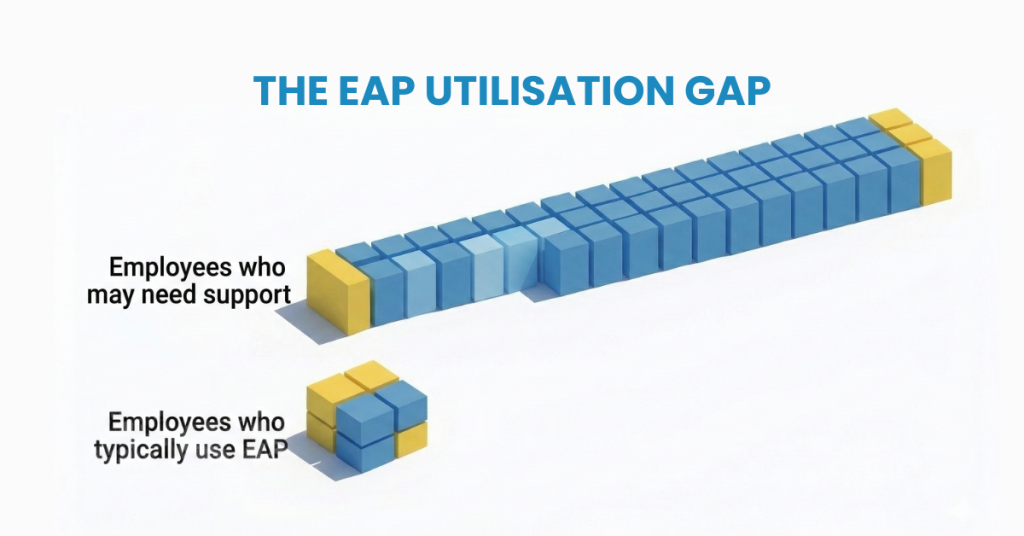
This has led many organisations to reconsider the role EAPs should play within workplace mental health systems. While EAP programs can provide valuable support in specific situations, they rarely address the broader organisational factors that influence employee wellbeing.
As a result, many employers are moving toward more integrated workplace mental health strategies that combine counselling support with prevention, leadership capability, and organisational change.
Are Employee Assistance Programs Enough for Workplace Mental Health?
Employee Assistance Programs can be effective in providing short-term counselling and crisis support. However, most organisations find that EAP programs alone are insufficient to address the broader realities of workplace mental health.
Workplace stress rarely arises from personal circumstances alone. In many cases, it is shaped by organisational conditions such as workload demands, leadership behaviour, role clarity, organisational culture, and periods of structural change.
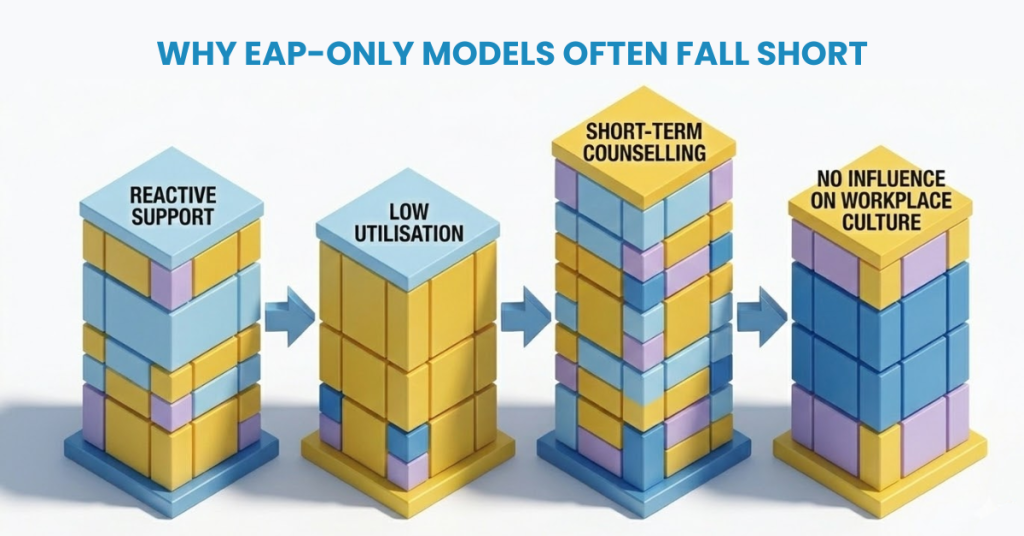
Because EAPs primarily focus on individual counselling, they have limited capacity to address these systemic drivers of stress. As a result, support often remains reactive rather than preventive.
For this reason, many organisations now position EAP services as one component within a broader workplace mental health strategy that includes prevention, early identification of risk, and leadership capability development.
What Is an Employee Assistance Program (EAP)?
An Employee Assistance Program (EAP) is a workplace service that provides employees with confidential short-term counselling and support for personal or work-related challenges.
Typical EAP services include:
✔ Short-term counselling sessions
✔ Crisis intervention
✔ Referrals to external mental health services
✔ Phone or online support access
These services are typically designed to be:
✔ confidential
✔ accessible
✔ broad in scope
While EAPs can help employees manage immediate stressors or difficult situations, they are generally designed as short-term interventions rather than comprehensive workplace mental health strategies.
The Value of EAPs in the Workplace
EAPs are not inherently ineffective. When implemented effectively, they can provide meaningful support for employees experiencing acute challenges.
EAP services can:
provide early, low-barrier access to psychological support
offer assistance during personal or professional crises
serve as an initial point of contact for employees uncertain where to seek help
In many situations, short-term support provided through an EAP may be entirely appropriate.
Difficulties arise, however, when EAP services are expected to function as a complete workplace mental health solution, rather than one element of a broader support framework.
The Limitations of EAP-Only Approaches
Low Utilisation Does Not Indicate Low Need
Many EAP programmes report utilisation rates in the low single digits, often around 3–5% annually.
Low engagement does not necessarily indicate that employees are coping well. Instead, it may reflect barriers such as limited awareness of services, concerns regarding confidentiality, perceived stigma associated with seeking psychological support, or the belief that services may be too generic.
Consequently, low utilisation can obscure substantial unmet mental health needs within an organisation.
Short-Term Support for Long-Term Challenges
EAP services typically offer a limited number of counselling sessions. While this model can be effective for short-term stress, it is often insufficient for more persistent challenges such as:
chronic workplace stress
burnout
ongoing anxiety or mood concerns
complex personal or family circumstances
Employees experiencing sustained difficulties may disengage once short-term support ends, or repeatedly access brief interventions without achieving lasting improvement.
Limited Integration With Organisational Context
EAP services typically operate independently from organisational decision-making structures. As a result, they have limited ability to address workplace conditions that contribute to employee distress.
These may include:
excessive workload demands
unclear role expectations
leadership communication practices
organisational restructuring
When support focuses solely on individual coping strategies, the underlying workplace drivers of stress often remain unaddressed.
Barriers for High-Pressure Roles
Employees in senior or high-responsibility roles may be particularly unlikely to use EAP services.
Common barriers include:
limited time availability
concerns regarding confidentiality or visibility
perceptions that EAP services are too generalised
reluctance to appear unable to cope
Ironically, those experiencing the highest levels of workplace pressure may therefore be the least likely to access EAP-based support. These dynamics are discussed further in mental health support for high-pressure roles.
Why Workplace Mental Health Strategies Must Extend Beyond EAP Programs
Workplace mental health is shaped by a range of organisational factors, including:
job demands and workload
decision-making autonomy
leadership behaviour
organisational culture
change management practices
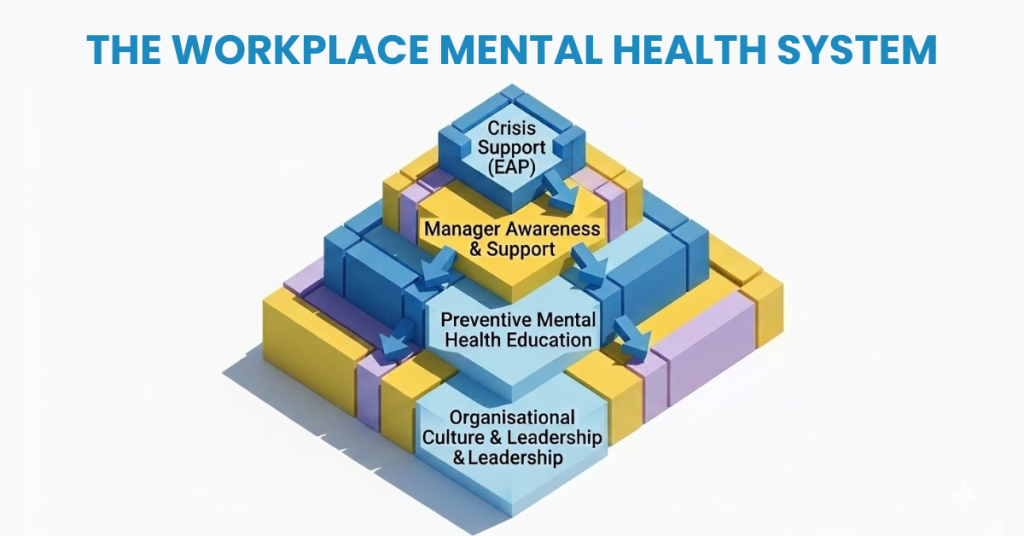
When these structural conditions contribute to employee stress, individual counselling alone cannot resolve the underlying issues.
A more effective approach recognises that workplace mental health support must operate across multiple levels:
individual employee support
manager capability and leadership practices
organisational systems and policies
The Risk of Over-Reliance on Individual Resilience
EAP-only approaches can unintentionally reinforce the idea that managing stress is primarily the responsibility of the individual employee.
This may lead to:
excessive emphasis on personal resilience without addressing workload
stigma associated with raising organisational concerns
burnout being interpreted as a personal failure rather than a systemic issue
While individual coping skills are important, organisations also share responsibility for creating environments where employees can work sustainably.
What a More Integrated Approach Looks Like
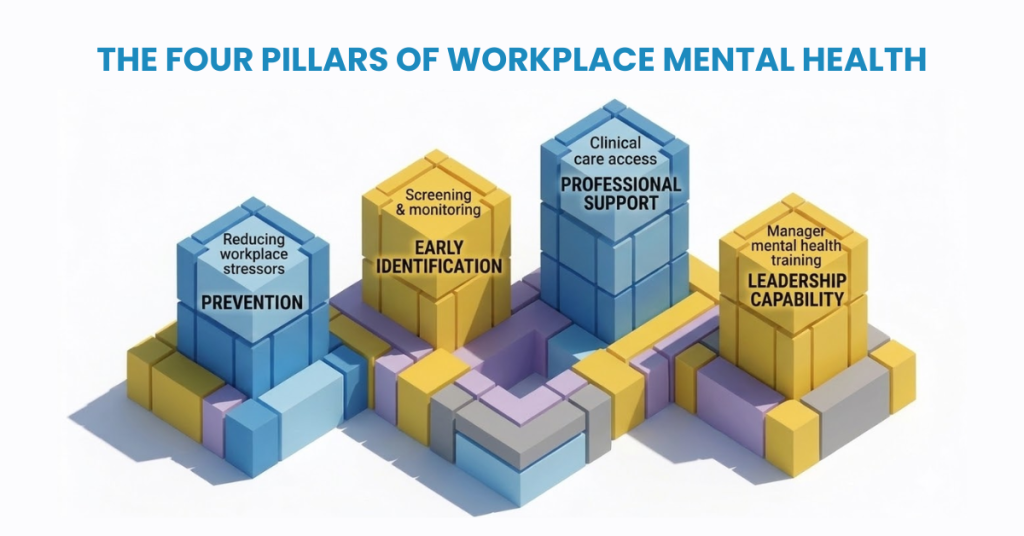
Organisations moving beyond EAP-only models typically adopt more comprehensive workplace mental health strategies.
Preventive Organisational Practices
Preventive approaches aim to reduce known stressors through realistic workload expectations, clear role definitions, transparent communication during organisational change, and leadership accountability for employee wellbeing.
Prevention reduces reliance on crisis-driven interventions.
Early Identification and Screening
Structured screening tools can help organisations identify employees at risk of burnout, emerging anxiety or mood concerns, and patterns of stress across teams.
Early identification allows organisations to intervene before difficulties escalate.
Access to Ongoing Professional Support
Employees experiencing complex or persistent challenges may benefit from access to longer-term psychological care, clinicians familiar with workplace dynamics, and flexible confidential mental health services.
This level of support often extends beyond what EAP programmes are designed to provide.
Manager Capability and Psychological Safety
Managers play a critical role in supporting employee mental health.
Equipping managers to recognise early signs of distress, initiate supportive conversations, and respond appropriately strengthens the organisation’s overall mental health support system.
Alternatives to EAP Programs for Workplace Mental Health
As organisations recognise the limitations of EAP-only models, many explore complementary approaches to supporting employee wellbeing.
These approaches may include:
workplace mental health screening to identify early indicators of burnout or psychological distress
access to ongoing clinical support beyond short-term counselling
leadership and manager training to strengthen mental health literacy
organisational interventions addressing structural stressors
integrated workplace mental health strategies combining prevention, education, and professional support
Organisations often benefit from partnering with providers experienced in workplace mental health. CALM International works with organisations to strengthen mental health systems beyond standalone EAP models, combining clinical expertise, organisational insight, and leadership consultation.
When Organisations Should Seek Professional Workplace Mental Health Support
Organisations may benefit from professional mental health support when:
employee stress or burnout becomes widespread
leadership teams feel uncertain about how to respond to mental health concerns
EAP utilisation remains low despite visible employee strain
managers lack confidence supporting distressed employees
organisational change increases psychological pressure on staff
In these situations, organisations often require support that extends beyond traditional EAP services, including organisational assessment, leadership consultation, structured employee screening, and access to clinicians familiar with workplace environments.
Key Takeaways
EAP programs provide valuable short-term support but rarely address workplace mental health challenges on their own
low utilisation often reflects structural barriers rather than low employee need
organisational factors such as workload and leadership behaviour strongly influence employee wellbeing
effective workplace mental health strategies combine prevention, early identification, and professional support
integrated approaches support sustainable employee wellbeing
Building a More Effective Workplace Mental Health System
Workplace mental health support is most effective when it:
addresses both individual and organisational factors
provides clear pathways for employees to access support
aligns with workplace realities and leadership practices
integrates clinical expertise with organisational insight
EAP services can play an important role within this system, but they should not carry the entire responsibility for employee wellbeing.
Organisations that invest in integrated mental health strategies are better positioned to support employees, strengthen leadership capability, and build healthier workplace cultures over time.