

Ask any experienced teacher which conversations they find hardest, and parent meetings about SEND tend to come up quickly. Not because teachers do not care, but because the stakes feel high, the emotional terrain is unpredictable, and most teachers have never been formally trained to navigate it.
These conversations matter enormously. A well-handled meeting can set the tone for years of productive collaboration between a family and a school. A poorly handled one, even when the intentions were good, can create distrust that proves very difficult to repair. The difference often comes down not to what is said, but how, and whether the family leaves the room feeling like a partner or an afterthought.
This guide is practical. It covers what families of SEND students often carry into a school meeting, the communication principles that tend to work, how to handle specific types of conversations, and what to do when things get genuinely difficult.
For a broader overview of SEND provision in schools, see our guide on Supporting SEND Students in the Classroom: A Guide for Teachers and School Leaders.
What Families Are Often Carrying Before They Even Sit Down
It helps to start here, before thinking about agendas or talking points, because the emotional context a parent brings to a school meeting shapes everything about how that meeting unfolds.
Many parents of SEND students arrive having already spent months, sometimes years, trying to get their concerns about their child taken seriously. They may have been told the child is “fine”, that they are overreacting, or that the behaviour they are worried about is just a phase. By the time a formal identification is in place, a lot of families have developed a kind of defensive vigilance around school interactions. That is not hostility. It is a learned response to a system that did not listen quickly enough.
Others are at the very beginning of this journey. They are trying to absorb a new diagnosis, unfamiliar terminology, and a set of processes they have never encountered before, all while still being a parent, often to a child who is struggling and distressed. A school meeting can feel genuinely overwhelming in that context.
And some families are simply exhausted. Parenting a child with significant additional needs takes a toll (on the family) that is not always visible. Recognising this, even without naming it explicitly, changes the quality of a conversation. Teachers who approach these meetings with that awareness tend to communicate differently, and usually more effectively.

Five Principles That Actually Make a Difference
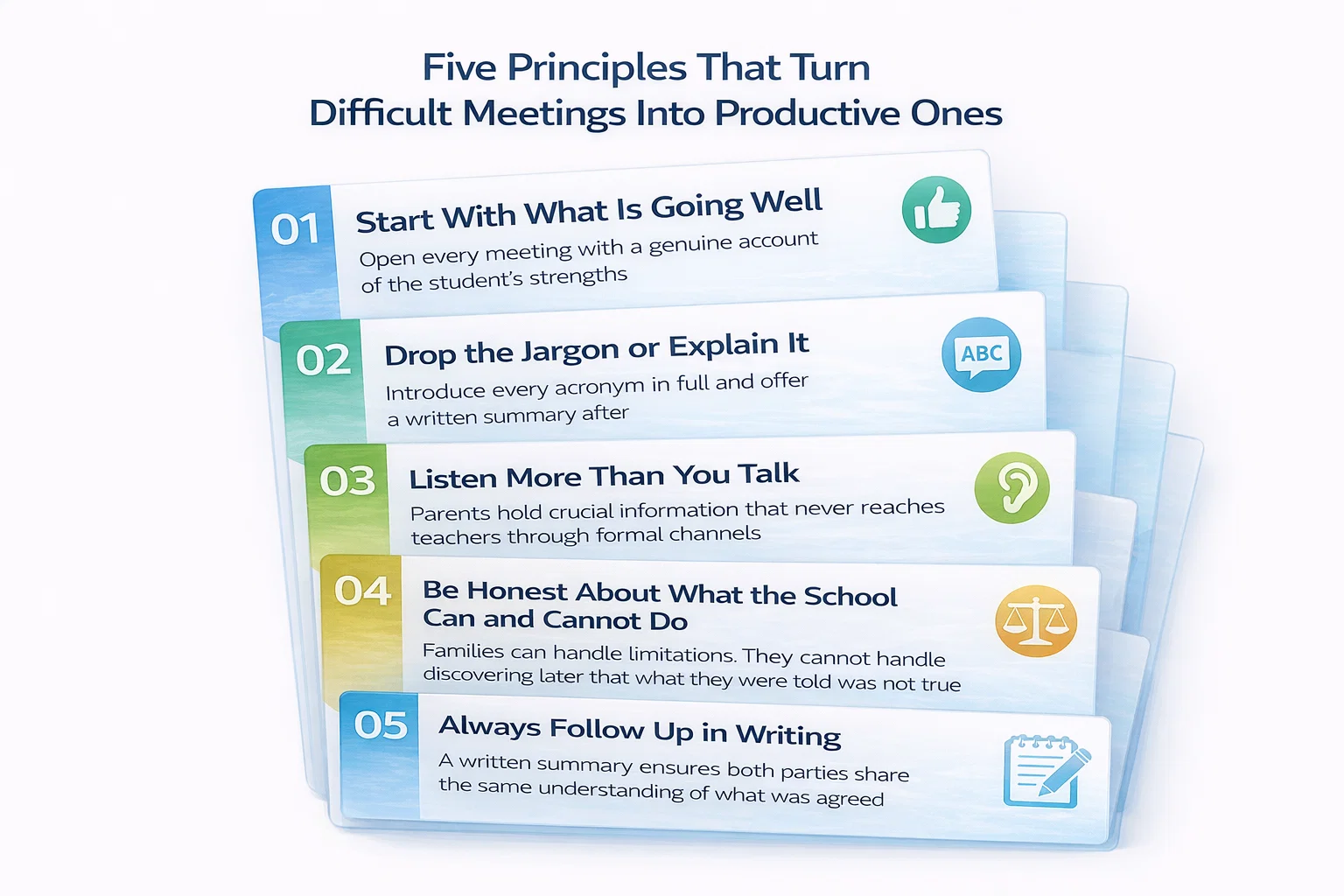
1. Start With What Is Going Well
This sounds simple. In practice, it is one of the most consistently missed opportunities in SEND communication.
Parents of SEND students frequently report that school conversations focus almost entirely on what their child cannot do. The difficulties, the gaps, the incidents. Strengths and progress get a brief mention at best. The result is that families often leave meetings feeling worse about their child’s situation than when they arrived, even when the meeting was technically informative.
Starting with a genuine, specific account of what the student is doing well is not about softening bad news or avoiding hard truths. It is about accuracy. A student is not only their difficulties. And signalling to a parent that their child is genuinely known and valued, not just managed, creates a very different atmosphere for the rest of the conversation.
2. Drop the Jargon, or at Least Explain It
SEND is full of acronyms. IEP, EHCP, SENCO, SEMH, ASD, SpLD. In a school context, these are shorthand. To a parent who is new to all of this, they can feel like a wall.
The practical fix is not complicated: introduce any term in full the first time, check in occasionally that the parent is following rather than assuming they will ask if lost, and offer a written summary after the meeting so families can process things at their own pace. That last point matters more than people realise. A lot of important information simply does not land in the room when someone is also trying to manage their emotions.
3. Listen More Than You Talk
Many school meetings with SEND families are structured as briefings. The school presents its view of the student’s needs, describes what is being done, and invites the parent to agree. That is not a conversation.
Parents often hold crucial information about how a student is actually experiencing school, information that never reaches teachers through formal channels. A parent who mentions their child cries every Sunday evening, or refuses to attend on the days they have a particular lesson, or has been saying they feel stupid for months, is offering important, essential information. That kind of data could directly shape the school’s response.
4. Be Honest About What the School Can and Cannot Do
One of the quickest ways to damage trust with a SEND family is to make promises in a meeting that do not materialise afterwards. It happens more than schools would like to admit, often because the person in the meeting wants to be reassuring and does not stop to check whether the commitment is actually deliverable.
Families can handle limitations. What they struggle to handle is discovering later that what they were told was not true, especially if finding out required them to push for it. Being clear upfront about what is possible, what the constraints are, and what the school will do within those constraints, tends to build more lasting trust than optimistic reassurance that later falls apart.
5. Always Follow Up in Writing
Every significant meeting with a SEND family should be followed by a brief written summary covering what was discussed, what was decided, and what happens next.
A written summary ensures both parties have the same understanding of what was agreed. It gives the family something to refer back to when memory fades or anxiety distorts. It creates a record that protects everyone if differing recollections surface later. It also tells the family, in a concrete way, that the conversation was taken seriously. That signal matters.
Guidance for Specific Conversations
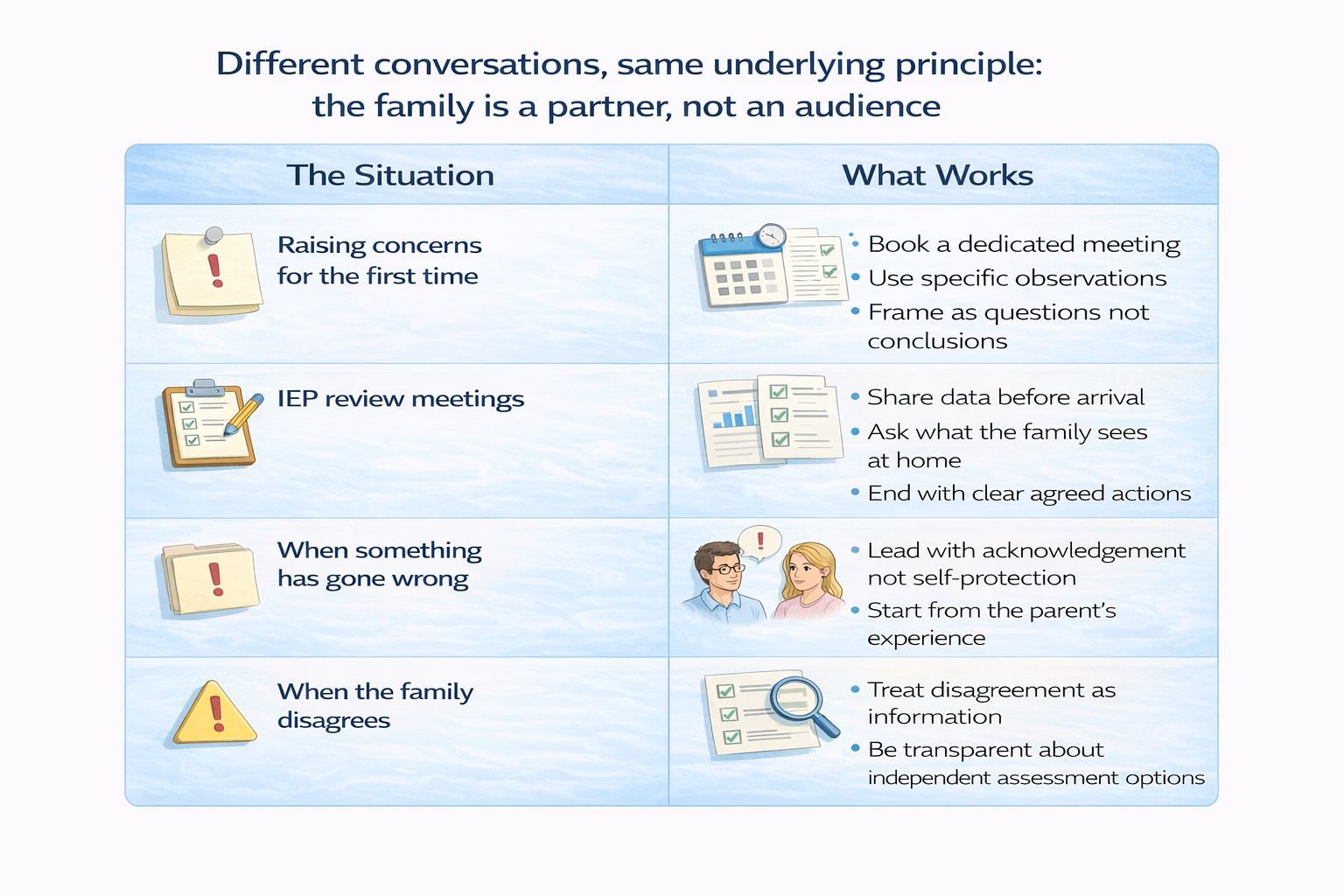
Raising Concerns for the First Time
This is often the conversation teachers dread most. And it is, genuinely, one of the most consequential. How a school first raises concerns about a student’s needs can shape a family’s relationship with that school for years, as well as the parents’ perception of their child.
A few things make a significant difference here:
- Book a dedicated meeting. Raising significant concerns at pickup or in a brief corridor exchange is not fair to the family.
- Be specific about what has been observed, using concrete examples rather than general impressions, and avoid diagnostic language.
- Frame concerns as questions rather than conclusions. Asking whether the family has noticed similar things at home is very different from stating that the student has a problem.
- Explain clearly what the school is proposing to do next and give the family time to respond before moving to action points.
It is also worth being prepared for a range of emotional reactions. Some parents will feel relieved that their concerns have been validated. Others will be shocked, upset, or defensive. None of those responses is wrong, and none of them requires the teacher to resolve the emotion on the spot. Acknowledging that this is a lot to process, and genuinely meaning it, is usually the most useful thing to do.
IEP Review Meetings
These are the most regular formal touchpoints between a school and a SEND family, and they are frequently handled as administrative events rather than genuine reviews. The agenda is predetermined, the conclusions are already drafted, and the parent is invited to sign off.
Effective IEP reviews look different:
- Share relevant progress data with the family before the meeting, not on arrival. Parents who walk in already informed can contribute rather than just absorb.
- Ask what the family has observed at home before presenting the school’s assessment. Their perspective is data.
- Honestly evaluate whether current targets and strategies are working.
- Involve the student in a way that is meaningful and appropriate to their age.
- End with clear agreed actions, named responsibilities, and a confirmed date for the next review.
For a full breakdown of what an effective IEP contains and how to write one, read our guide on how to write an effective individual education plan.
When Something Has Gone Wrong
There will be times when a school needs to have a difficult conversation with a family because something did not happen as it should. Strategies were not implemented. An incident was not communicated promptly. A commitment was made and not kept.
These conversations go better when the school leads with acknowledgement rather than self-protection. A parent who senses the school’s primary concern is limiting its own liability tends to escalate. A parent who feels genuinely heard tends to stay in problem-solving mode. That does not mean accepting blame that is not warranted. It means starting from the parent’s experience of what happened before moving to explanations and next steps.
When the Family Disagrees With the School
This is uncomfortable territory, and the discomfort sometimes causes schools to become defensive in ways that make things worse. A family that feels its perspective is being managed rather than considered tends to dig in.
The more productive approach is to treat the disagreement as information. What are they seeing at home that the school is not accounting for? What outcome are they actually hoping for? Often the underlying concern is something the school can engage with constructively, even if the surface-level disagreement persists.
Where genuine disagreement cannot be resolved, families have the right to know what processes are available to them, including requesting an independent assessment or seeking advice from a SEND advocacy service. Being transparent about this is both an ethical obligation and, counterintuitively, a trust-building move.
A Note on International School Settings
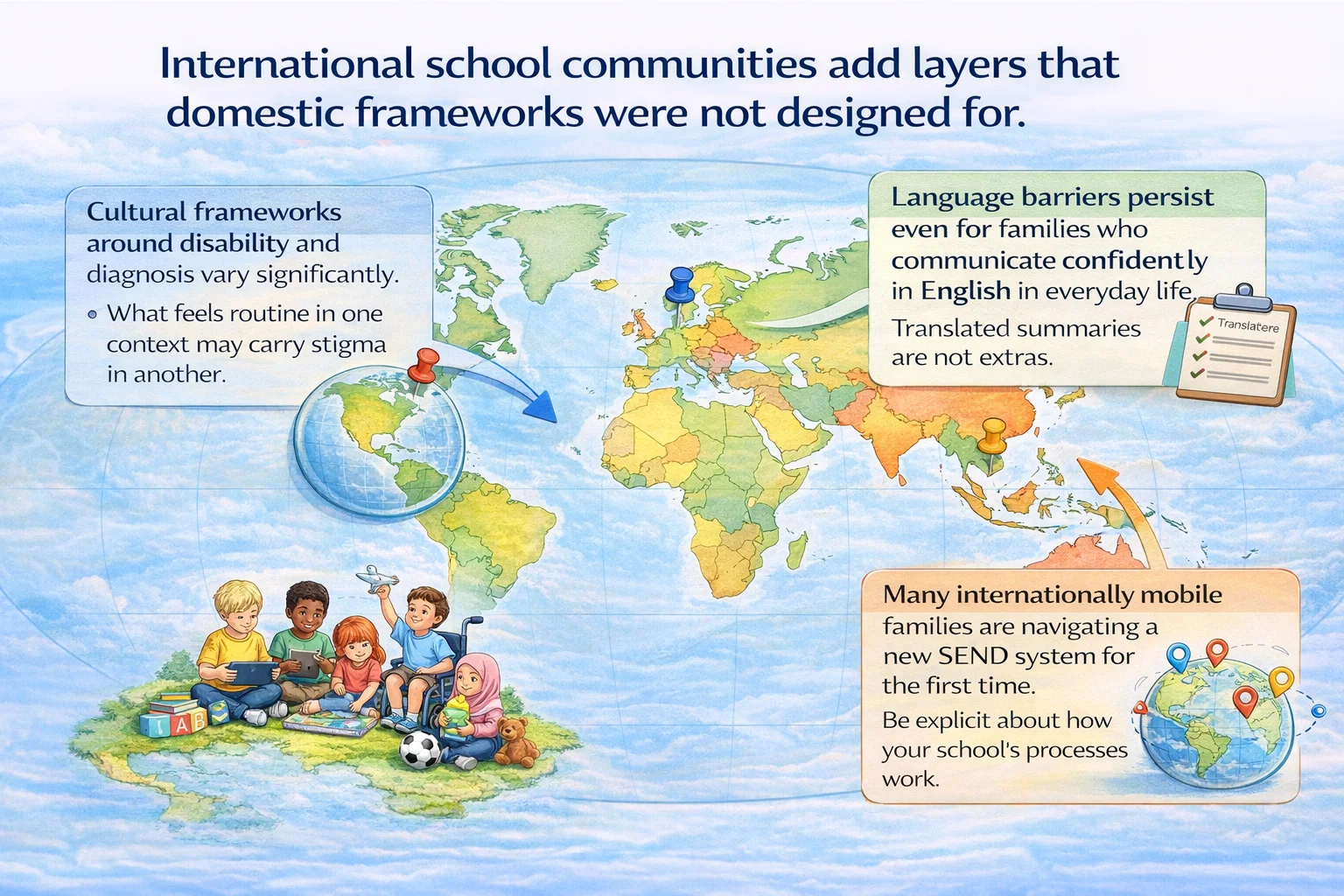
In internationally diverse school communities, these conversations carry some additional complexity that is worth naming.
Families from different cultural backgrounds may hold very different frameworks for understanding learning differences and disability. In some cultures, a diagnosis of ADHD or dyslexia carries significant stigma. In others, the concept of neurodevelopmental difference is relatively unfamiliar. Assuming a shared understanding is a common source of miscommunication that schools often do not realise is happening.
Language is a practical barrier, too. Even families who communicate confidently in English in everyday situations may struggle with professional and clinical language in an emotionally charged meeting. Translated written summaries and access to interpreters where needed are not extras. They are basic conditions for genuine communication.
And many internationally mobile families are encountering a new SEND system for the first time, having previously navigated a different one. Being explicit about how this school’s processes work, what the terminology means here, and how it may differ from what the family has experienced elsewhere goes a long way.
When the Relationship Has Broken Down
Sometimes things deteriorate beyond the point where ordinary communication is productive. It happens. Needs can escalate faster than systems respond. Early miscommunications compound. Families and schools reach genuinely different conclusions about what a student needs, and neither side can find a way to move.
In those situations, an external perspective often helps. A mediation service, a SEND advocacy organisation, or an independent clinical professional who can assess the student’s needs without an institutional stake in the outcome can provide a shared evidential base that both parties can engage with, even when direct communication has stalled.
At CALM International, we work with schools and families in exactly this position. If you are a school leader trying to rebuild a relationship that has broken down, or a family that feels the school is not hearing you, a confidential consultation with one of our clinicians is a practical place to start.