
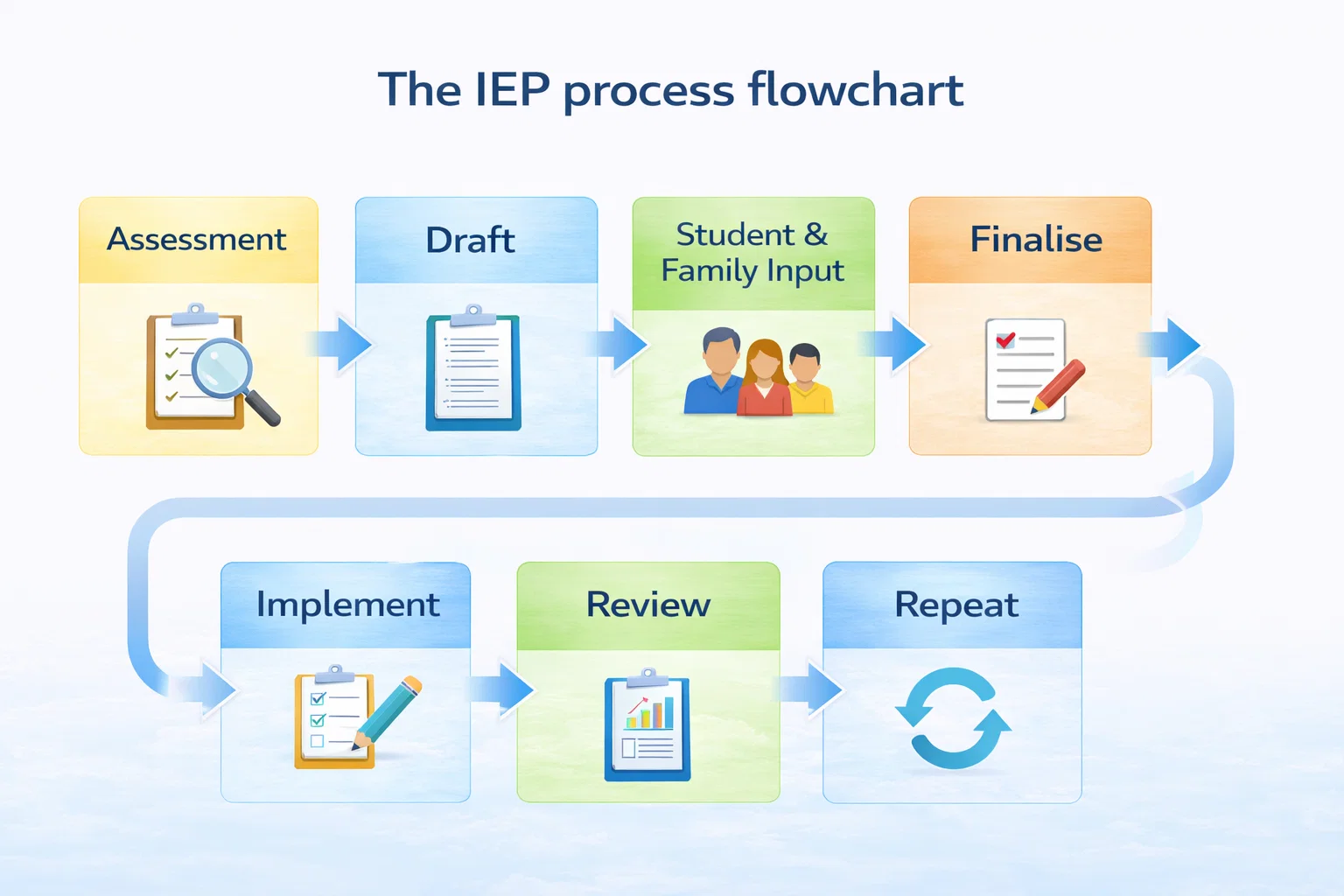
An Individual Education Plan, commonly referred to as an IEP, is one of the most important documents in a Special Educational Needs and Disability (SEND) student’s school life. At its best, it is a practical, living tool that guides every teacher who works with that student, keeps the family informed and involved, and gives the student themselves a clear sense of where they are headed and what support they can expect.
At its worst, it is a compliance exercise. Pages of documentation written to satisfy a regulatory requirement, filed after the annual review, and rarely consulted by the people who need it most. The gap between these two versions is not a matter of intention. Most schools genuinely want to get it right. The problem is usually knowing what an effective IEP actually contains, and how to write one that does real work in practice.
This article covers guidelines on elements to be included in an IEP, tips on setting targets that are useful and clear, the role of assessment, strategies for involving students and families meaningfully, and what most commonly undermines the effectiveness of IEPs.
For a broader overview of how schools can support SEND students day to day, see Supporting SEND Students in the Classroom: A Guide for Teachers and School Leaders.
What an IEP Is and What It Is Not
An IEP is a written plan describing a student’s specific educational needs, the targets they are working toward, and the strategies, resources, and support that will be put in place to help them get there. It also sets out how and when progress will be reviewed.
For students with the most significant needs, a more formal statutory document may exist alongside it, such as an Education, Health and Care Plan in England, or an equivalent in other jurisdictions. These carry legal weight and involve health and social care agencies as well as education. A school-based IEP should sit consistently within whatever statutory framework applies.
What an IEP is not is a diagnosis, a record of deficits, or a justification for lower expectations. A good IEP is forward-looking. It starts from where the student is currently, identifies where they need to get, and maps a realistic, supported route between the two.
The Role of Assessment in Writing an IEP
A well-written IEP is grounded in assessment data. Without an accurate picture of a student’s current attainment, their cognitive and learning profile, and what has and has not worked for them previously, the plan is essentially guesswork.
Assessment information that typically informs an IEP includes:
- Teacher observations and progress data
- Standardised assessments of reading, writing, and numeracy
- Specialist reports from speech and language therapists, occupational therapists, or educational psychologists
- The student’s own account of their experience of learning
For students whose needs relate to cognition and learning, such as those with dyslexia, ADHD, or processing difficulties, a psychoeducational assessment is one of the most valuable sources of information available. Carried out by a qualified psychologist, it provides a detailed map of a student’s cognitive strengths and challenges, identifies the specific nature of any learning difficulties, and produces evidence-based recommendations that translate directly into IEP targets and strategies.
Where a full psychoeducational assessment has not been carried out, the SENCO, who is the Special Educational Needs Coordinator responsible for overseeing all SEND provision in the school, should draw on as wide a range of evidence as possible before writing or reviewing an IEP. Basing targets on thin information is one of the most common reasons IEPs fail to drive meaningful progress.
What an Effective IEP Should Contain
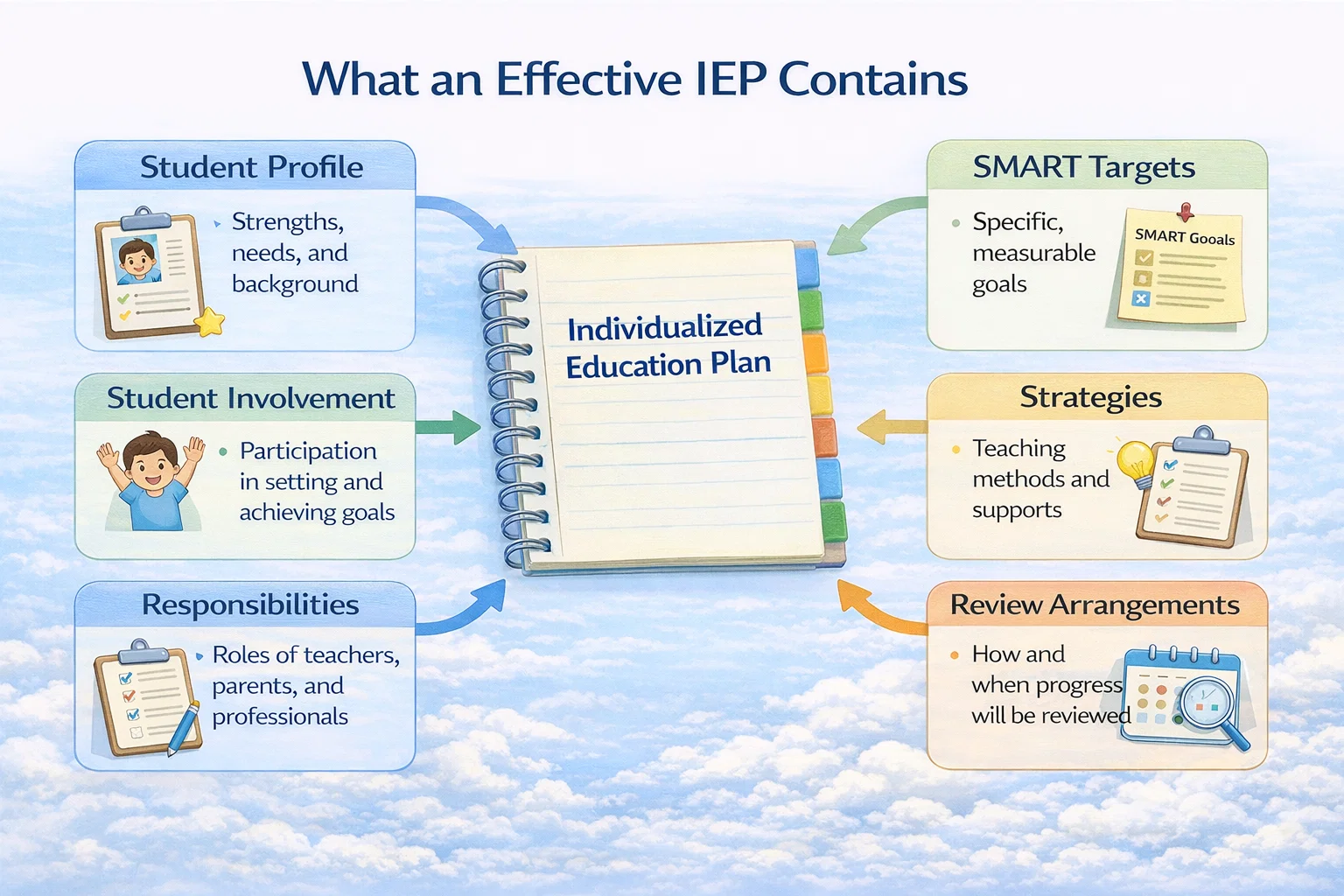
Formats vary between schools and systems, but the core components of an effective plan are consistent.
1) Student Profile
A brief summary of the student’s identified needs, their diagnosis if one exists, their current attainment across relevant areas, and their key strengths. Any teacher reading this document should get a clear, practical picture of this student as a learner within a couple of minutes. Lengthy clinical descriptions should be avoided.
2) SMART Targets
Targets are the heart of the IEP, and they are also where most plans fall short. Effective targets are SMART:
(S) Specific: they describe exactly what the student will be able to do, not broadly what area they are working on
(M) Measurable: progress can be observed and recorded in a concrete way
(A) Achievable: realistic given the student’s starting point and the support available
(R) Relevant: they address the student’s most significant areas of need
(T) Time-bound: they specify a timeframe within which progress will be reviewed
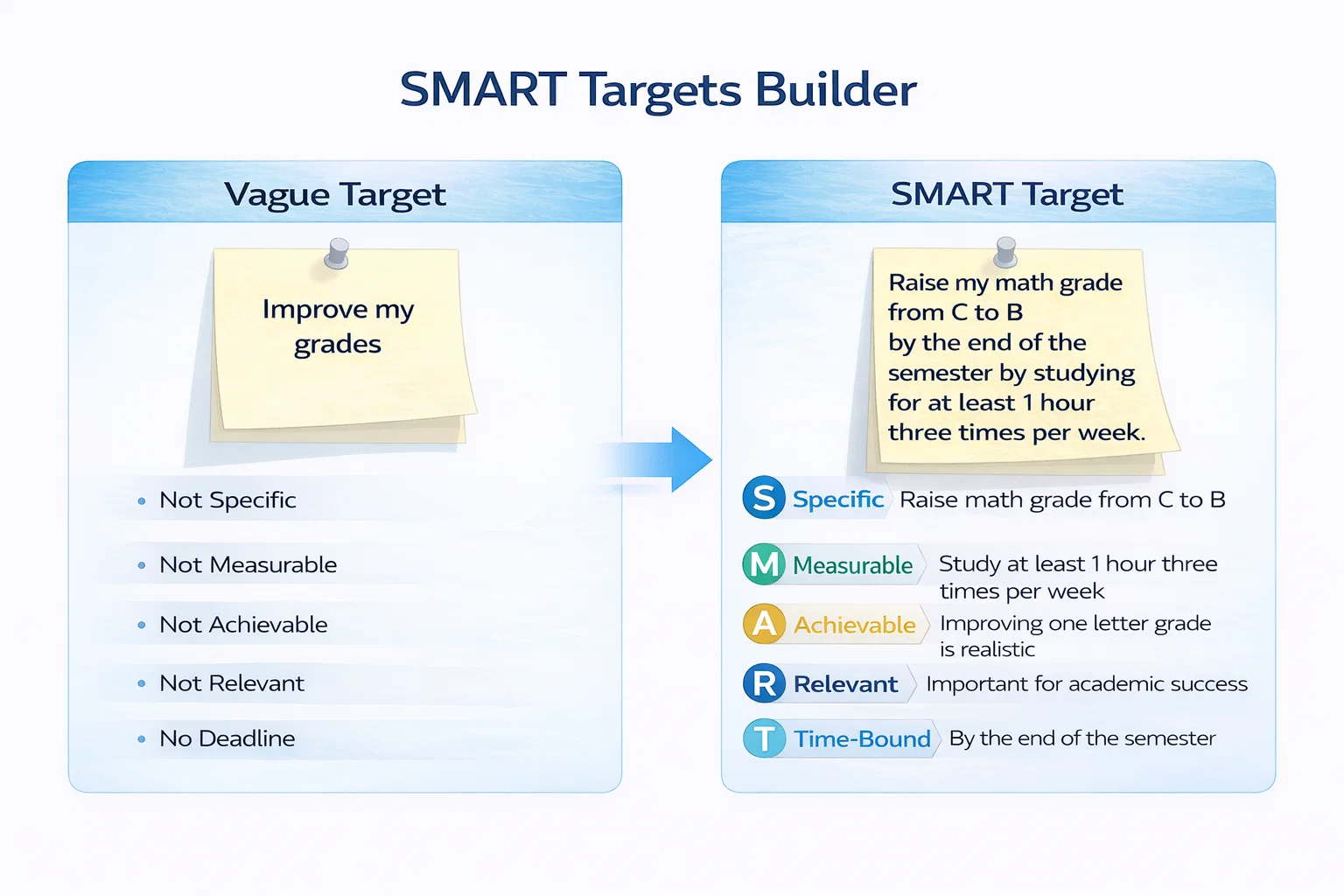
“Improve reading” is not a SMART target. “By the end of term, the student will be able to read aloud a level-appropriate text with no more than three errors per hundred words, using phonics strategies when encountering unfamiliar words,” is. The difference matters. Vague targets cannot be measured, cannot be communicated consistently across teachers, and cannot tell anyone whether the support is working.
Most IEPs should contain between three and five targets at any one time. More than that risks diluting focus and making the plan difficult for teachers to actually hold in mind.
3) Strategies and Support
For each target, the IEP should specify what strategies and resources will be used. This section needs to be concrete enough that any teacher, including a supply teacher who has never met the student, can read it and know what to do. Effective strategies sections include:
- Specific teaching approaches or adaptations, such as providing written instructions alongside verbal ones, using graphic organisers, or allowing extra processing time
- Resources and tools the student has access to, such as text-to-speech software, a multiplication grid, or coloured overlays
- Support arrangements, including whether a teaching assistant is involved, how often, and in what capacity
- Environmental adjustments, such as preferred seating, reduced visual clutter, or noise-reducing headphones
Strategies should connect directly to the targets they are intended to support. A list of generic good classroom practice that applies equally to every student is not a strategies section. It is a placeholder.
4) Review Arrangements
The IEP should specify when and how progress will be reviewed, who will be involved, and what will happen with the findings. Most IEPs are reviewed termly or twice yearly, but the right frequency depends on the student’s needs and how quickly things are moving. A student making rapid progress, or whose situation is changing significantly, may need more frequent review than the standard schedule allows.
Review should include the student and their family as genuine participants, not just attendees who hear what professionals have already decided. That means sharing draft documentation in advance, creating real space for their perspective, and being honest about what is and is not working.
5) Agreed Responsibilities
A good IEP is clear about who is responsible for what. For example:
- Which teachers are implementing which strategies
- What is the SENCO’s ongoing role
- What support the family has agreed to provide at home
- The goals to which the student has committed
Shared accountability makes the plan more likely to be consistently implemented, and gives everyone a clear sense of their part in it.
Involving Students in Their Own IEP
This is one of the most underused elements of effective IEP practice. Many schools involve students in a tokenistic way, asking them to sign a document or answer a few questions at the end of a meeting that has already concluded. That is not meaningful involvement.
Students who genuinely help set their own targets tend to be more motivated to work toward them. They also often have insight into what helps them learn that adults do not have access. A student with ADHD may be able to articulate exactly which classroom conditions make concentration harder. A student with dyslexia may know which reading strategies actually help them and which just feel performative.
Age-appropriate involvement can take several forms:
- Asking the student to complete a brief self-reflection before the review meeting, covering what is going well, what they find difficult, and what they wish their teachers knew about how they learn
- Sharing draft targets with the student before they are finalised and genuinely accepting their response
- Ensuring the language used to describe the student’s needs in the IEP is language with which the student is comfortable
- Giving the student their own copy of the IEP in a format that is accessible and meaningful to them, not just the formal version produced for professional use
Involving Families in the IEP Process
Families are a critical source of information about a student’s needs, and they are the people most invested in the student’s progress. An IEP process that treats families as passive recipients of professional decisions misses both an ethical obligation and a practical opportunity.
Meaningful family involvement includes:
- Sharing relevant assessment information with families in plain language before asking them to contribute to planning
- Inviting families to share their own observations about the student’s strengths, challenges, and what works at home
- Being honest about what the school can and cannot provide, rather than making commitments that will not be kept
- Following up after review meetings with a written summary of what was agreed and what happens next
- Creating an accessible channel for families to raise concerns between formal review points
Families who feel genuinely involved tend to be more supportive partners in implementing agreed strategies at home, more constructive when things go wrong, and more trusting of the school over time. Families who feel excluded or talked at may become adversarial, not necessarily because they are difficult, but because they are advocating for a child in a system that has locked them out.
Common Reasons IEPs Fail to Drive Progress
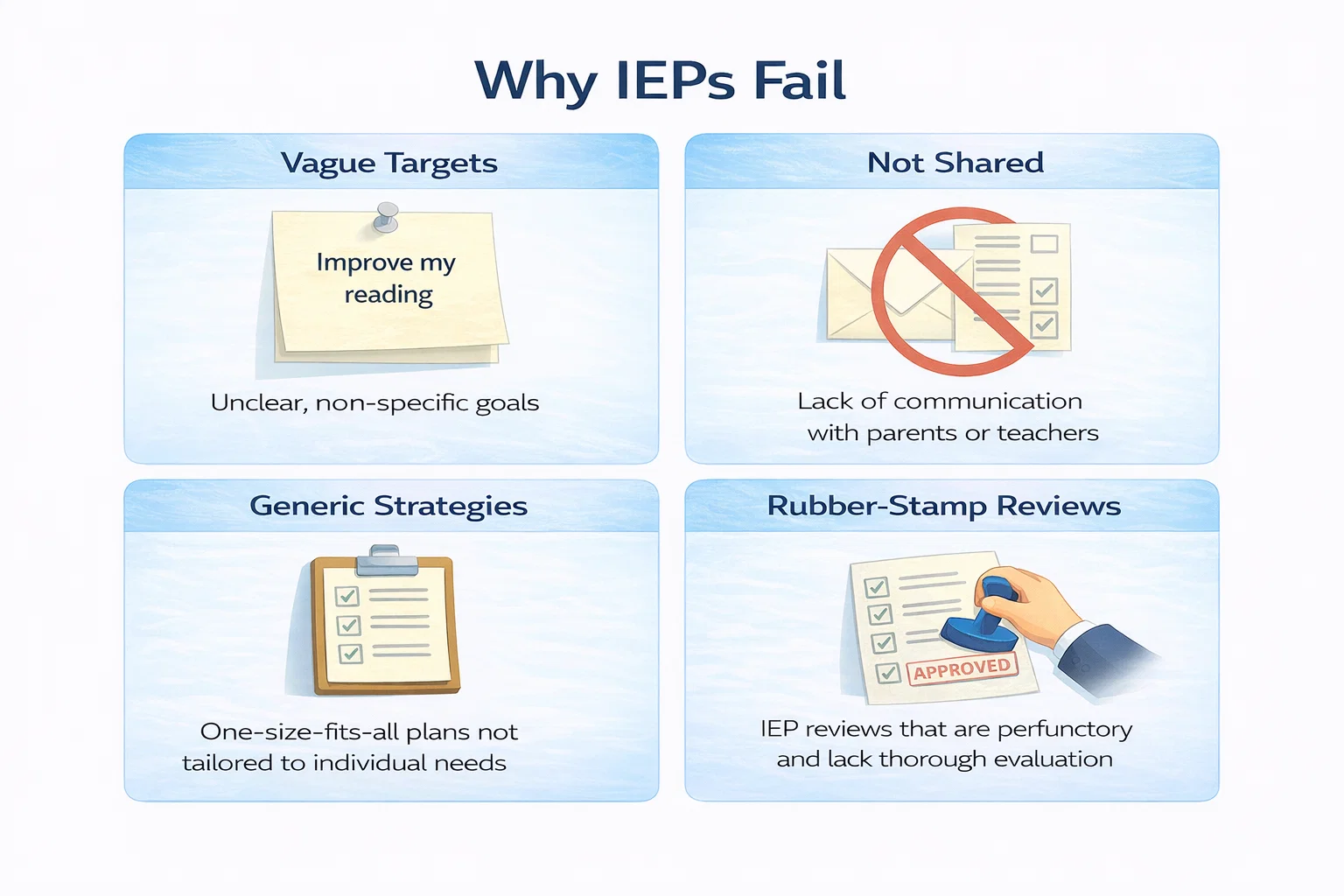
Targets That Are Too Vague to Be Useful
- If a teacher cannot look at a target and know clearly whether the student has met it, the target is not doing its job. This is the single most common IEP failure, and it is entirely preventable. Reviewing targets regularly and asking whether each one is genuinely measurable is a useful habit for SENCOs and class teachers alike.
The IEP Is Not Shared With All Relevant Teachers
- A student may be taught by eight or ten different teachers across a school week. If only the form tutor and SENCO had seen the IEP, the strategies it contains would have been implemented for a fraction of the student’s day. Schools need a clear system for getting IEP information to every teacher who works with a SEND student, in a format that is quick to read and easy to enact.
Strategies Are Generic Rather Than Individualised
- A strategies section listing general good classroom practice that applies equally to every student is not an IEP. It is a generic SEND document with a name on it. Strategies should be directly derived from assessment data and knowledge of the individual, specific enough that they could not apply to any other student on the school’s SEND register.
Review Is Treated as an Administrative Event
- If every IEP review ends with minor target tweaks and a continuation of existing strategies, regardless of whether those strategies are working, the review process is not functioning. A genuine review means looking honestly at progress data, asking hard questions about what is and is not effective, and being willing to make significant changes when the evidence calls for it.
When External Assessment Can Strengthen an IEP
Some students’ needs are not fully captured by school-based assessment. Progress is not responding to current strategies despite consistent implementation, or the profile is complex enough that specialist input would significantly improve the quality of the plan.
A psychoeducational assessment from a qualified psychologist can provide the detailed, evidence-based picture that makes a much more targeted IEP possible. Critically, it identifies not only what a student is finding difficult but why, which is the information most needed to design strategies that will actually work rather than strategies that seem reasonable.
At CALM International, our psychologists carry out psychoeducational assessments for children and young people across a range of ages and needs. Findings are presented in a clear report with specific recommendations for school and home, and our team is available to liaise directly with schools to help translate those recommendations into effective IEP targets and strategies.
If you are a school leader, SENCO, or teacher who feels a student’s current IEP is not adequately capturing their needs, or a family who wants a clearer picture of their child’s learning profile, a consultation with one of our clinicians is a practical first step.