
Students with special educational needs and disabilities (SEND) are present in almost every school. Yet in many schools, the gap between what SEND students need and what they actually receive remains significant, not because teachers do not care, but because the systems, knowledge, and support required to close that gap are not consistently in place.
Supporting SEND students effectively is not a specialist task reserved for the school’s dedicated SEND team. It is a whole-school responsibility that requires teachers who understand the range of needs they are likely to encounter, school leaders who build the conditions for effective provision, and families who feel genuinely informed and involved in their child’s education.
This guide provides an overview of what effective SEND support looks like across three interconnected areas: classroom practice, individual planning, and family communication.
What SEND Means in a School Context
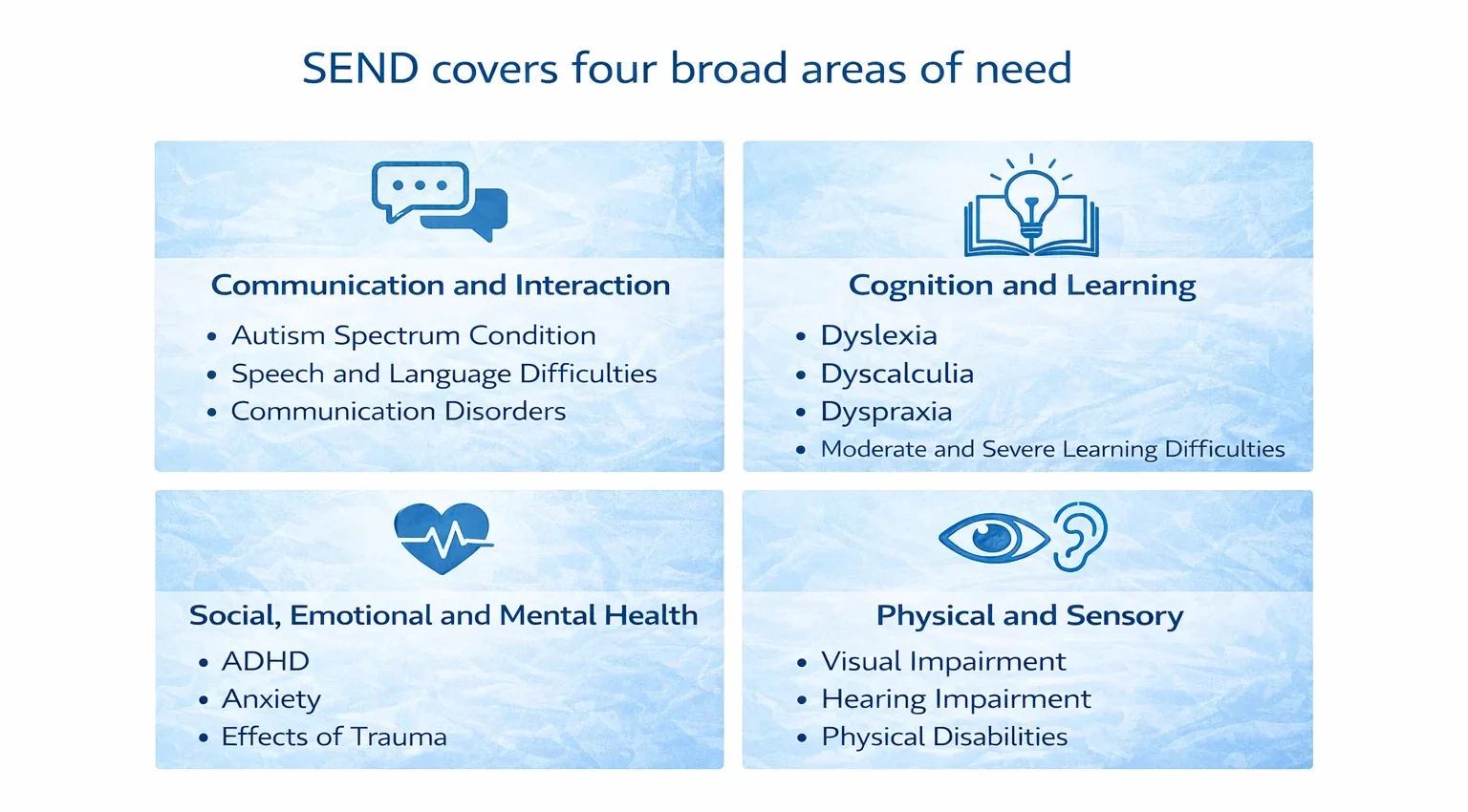
SEND is a broad term that covers a wide range of needs. In most educational frameworks, these are grouped into four broad categories:
- Communication and interaction needs, which include autism spectrum conditions and speech, language, and communication difficulties
- Cognition and learning needs, which include dyslexia, dyscalculia, dyspraxia, and other moderate or severe learning difficulties
- Social, emotional, and mental health needs, which include ADHD, anxiety, and the effects of trauma
- Physical and sensory needs, which include visual impairment, hearing impairment, and physical disabilities
Within each of these categories, there is enormous individual variation. A student identified as having an autism spectrum condition may be highly academically able and struggle primarily with social interaction and sensory processing. Another student with the same diagnosis may have significant communication needs alongside academic difficulties. Treating students as representatives of a category rather than as individuals is one of the most common and consequential mistakes in SEND provision.
Effective support begins with understanding the individual student: their specific strengths and challenges, the strategies that have worked for them in the past, and the goals they and their family have for their education. This understanding is most usefully captured in an individual education plan, but it should inform every interaction a teacher has with that student, not only formal review processes.
Why Inclusion Matters and What It Actually Requires
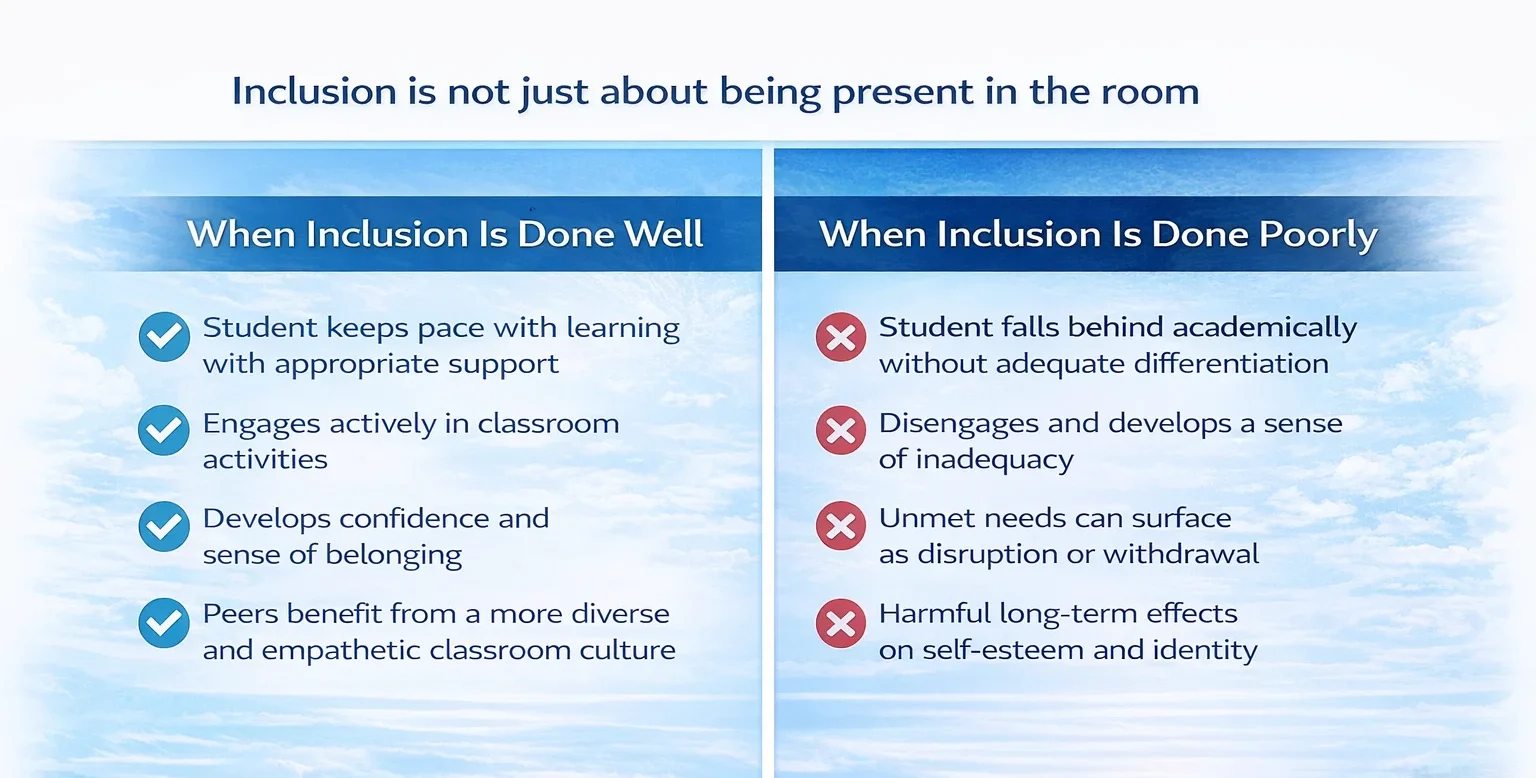
The case for including SEND students in mainstream education is well established. Research consistently shows that, when implemented well, inclusive education benefits SEND students academically and socially, and positively affects the attitudes and social development of their non-SEND peers. Inclusive classrooms tend to produce better outcomes for everyone, not only for those with identified needs.
Inclusion done poorly, however, produces the opposite effect. When a SEND student is placed in a mainstream classroom without adequate support, differentiation, or understanding from their teacher, the consequences reach beyond that individual student. The SEND student may fall behind academically, disengage from learning, and develop a deepening sense of inadequacy when they cannot keep pace with their peers. Other students in the class may also be affected, particularly when unmet needs manifest as disruption, withdrawal, or behaviour that the teacher is not equipped to manage constructively. For the SEND student, these experiences can be actively harmful, reinforcing a sense of difference and failure that follows them well beyond their school years.
What genuine inclusion requires is not simply goodwill, though that matters. It requires:
- Teachers with sufficient knowledge of SEND to adapt their practice
- School leaders with sufficient commitment to resource and prioritise SEND provision
- Families who are kept informed and genuinely consulted
- A school culture that treats diversity of need as an ordinary feature of any community rather than an exceptional challenge to be managed
The Teacher’s Role in Supporting SEND Students
For most SEND students, the class teacher is the most important adult in their school experience. The relationship between a student and their teacher, the quality of the learning environment the teacher creates, and the degree to which the teacher understands and responds to the student’s individual needs all have a direct and significant impact on outcomes.
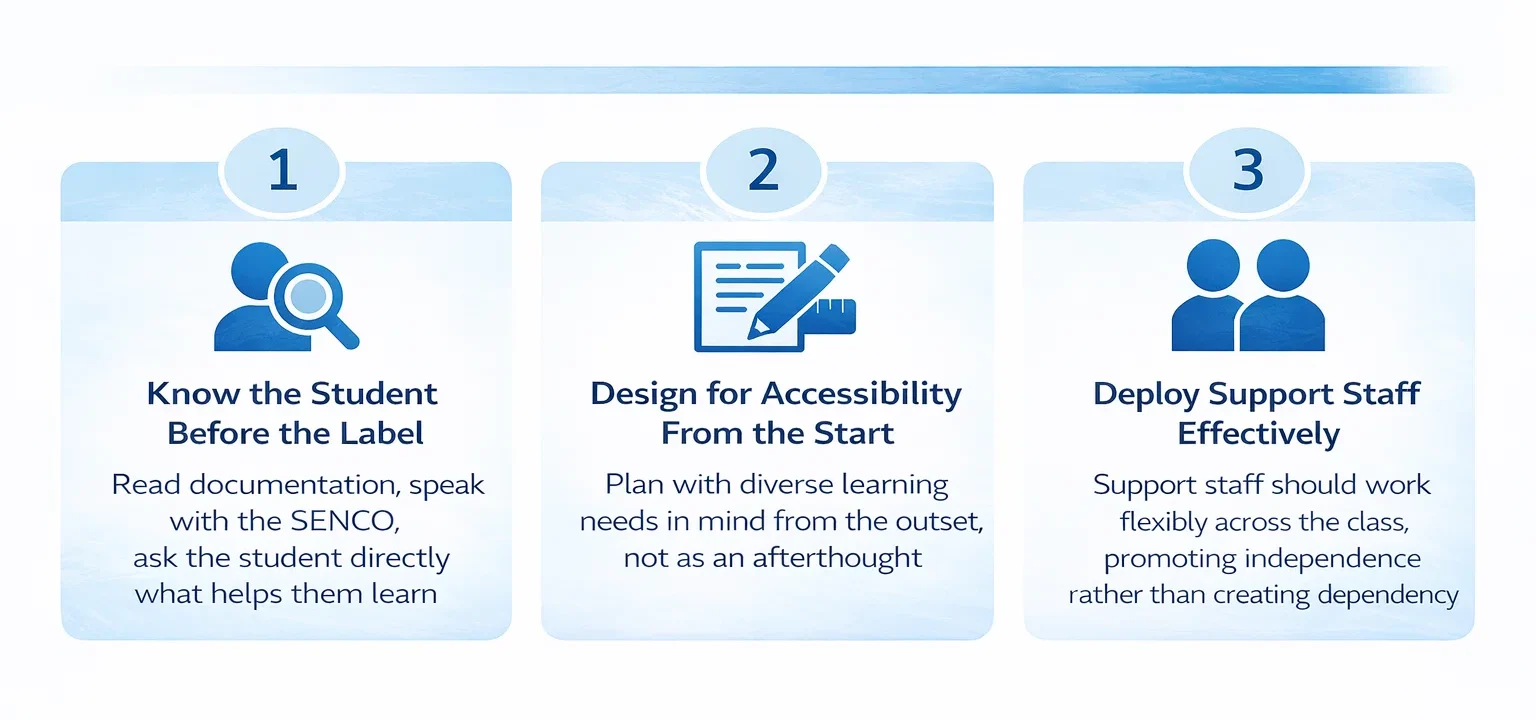
Knowing the Student Before the Label
The most effective teachers of SEND students are those who take time to understand the individual behind the diagnosis. This means reading available documentation thoughtfully, speaking with the Special Educational Needs Coordinator (SENCO) and learning support team, and, where appropriate, having a direct conversation with the student about what helps them learn and what makes things more difficult. It also means being willing to revise assumptions when a student’s classroom behaviour does not fit the expected profile for their diagnosis.
Designing for Accessibility From the Start
Rather than planning lessons for a notional average student and then adapting for SEND students afterwards, the most effective approach is to design lessons with a range of learning needs in mind from the outset. This means considering how the content will be presented, what scaffolding will be available, how students will demonstrate their understanding, and what the physical and sensory demands of the lesson are, before the lesson begins, rather than during it. When accessibility is built into the design from the start, every student can engage with the lesson without requiring last-minute adjustments, and the teacher is not left improvising support for individual students while simultaneously managing the rest of the class.
Working Effectively with Support Staff
In many classrooms, SEND students are supported by a teaching assistant or learning support assistant. The evidence on how this support is best deployed is clear: support staff are most effective when they work flexibly across the classroom, promoting independence and peer interaction, rather than sitting exclusively with one student and doing much of the cognitive work on their behalf. Class teachers are responsible for ensuring that support staff understand the lesson objectives and the specific strategies being used for each student, and for maintaining the primary teaching relationship with all students in the room, including those with SEND.
The Role of Individual Education Plans
An individual education plan, or IEP, is a document that sets out a student’s specific needs, the targets they are working toward, the strategies and resources that will be used to support them, and the arrangements for reviewing progress. For students with the most significant needs, a more formal document such as an Education, Health and Care Plan may be in place, which may carry legal weight and involve a wider range of agencies.
At their best, IEPs are living documents that genuinely guide day-to-day practice. At their worst, they are administrative exercises completed for compliance purposes and rarely consulted by the teachers who need them most. The difference lies in how they are written, how they are shared, and how they are used.
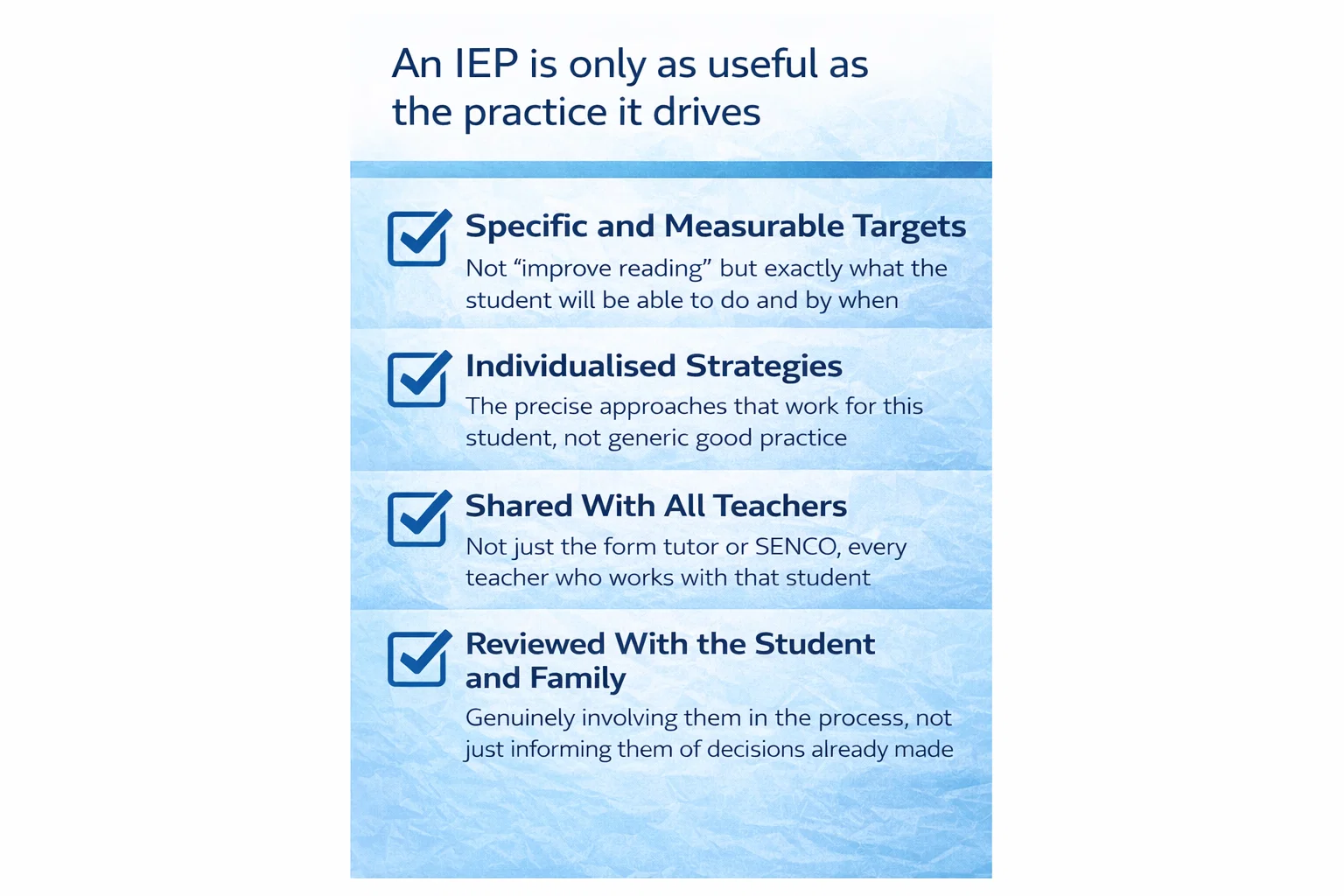
Effective IEPs share several characteristics:
- They are written with specific, measurable targets rather than vague aspirations
- They identify the precise strategies that have been shown to work for the individual student
- They are shared with all teachers who work with that student, not only those in formal pastoral or learning support roles
- They are reviewed regularly, with the student and family genuinely involved in that review rather than simply informed of decisions made by professionals
For many students, the process of developing an IEP begins with a psychoeducational assessment. This is a structured evaluation carried out by a qualified psychologist that maps a student’s cognitive and learning profile in detail, identifying specific strengths, difficulties, and the strategies most likely to support them. The findings from a psychoeducational assessment provide the kind of precise, evidence-based picture that an effective IEP is built on. To understand more about what the process involves, read “What Is a Psychoeducational Assessment?”
Family Communication and Partnership
Families of SEND students are often highly informed about their child’s needs, sometimes more so than the school professionals working with them. They observe their child across a much wider range of contexts and over a much longer time period than any teacher or SENCO. Treating families as partners in their child’s education, rather than as recipients of information, tends to produce significantly better outcomes for students.
Effective family communication in a SEND context means more than sending home reports and inviting parents to annual reviews. It means:
- Creating genuine two-way communication channels rather than one-directional updates
- Being honest about what the school is and is not able to provide
- Responding promptly and constructively to family concerns
- Ensuring that families understand the decisions being made about their child’s support and have a meaningful opportunity to contribute to those decisions
For families of newly identified SEND students, the process of understanding a diagnosis and navigating school systems can be overwhelming. Schools that provide clear information, designate a consistent point of contact, and approach these conversations with both honesty and compassion tend to build the kind of trust that sustains the relationship through the inevitable difficulties that arise over time.
For practical guidance on navigating these conversations, see our guide on talking to parents of SEND students.
What School Leaders Need to Get Right
The quality of SEND provision in a school is ultimately a leadership responsibility. Individual teachers can do a great deal within their classrooms, but the systemic conditions that determine whether SEND students are genuinely supported are set at the leadership level.
Empowering the SENCO
The SENCO is the designated school professional responsible for coordinating SEND provision, advising teachers, overseeing assessment and planning, and liaising with families and external agencies. The role is central to how effectively a school supports its SEND students, but it is only effective when it is given adequate time, authority, and resources.
A SENCO who spends the majority of their time on paperwork and administration, who has no influence over staffing or timetabling decisions, and who is not consulted in school improvement planning is unlikely to drive meaningful change in provision. School leaders who take SEND seriously treat the SENCO as a key strategic role, not an administrative function.
Building Staff Knowledge and Confidence
Many teachers feel underprepared to support SEND students effectively, and this is not a reflection of their ability or commitment. Initial teacher education has historically provided limited SEND training, and ongoing professional development in this area is inconsistent across schools. School leaders have a responsibility to invest in structured, practical SEND professional development for all teaching staff, not only those in designated support roles. Teachers who feel knowledgeable and confident are more likely to design accessible lessons, identify concerns early, and engage constructively with families.
Monitoring Outcomes, Not Just Compliance
Regulatory frameworks require schools to meet certain SEND obligations, and compliance with these requirements is necessary. But compliance is a floor, not a ceiling. Schools that monitor the actual outcomes of SEND students, including their academic progress, attendance, wellbeing, and sense of belonging, rather than simply ensuring that paperwork is in order, are far more likely to identify where provision is falling short and to act on what they find.
Student voice is a particularly underused source of evidence in this area. Regular, structured conversations with SEND students about their experience of school provide insight that inspires course corrections, no data dashboard can capture.
Supporting the Whole Student, Not Just the Learner
SEND provision in many schools is designed primarily around academic access. Accommodations focus on how a student receives information, demonstrates knowledge, and performs in assessments. These adjustments matter, but they address only part of what a SEND student needs to thrive in school.
SEND students often carry a significant social and emotional load alongside their learning differences. They may struggle with peer relationships, experience higher rates of anxiety, and be more vulnerable to isolation, low self-esteem, and the cumulative effect of feeling different in an environment that was not originally designed with them in mind. A school that tracks a SEND student’s academic progress without attending to their emotional wellbeing and social connectedness is only seeing part of the picture.
School leaders have a responsibility to ensure that SEND provision extends into these dimensions. This means pastoral systems that check in with SEND students about how they are feeling, not only how they are performing. It means extracurricular and social opportunities that are genuinely accessible, not theoretically inclusive. And it means creating a school culture in which difference is not something students learn to hide, but something the community is equipped to understand and accommodate with consistency and without making students feel that their needs are a burden.
When External Support Is the Right Step
There are situations in which a student’s needs are complex enough that school-based provision alone is insufficient. This may be the case when:
- A student has not yet received a formal assessment or diagnosis but is clearly struggling
- There are co-occurring mental health difficulties alongside identified SEND
- A student’s behaviour is not responding to school-based strategies
- A family is in significant distress and needs support that goes beyond what the school can provide
In these situations, a referral to external clinical support is an appropriate and important step. At CALM International, our clinicians work with SEND students and their families, providing assessment, therapeutic support, and guidance that complements and strengthens what schools are doing. We also work with school leaders and teachers to support the development of more effective and inclusive provision.
If you are a teacher or school leader navigating a complex SEND situation, or a family seeking clarity about your child’s needs and the support available to them, a confidential consultation with one of our clinicians can help identify the most appropriate next steps.