Workplace mental health has become a defining issue for organisations across industries. Rising workloads, constant connectivity, economic uncertainty, and increasingly complex work environments have placed sustained psychological demands on employees at every level. While awareness of mental health has improved, many organisations continue to struggle to translate intention into effective, durable support. In practice, workplace mental health efforts are often fragmented — reactive rather than preventive, individual-focused rather than systemic, and disconnected from how work is actually designed and led. Effective workplace mental health support is not about isolated initiatives or crisis response alone. It requires a coherent, organisation-wide approach that recognises how job design, leadership behaviour, organisational systems, and culture interact to shape employee wellbeing.
This guide provides organisations with a systems-level, practical framework for understanding workplace mental health, identifying gaps in existing approaches, and building support that is both humane and operationally realistic.
Why Workplace Mental Health Support Is a Strategic Organisational Issue
Employee mental health directly influences how organisations function over time.
When psychological wellbeing is poorly supported, organisations often experience:
- Persistent disengagement and reduced discretionary effort
- Increased absenteeism and presenteeism
- Higher turnover, particularly among experienced staff
- Strained working relationships and reduced psychological safety
- Leadership fatigue and impaired decision-making
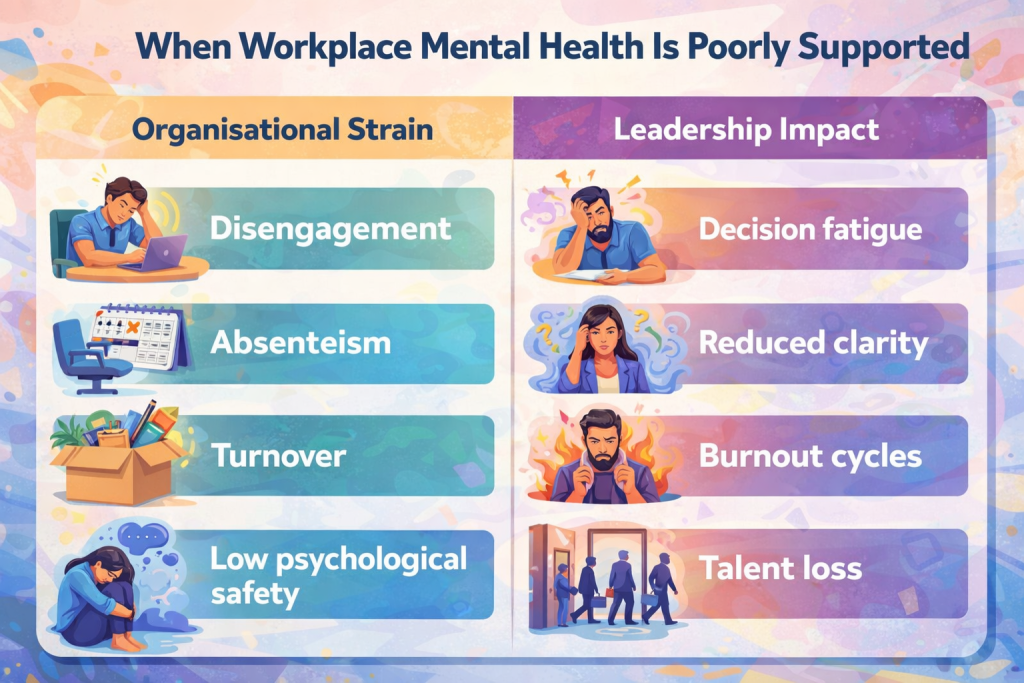
These outcomes are frequently misattributed to motivation or resilience, when they more accurately reflect systemic strain.
Conversely, organisations that approach mental health deliberately and structurally are better positioned to sustain performance, retain talent, and navigate periods of change.
Importantly, workplace mental health is not solely an individual responsibility. It is shaped by workload design, leadership expectations, decision autonomy, recovery time, and access to appropriate support.
How Workplace Mental Health Support Commonly Breaks Down
Across HR, consulting, and wellbeing literature, several failure patterns appear repeatedly — yet are rarely named explicitly.
Common breakdowns include:
- Treating burnout as a personal issue rather than an organisational signal
- Over-emphasising individual resilience while ignoring workload design
- Relying on Employee Assistance Programmes (EAPs) as a default solution instead of a preventative measure
- Intervening only once performance or attendance declines
- Expecting managers to handle mental health concerns without training
These approaches often create the appearance of action while leaving root causes unaddressed, gradually eroding trust in wellbeing initiatives.
Core Workplace Mental Health Challenges Organisations Face
Across industries and regions, organisations encounter overlapping mental health challenges that rarely exist in isolation:
- Chronic work-related stress and sustained overload
- Emotional exhaustion and burnout
- Anxiety linked to performance expectations, job security, or constant change
- Declining motivation, engagement, or sense of purpose
- Blurred boundaries between work and personal life
These challenges are especially pronounced in:
- Fast-paced or high-growth environments
- People-facing and decision-critical roles
- Leadership and management positions
- Organisations operating across time zones or cultures
A persistent challenge for leaders is recognising when employee stress has crossed into burnout, and when early intervention is required.
For a deeper diagnostic breakdown, see Employee Stress vs Burnout: What Organisations Should Know.
Understanding Stress, Burnout, and Mental Health at Work
Not all workplace stress is harmful. Short-term pressure can be motivating when employees have:
- Clear priorities
- Sufficient autonomy
- Adequate resources
- Time for recovery
Problems arise when stress becomes chronic, normalised, and poorly supported.
Burnout develops when prolonged stress is met with insufficient recovery, control, or support. It is characterised by emotional exhaustion, detachment from work, and a reduced sense of effectiveness — and it does not resolve through short breaks alone.
Understanding these distinctions allows organisations to respond proportionately rather than relying on generic wellbeing initiatives.
A Systems-Level Framework for Workplace Mental Health Support
High-functioning workplace mental health support operates across three interdependent layers.
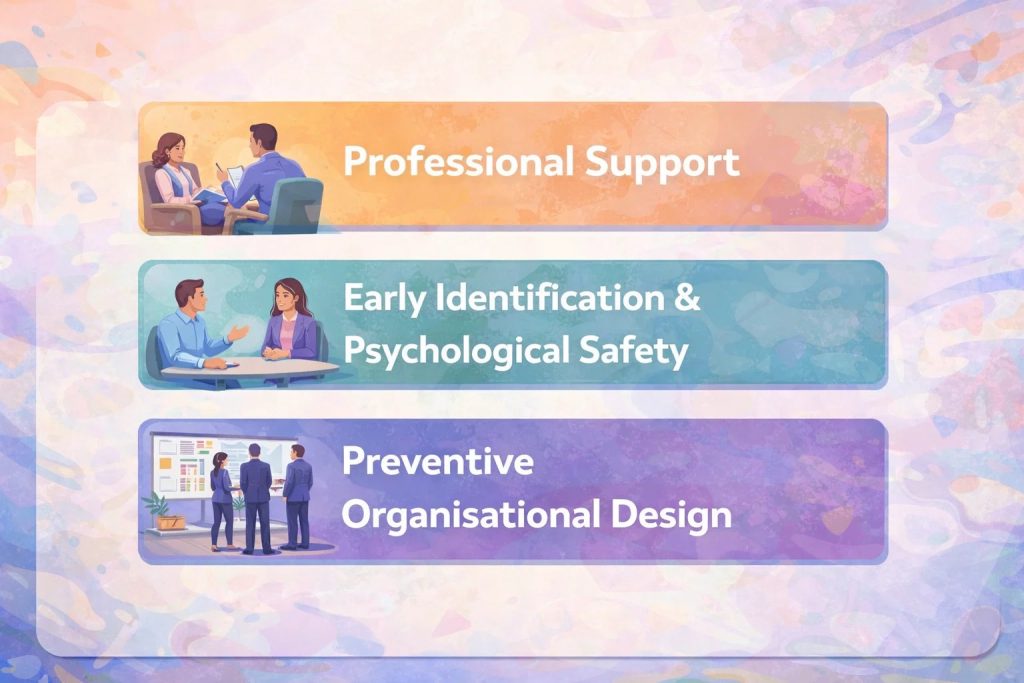
1. Preventive Organisational Design
Prevention focuses on reducing avoidable psychological strain through intentional work design, including:
- Realistic workload expectations
- Clear role boundaries and decision rights
- Predictable communication during change
- Leadership behaviours that support prioritisation and recovery
Prevention does not eliminate stress — it ensures stress remains manageable and recoverable.
2. Early Identification and Psychological Safety
Early identification depends on environments where employees feel safe acknowledging strain before it escalates.
Key elements include:
- Managers trained to recognise early warning signs
- Regular, non-crisis-driven check-ins
- Access to confidential mental health screenings and therapy if needed
- Clear messaging that help-seeking is responsible, not weak
Psychological safety is not a “soft” concept — it is a prerequisite for effective mental health support.
3. Access to Appropriate Professional Support
When additional support is needed, organisations must ensure access to:
- Qualified mental health professionals
- Confidential counselling and assessment
- Role-aware support aligned with real workplace demands
This is particularly critical for employees in high-pressure roles, where sustained responsibility and visibility increase mental health risk.
For role-specific considerations, see Mental Health Support for High-Pressure Roles.
Why One-Size-Fits-All Mental Health Solutions Fall Short
Many organisations rely heavily on Employee Assistance Programmes (EAPs) as their primary mental health offering. While EAPs can play a valuable role, they are rarely sufficient as a standalone strategy.
Common limitations include:
- Low awareness or engagement
- Short-term, session-limited support
- Crisis-focused rather than preventive models
- Limited continuity of care
- Minimal integration with organisational context
As a result, employees with ongoing, complex, or role-specific needs may remain unsupported.
For a deeper dive, see Why EAPs Alone Are Not Enough for Employee Mental Health.
Workplace Mental Health Maturity Model (Executive View)
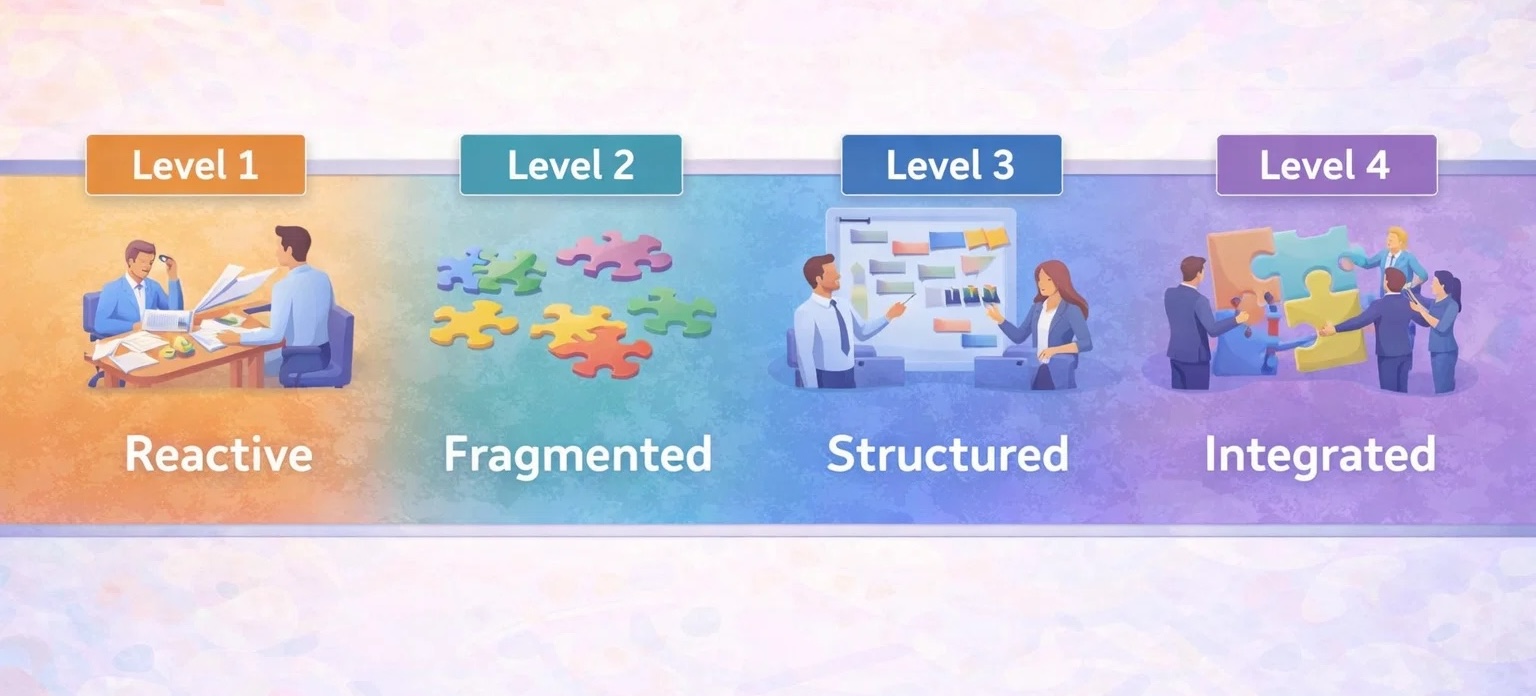
Understanding where an organisation currently sits helps leaders move from fragmented efforts toward sustainable support.
| Level | Organisational Pattern | Typical Characteristics |
| Level 1: Reactive | Individual-focused | EAP-only support, crisis-driven action, mental health addressed after breakdown |
| Level 2: Aware but Fragmented | Inconsistent | Workshops without follow-through, uneven manager capability, unclear pathways |
| Level 3: Structured | Preventive | Clear policies, manager training, early identification, professional support beyond EAPs |
| Level 4: Integrated | Systems-level | Mental health embedded in leadership, role design, performance, and change processes |
Most organisations operate across multiple levels simultaneously. Progress does not require perfection — it requires reducing reliance on reactive models and strengthening preventive, integrated support.
Mental Health in High-Pressure and Leadership Roles
High-pressure roles carry elevated mental health risk due to:
- Sustained accountability and decision-making
- Emotional labour and exposure to conflict
- Limited opportunities for psychological recovery
- Cultural expectations around endurance and performance
Ironically, these employees are often least likely to seek support due to concerns about credibility or visibility — making proactive, confidential pathways essential.
Building a Sustainable Workplace Mental Health Strategy
A sustainable approach requires alignment across leadership, policy, and practice, including:
- Explicit leadership accountability
- Clear mental health policies and communication
- Access to clinically qualified expertise
- Integration with HR, performance, and change systems
- Evaluation beyond utilisation metrics
Strategies must reflect organisational reality rather than aspirational wellbeing ideals.
At CALM International, workplace mental health is approached as a systems-level organisational capability, integrating clinical expertise with organisational insight to support employees, leaders, and teams in context-appropriate ways.
Measuring Impact Without Reducing Mental Health to Numbers
While organisations often seek metrics, mental health support should not be reduced to usage statistics alone.
More meaningful indicators include:
- Employee perceptions of psychological safety
- Manager confidence in addressing mental health concerns
- Patterns of early intervention versus escalation
- Retention and engagement trends over time
Balanced evaluation enables refinement without compromising trust or confidentiality.
Workplace Mental Health as an Organisational Responsibility
Workplace mental health support is no longer optional. It is a core responsibility of modern leadership.
Organisations that invest in structured, informed approaches are better positioned to retain talent, navigate uncertainty, and sustain performance without burnout cycles.
Understanding how stress, burnout, role-specific pressures, and support systems interact is the foundation of meaningful action.
Taking the Next Step
Effective workplace mental health support does not require perfection. It requires intentional design, structural alignment, and access to appropriate expertise.
For organisations seeking clarity on current gaps — whether around stress, burnout, high-pressure roles, or the limits of existing EAP models — professional guidance can help identify proportionate, context-appropriate next steps.
At CALM International, workplace mental health support is designed to complement existing organisational systems, combining clinical expertise with an understanding of real workplace demands.
👉 Explore CALM International’s workplace mental health support services