
When a student is visibly struggling, most teachers feel a strong instinct to help. That instinct is one of the things that makes teaching such a meaningful profession. But without clear guidance on what helping actually looks like in a school context, well-meaning teachers can find themselves either doing too little out of uncertainty, or taking on far more than is appropriate for their role.
This article is designed to give teachers, and the school leaders who support them, a clear and practical framework. It sets out what teachers can and should do when they notice a student in difficulty, and equally importantly, what falls outside the scope of the teaching role and why that boundary matters for everyone involved.
Understanding this distinction is not about limiting care. It is about directing care in ways that are effective, appropriate, and sustainable for both the teacher and the student.
What Teachers Can Do
Notice and Document Changes in Behaviour
Teachers spend more time with students than almost any other adult in their lives. This gives them a significant advantage when it comes to spotting early signs of difficulty. Changes in behaviour, mood, attendance, academic engagement, or social interaction are often the first indicators that something is wrong, and a teacher is frequently the first person to observe them.
Noticing is not enough on its own. Teachers should also document what they observe in a factual, non-diagnostic way.
A brief written note recording the date, the observed behaviour, and any relevant context provides an important record that can be shared with a school counsellor or pastoral lead. It also protects the teacher by demonstrating that concerns were identified and acted upon appropriately.
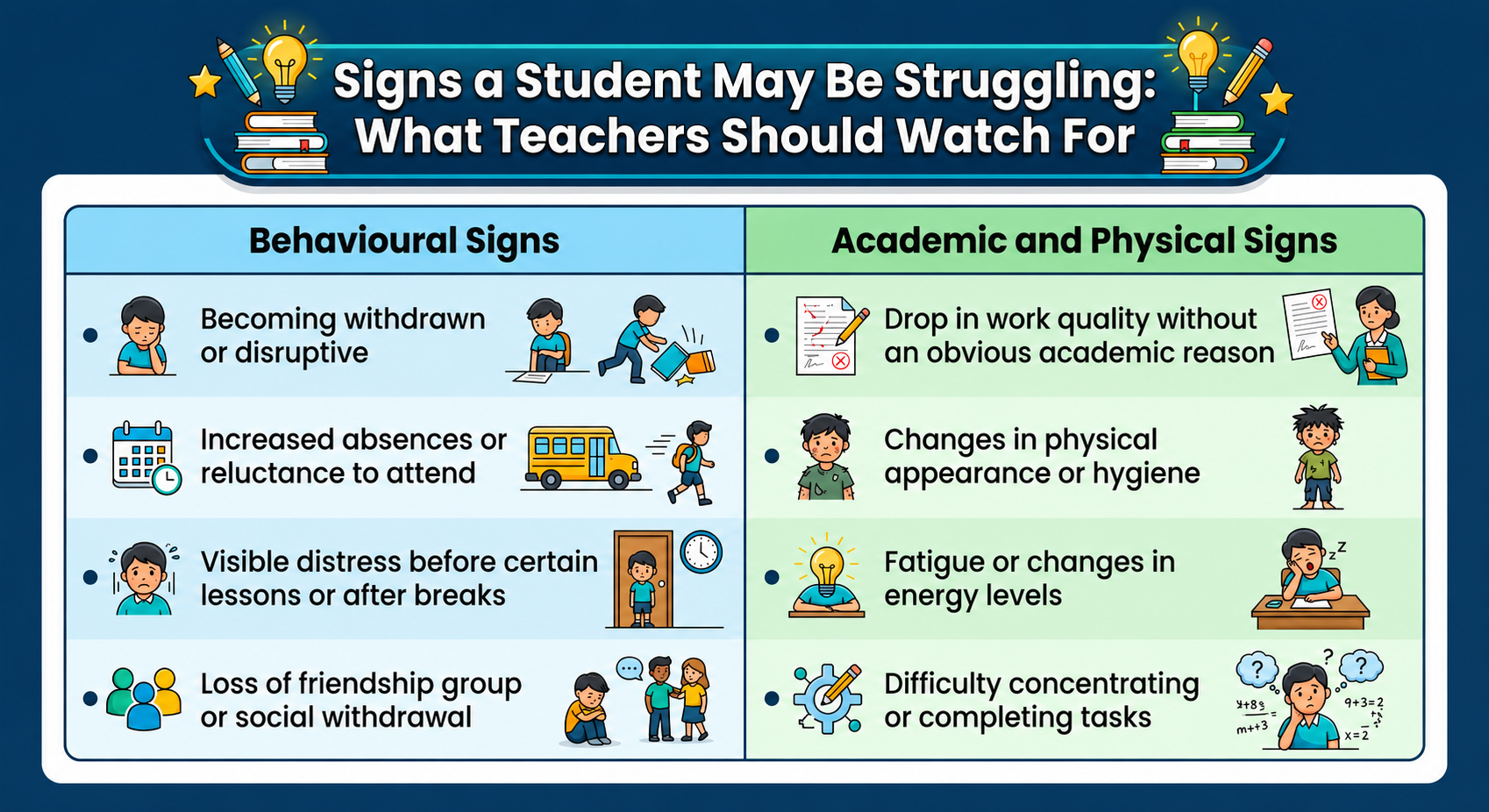
Some signs to watch for include a previously engaged student becoming withdrawn or disruptive, a drop in the quality or completion of work without an obvious academic reason, changes in physical appearance or hygiene, increased absences or reluctance to come to school, and visible distress at specific times such as before certain lessons or after breaks.
Create a Stable and Supportive Classroom Environment
One of the most powerful things a teacher can do for a struggling student does not require any specialist training. A well-structured, predictable, and emotionally safe classroom environment provides a form of stability that can be genuinely therapeutic for students going through a difficult time.
This includes maintaining consistent routines so students know what to expect, responding to mistakes and failure in a calm and non-shaming way, using language that normalises a range of emotional experiences, and ensuring that no student feels singled out, embarrassed, or unsafe in the classroom. For students who face instability at home or who are managing anxiety, this kind of environment can make a meaningful difference to their daily experience.
Have a Brief and Caring Check-In
Teachers do not need to initiate a formal conversation or attempt to uncover what is happening in a student’s life. A simple, genuine check-in is enough. Something as brief as staying back after class to say you have noticed a student seems a little different lately and asking if they are doing okay can open a door without placing pressure on the student to disclose more than they are ready to share.
The goal of a check-in is not to gather information or to fix anything. It is to let the student know they have been seen and that someone cares. That alone can be significant for a young person who may feel invisible or alone in what they are experiencing. Teachers should listen without trying to problem-solve, avoid making promises they cannot keep, and be honest that they may need to pass concerns on to someone who can help more directly.
Refer and Communicate with the Right People
When a teacher has observed concerning changes in a student, the most important action they can take is to pass that concern on through the school’s established referral process. This typically means speaking with a school counsellor, a head of year, a pastoral care coordinator, or another designated safeguarding lead, depending on the school’s structure.
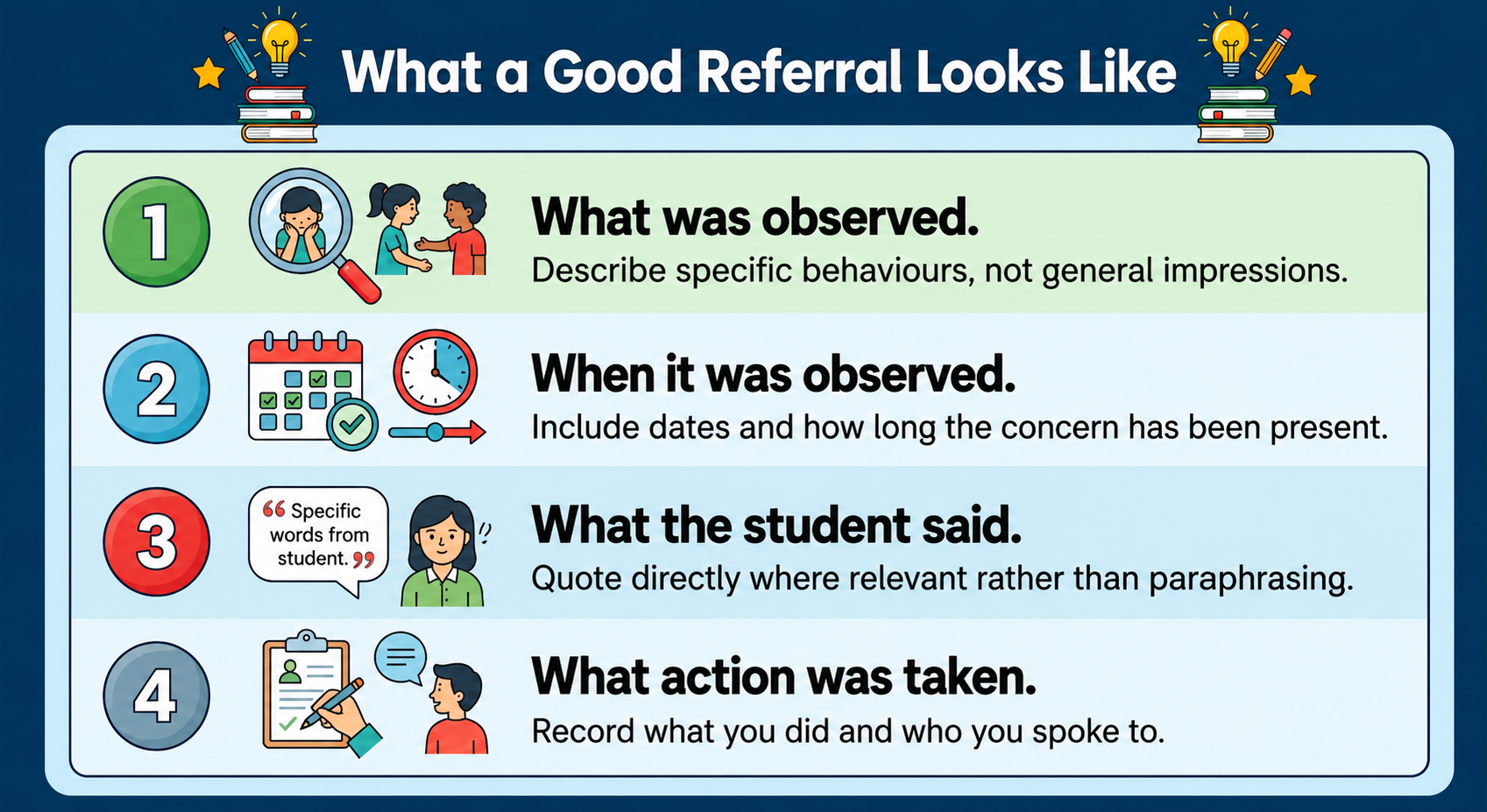
A good referral includes specific observations rather than general impressions. Describing what was noticed, when it was noticed, and how long it has been observed gives the receiving professional useful context to work with. Saying a student seems off is much less useful than noting that a student who previously participated actively in class has not spoken in group discussions for two weeks and has submitted incomplete work on three occasions.
Where appropriate, and in line with school policy, teachers may also have a role in communicating with a student’s family. This should be done in coordination with pastoral staff rather than independently, and should be handled with care to avoid causing alarm or breaching confidentiality.
Maintain Consistency and Warmth After Referral
Once a referral has been made, the teacher’s role does not end. Continuing to show up consistently for a struggling student, maintaining the same warmth and predictability in the classroom, and not treating the student differently in ways that might cause embarrassment or anxiety are all important ongoing contributions.
Students who know they are being supported by both their teacher and the school’s wellbeing team often feel more secure than those whose teacher becomes distant after a referral is made. The classroom relationship remains valuable even when clinical or pastoral support has been engaged elsewhere.
What Teachers Cannot Do
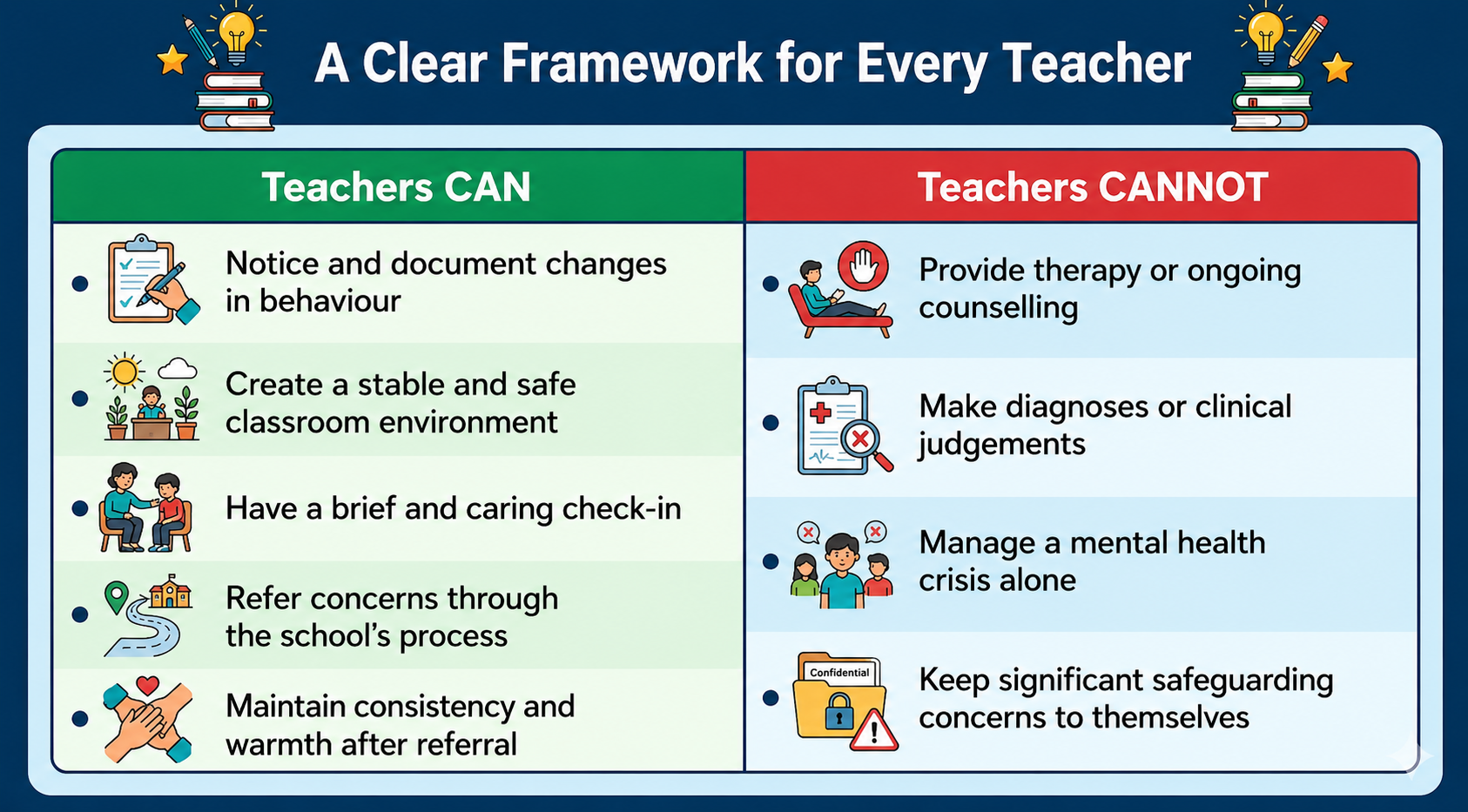
Provide Therapy or Ongoing Counselling
This is one of the most important boundaries for teachers to understand. No matter how caring or capable a teacher is, providing therapeutic support to a student is outside the scope of the role. This includes having repeated one-to-one conversations that are intended to process a student’s emotional difficulties, offering advice on how to manage mental health conditions, or positioning themselves as the student’s primary emotional support.
These forms of support require clinical training and professional supervision for good reason. Without them, even the best intentions can lead to harm, whether by reinforcing unhelpful patterns, missing something clinically significant, or creating a dependency that the teacher is not equipped to manage safely. If a student begins to rely on a teacher in this way, it is a signal that the referral to more appropriate support is overdue, not a reason to continue.
Make Diagnoses or Clinical Judgements
Teachers sometimes observe behaviour that resembles symptoms associated with anxiety, depression, ADHD, or other conditions. Noting these observations is appropriate. Sharing them with a qualified professional is appropriate. Communicating a diagnosis or clinical conclusion to a student, their family, or colleagues is not.
Describing a student as having anxiety or being depressed, even informally, can have significant consequences. It can affect how others perceive and treat the student, create distress for the student or their family, and in some cases affect formal records. Teachers should use descriptive, observational language rather than clinical language, and leave interpretation to those qualified to do it.
Manage a Mental Health Crisis Alone
If a student discloses that they are thinking about harming themselves, or if a teacher witnesses a situation of acute distress, their role is to stay with the student, remain calm, and get the appropriate people involved immediately. This means a school counsellor, a safeguarding lead, or in serious cases, emergency services.
A teacher should not attempt to talk a student through a crisis, provide crisis counselling, or make decisions about the appropriate response without support. Schools should have clear protocols for exactly this situation, and every teacher should know what those protocols are before they are ever needed.
Keep Significant Concerns to Themselves
Some teachers hesitate to raise concerns because they do not want to overreact, breach a student’s confidence, or cause problems for a family. This hesitation is understandable, but staying silent when a student may be in difficulty is itself a risk. Schools have referral and safeguarding processes precisely so that teachers do not have to make these judgements alone.
If a student has explicitly asked a teacher to keep something confidential, the teacher should be honest that they cannot always do that, particularly if the information relates to the student’s safety or the safety of others. Students generally understand this when it is explained clearly and with care. Promising confidentiality that cannot be guaranteed does more harm than being upfront from the start.
Why These Boundaries Benefit Everyone
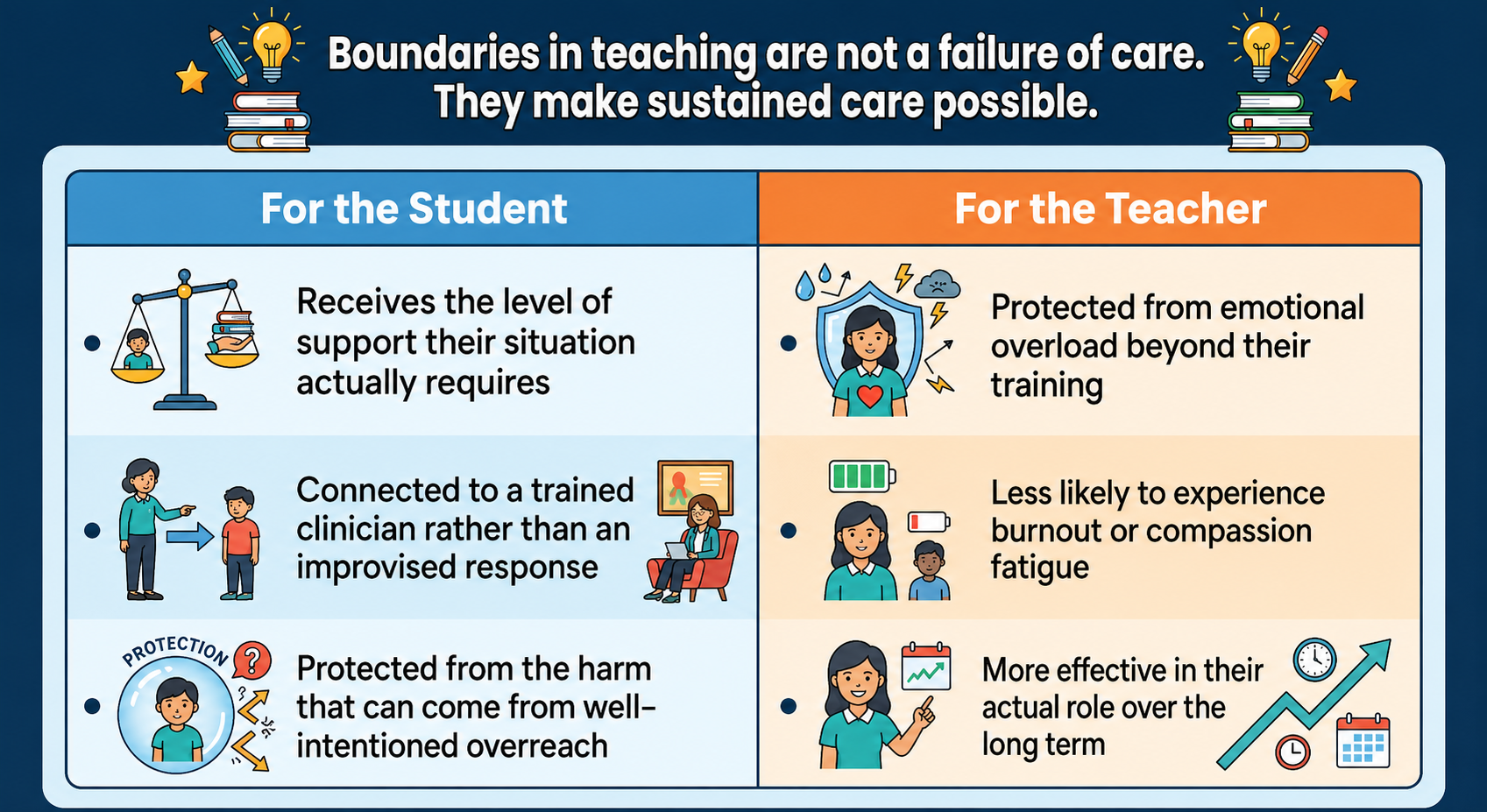
It can feel counterintuitive to say that doing less is sometimes the right choice. But the boundaries around the teacher’s role in student mental health exist for good reasons, and understanding them protects both teachers and students.
For students, being referred to a qualified professional means they receive the level of support their situation actually requires. A kind and attentive teacher is valuable. A trained clinician who can assess, diagnose, and provide evidence-based support is something different, and some students need that.
For teachers, maintaining these boundaries protects against the emotional overload that comes from carrying responsibilities beyond the scope of their training. Teachers who absorb too much of a student’s distress without adequate support for themselves are at heightened risk of burnout and compassion fatigue. Knowing where the role ends is not a limitation on care. It is part of what makes sustained care possible.
When External Support Is the Right Next Step
There are situations where the support available within a school is not sufficient for a student’s needs. This might be the case when a student’s difficulties are persistent and not improving despite school-based support, when there are signs of a more significant mental health condition that requires clinical assessment, or when a student’s home situation is contributing to their distress in ways that go beyond what any school can address.
In these situations, encouraging families to seek external professional support is an appropriate and important step. At CALM International, we work with students and families across international school communities. Our clinicians are experienced in working with the particular stressors that affect internationally mobile children and young people, including transitions, identity, academic pressure, and cultural adjustment.
If you are a teacher or school leader who is concerned about a student and unsure of the right next step, or if you are a parent who has been told their child may need support beyond what the school can provide, we welcome enquiries. A consultation can help clarify the picture and identify the most appropriate pathway forward