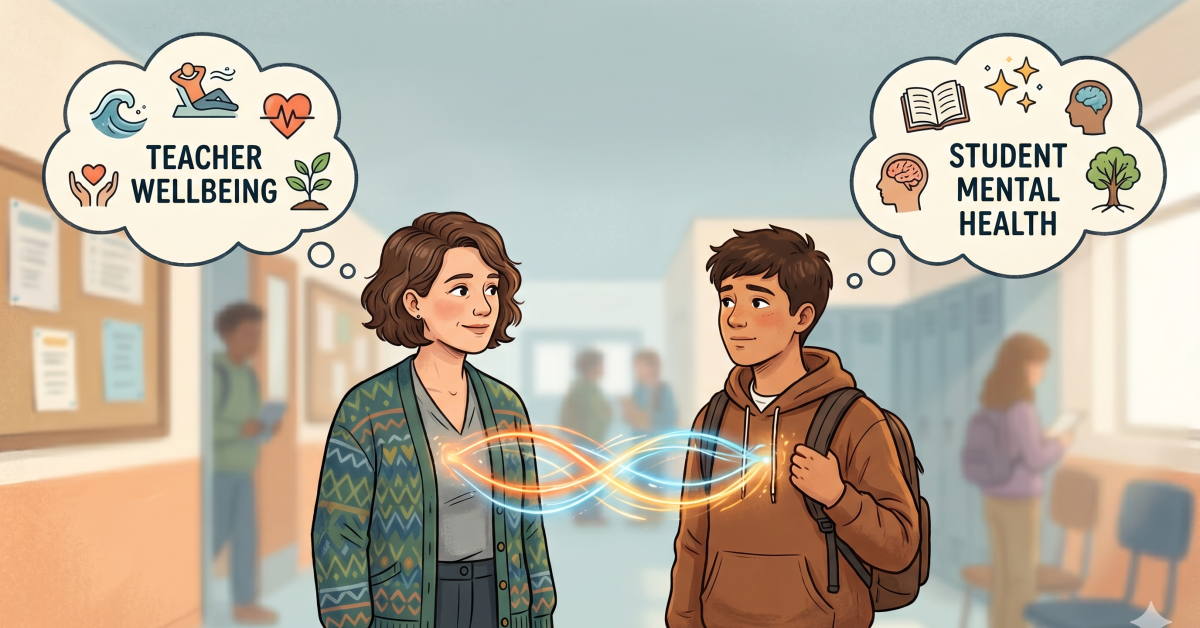
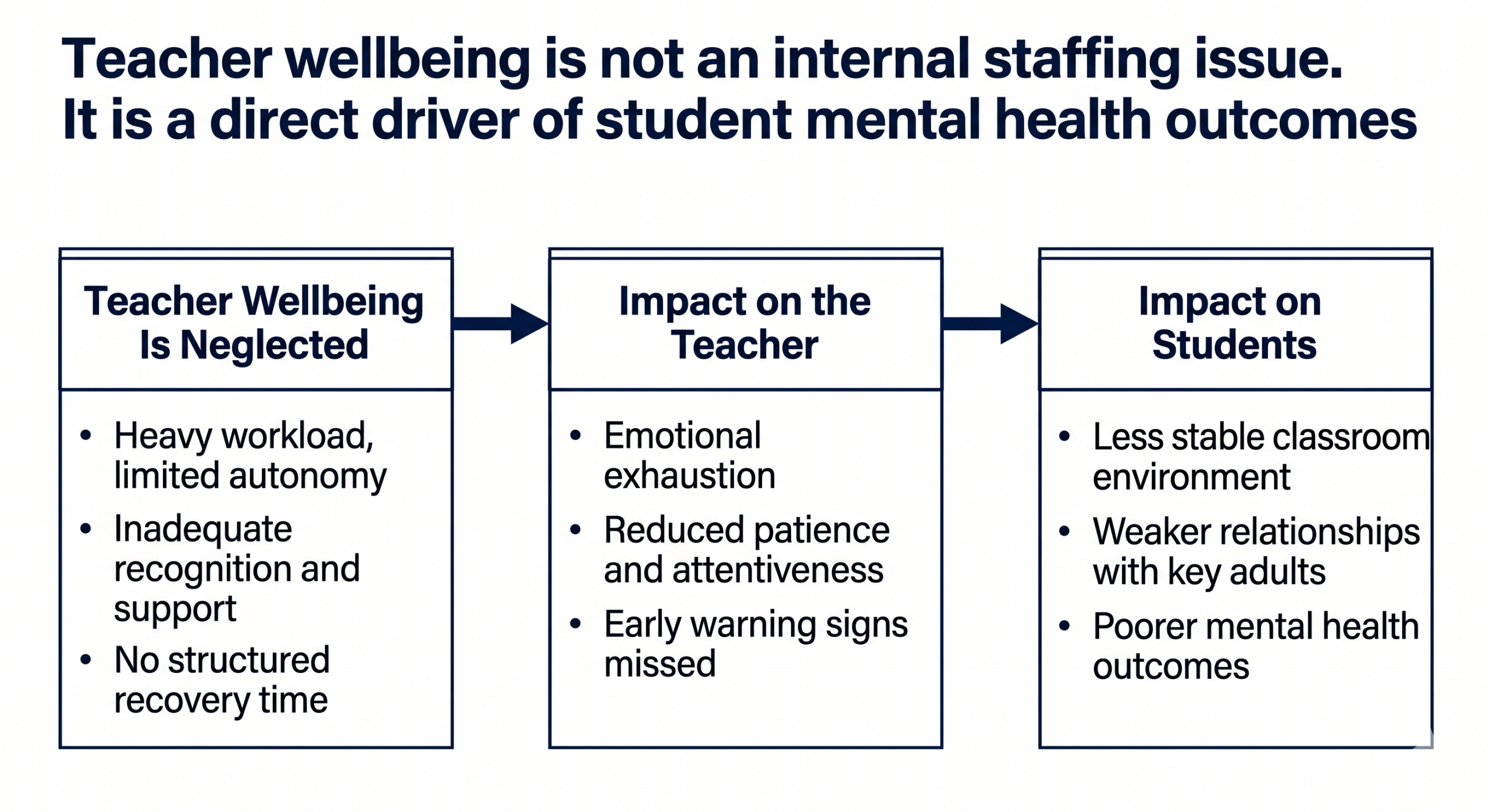
Teachers occupy a uniquely demanding position. They are educators, mentors, and often the first adult outside of a student’s family to notice when something is wrong. As awareness of student mental health has grown, so have the expectations placed on teachers, often extending beyond what is clearly defined, supported, or sustainable in practice. The relationship between teacher wellbeing and student mental health is not incidental. How supported, resourced, and emotionally healthy a teacher feels directly shapes their capacity to support the students in their care. Schools that treat these two things as separate concerns tend to find that both falter. In practice, teacher wellbeing is often treated as an internal staffing issue, when in reality it is a direct driver of student mental health outcomes.
This guide explores what teachers can realistically do to support struggling students, where the boundaries of that role lie, and what structures, in schools and beyond, help both educators and students thrive. Whether you are a teacher navigating a difficult situation, a school leader building a more supportive system, or a parent trying to understand how your child’s school handles mental health, this resource is written for you.
Why Teacher Wellbeing and Student Mental Health Are Inseparable
Research consistently shows that a teacher’s emotional state significantly influences classroom climate, student engagement, and behavioural outcomes. Teachers who feel supported, valued, and psychologically safe are better placed to provide the warmth, consistency, and attentiveness that students need, especially those who are already struggling.
In international school settings, this relationship carries additional weight. Students are often navigating the pressures of academic transition, cultural adjustment, and family relocation alongside the ordinary stresses of adolescence. In these environments, a trusted teacher is frequently the most consistent caring adult a student interacts with outside the home, which makes a teacher’s emotional availability particularly significant.
When teacher wellbeing is neglected, the impact reaches students directly. Burnt-out or emotionally depleted educators are less able to notice early warning signs, respond with patience, or model the kind of emotional regulation that supports healthy development in young people. The reverse is also true: schools that invest meaningfully in teacher wellbeing tend to see measurable improvements in student engagement and mental health outcomes.
This is not simply a matter of individual resilience. It is a systemic issue. Teachers working in environments with heavy workloads, limited autonomy, and inadequate recognition are at greater risk of emotional exhaustion, regardless of how committed or capable they are as individuals.
What Is the Teacher’s Role in Supporting Student Mental Health?
Teachers are not clinicians, and it is important that both schools and teachers themselves are clear about that boundary. Without this clarity, well-intentioned teachers often take on emotional responsibilities that exceed their role, increasing risk for both themselves and the student.
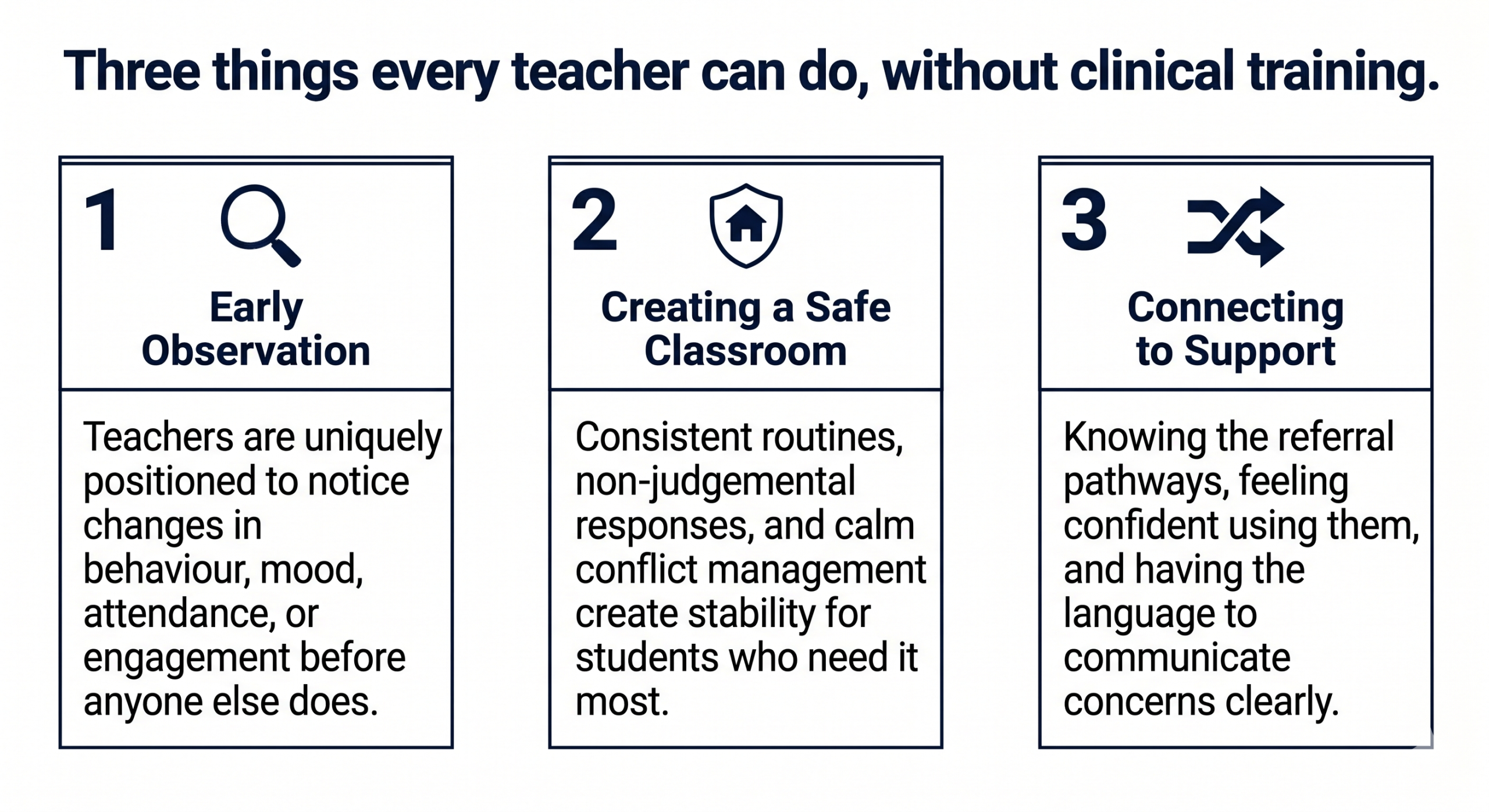
However, the teacher’s role in student mental health is still meaningful, and it operates across three practical levels:
Early Observation
Because teachers spend hours each day with students, they are uniquely positioned to notice changes in behaviour, mood, attendance, or academic engagement. A student who was previously enthusiastic but has become withdrawn, a normally social child who starts isolating themselves, or one who begins struggling to concentrate without any obvious academic explanation, these are changes that a classroom teacher is often the first to observe.
This observational role is one of the most valuable contributions a teacher makes to student mental health. It does not require clinical training. It requires attentiveness, consistency, and a genuine relationship with each student, all of which good teaching already demands.
Creating a Safe Classroom Environment
A teacher does not need to be a counsellor to create conditions where students feel safe, seen, and respected. Consistent routines, a non-judgemental response to mistakes, language that normalises emotional experience, and an approach to conflict that is calm and fair, all contribute to a classroom climate that actively supports mental health.
For students who are struggling at home or experiencing anxiety, the predictability and safety of a well-managed classroom can itself be a meaningful source of stability. This is one of the ways teachers support student mental health every day, often without recognising it as such.
Connecting Students to the Right Support
One of the most important things a teacher can do for a struggling student is to connect them, or their family, with the right support. This might mean referring a student to the school counsellor, flagging concerns with a head of year or pastoral care lead, or encouraging families to seek professional support outside school when a student’s needs exceed what the school can provide.
Making this connection effectively requires knowing the referral pathways available, feeling confident that concerns will be taken seriously, and having the language to communicate those concerns clearly to both the student and their family. Schools are responsible for ensuring this knowledge is accessible to all teaching staff, not only those in designated pastoral roles.
Understanding the Limits of the Teacher’s Role
One of the most common sources of stress for teachers who care deeply about their students, is role confusion. This happens when a teacher gradually takes on emotional responsibilities that go beyond their training, capacity, or professional remit, often with entirely good intentions.
Teachers are not expected to diagnose mental health conditions, provide ongoing therapeutic support, manage crises alone, act as a student’s primary mental health contact, or substitute for a school counsellor or psychologist. Attempting to do so, however well-intentioned, can lead to harm on both sides. The student may receive inadequate or inappropriate support, while the teacher absorbs emotional burdens they are not trained or resourced to carry.
Clarity about these limits is not a failure of care. It is a professional and ethical necessity that protects both the student and the teacher. A teacher who tries to become a primary support for a struggling student often ends up depleted and ultimately less effective in their actual role.
Schools play a critical part in establishing these boundaries clearly and reinforcing them in practice. When staff receive adequate training, know who to refer to and when, and trust that their concerns will be acted upon, they are far more effective within their legitimate role. They are also less likely to overextend in ways that lead to burnout.
It is also worth noting that some students will naturally seek to confide more in a trusted teacher than in a counsellor they have met only briefly. When this happens, teachers need to feel equipped to manage that dynamic with care, acknowledging the student’s trust while guiding them toward appropriate support rather than taking on more than they should.
Teacher Burnout and Compassion Fatigue: The Hidden Cost of Caring
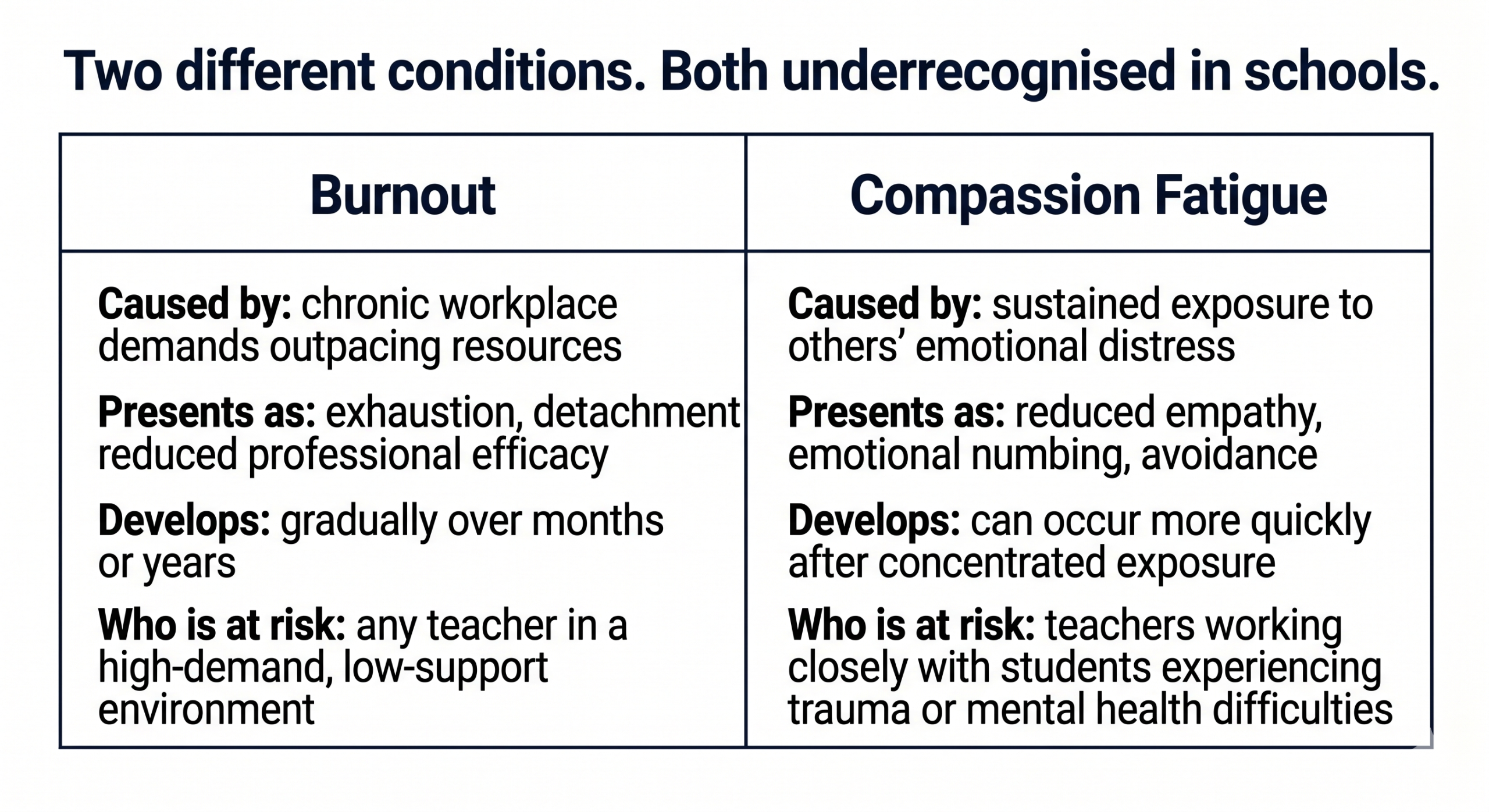
Teachers who work closely with students experiencing emotional difficulties are themselves at elevated risk of emotional exhaustion. Two distinct but related experiences are important to understand in this context: burnout and compassion fatigue.
Burnout is a state of chronic depletion that develops when the demands of a role consistently outpace the resources and recovery available to the person in it. In teachers, it typically presents as emotional exhaustion, a growing sense of detachment from students and colleagues, and a reduced feeling of professional efficacy. It is not a sign of weakness or lack of dedication. It is the predictable outcome of sustained emotional demand without adequate structural support.
Compassion fatigue is distinct from burnout, though the two are often confused. It is more specific to roles involving sustained exposure to others’ distress, and it reflects a gradual depletion of the capacity to empathise. Sometimes referred to as secondary traumatic stress, compassion fatigue can affect teachers who genuinely love their work but who have absorbed too much emotional weight over time without sufficient opportunity to recover.
Both are serious, both are underrecognised in school settings, and both have real consequences for the students those teachers serve. A teacher experiencing compassion fatigue may become emotionally distant or less responsive to the very students who need them most, not out of indifference, but because their reserves have run dry. Understanding this without assigning blame is important because it is a systemic problem that requires a systemic response, not a personal failing that can be resolved through individual effort.
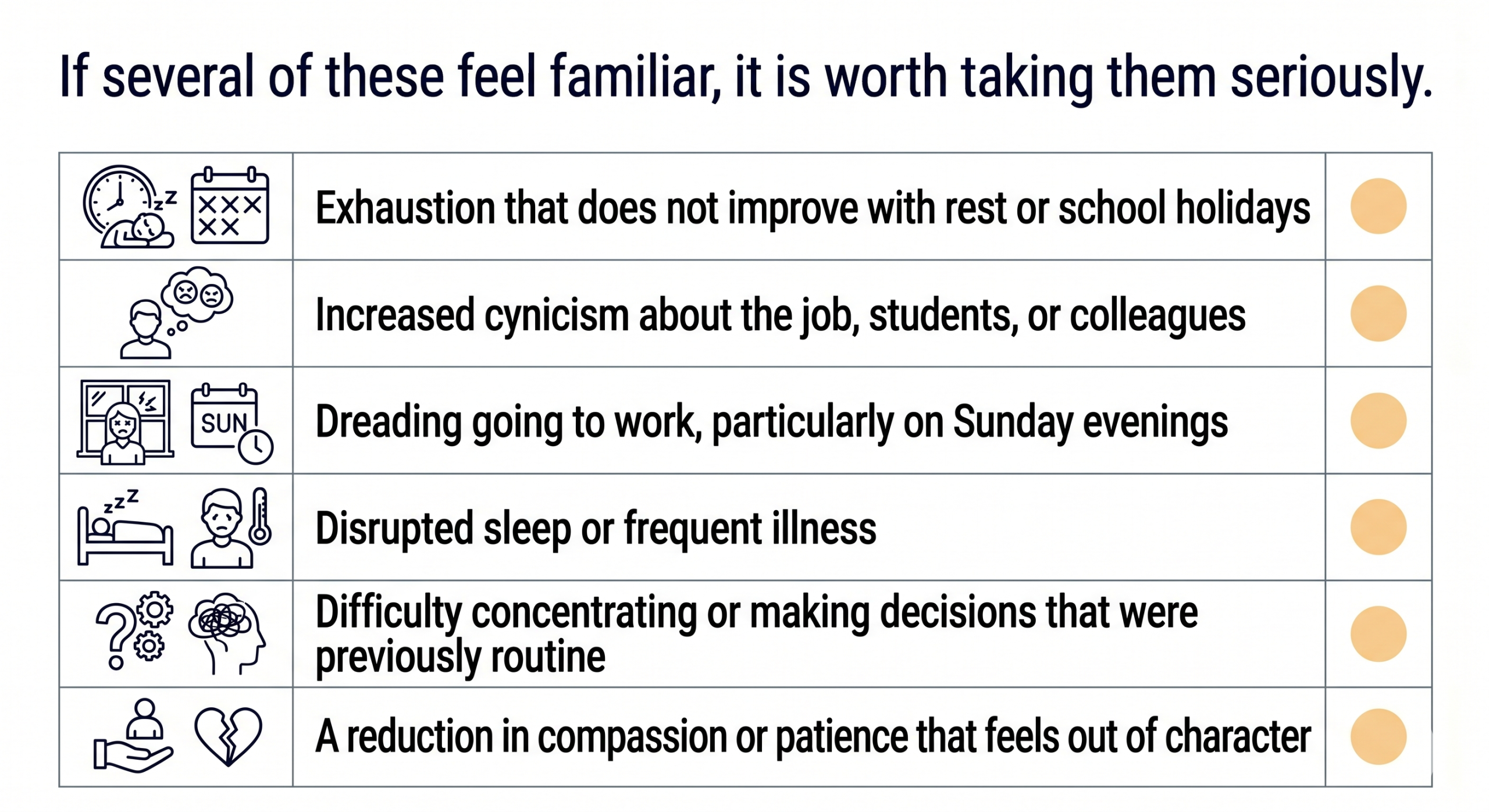
Warning signs include persistent exhaustion that does not improve with rest, increased cynicism about the job or about students, a sense of dreading going to work, physical symptoms such as disrupted sleep or lowered immunity, and a noticeable reduction in compassion or patience that feels out of character.
What Schools Can Do to Support Teacher Wellbeing
Supporting teacher wellbeing is not a peripheral concern for schools. It is a prerequisite for high-quality student mental health support. Schools that take a genuine systemic approach tend to see the strongest outcomes for both staff and students.
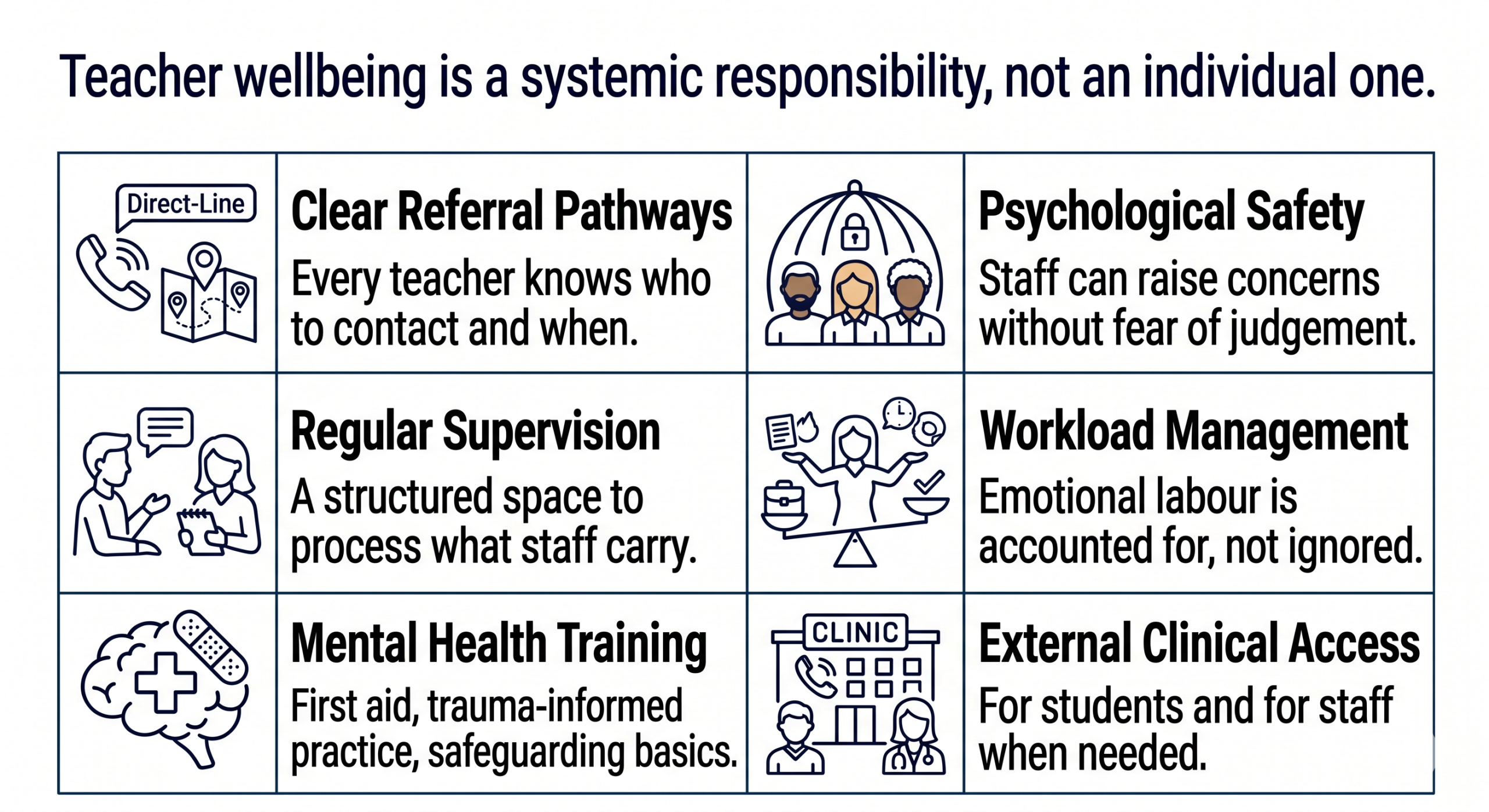
Effective structures typically include the following.
- Clear referral pathways, so that every teacher knows exactly who to contact and when. This removes uncertainty and reduces the risk that concerns fall through the gaps.
- Regular supervision or reflective practice sessions for staff who work with emotionally complex situations, giving teachers a structured space to process what they carry without bringing it into their personal lives.
- Training in mental health first aid, trauma-informed practice, and safeguarding. The goal is not to turn teachers into clinicians but to equip them with the foundational knowledge to recognise, respond, and refer appropriately.
- Psychological safety within the staff culture, where teachers feel genuinely able to raise concerns, ask for help, or acknowledge their own difficulties without fear of judgement or professional consequences.
- Workload management that accounts for the emotional labour involved in teaching, not just the instructional demands. Recovery time needs to be built into the structure, not treated as a personal responsibility.
- Access to external professional support, both for students whose needs go beyond what the school can address in-house, and for teachers who may benefit from clinical guidance themselves.
Schools that treat these elements as a coherent system rather than isolated initiatives are more likely to retain experienced staff, maintain consistent relationships with students, and build a culture where mental health support is genuinely embedded.
When Families and Schools Need External Support
There are times when a student’s mental health needs exceed what a school can appropriately address internally. This is not a failure on the school’s part. It is simply a recognition that some students need a level of clinical input that sits outside the scope of any pastoral or school counselling team.
Similarly, there are teachers and school staff who would benefit from professional support for the emotional challenges their roles present. Seeking that support is a sign of professional maturity. It also tends to make teachers more effective in their roles, not less.
At CALM International, we work with students, families, and educators across international school communities. Our clinicians understand the particular pressures of expat and internationally mobile family life, including how transitions, academic expectations, and cross-cultural adjustment can affect both students and the adults who support them.
If you are concerned about a student’s wellbeing, or if you are a teacher who is noticing signs of burnout or compassion fatigue in yourself, we welcome enquiries from families and school staff alike. A confidential consultation can help clarify what is happening, what level of support is appropriate, and what the right next steps are.