
Your child can explain the material at home, yet regularly leaves questions unanswered in exams. Their teacher says they understand the subject, but their timed results do not seem to reflect that understanding. Could extra time help, and do they need an assessment to qualify?
A psychoeducational assessment may be useful when persistent difficulties with reading, writing, attention or processing information affect timed work. However, not every student who struggles to finish an exam needs a full assessment. Start with the school: clarify the difficulty, review existing support and ask what evidence is required before booking new testing.
For families preparing for IGCSE or IB examinations in 2027, this is a useful conversation to begin now. This guide explains how to approach it and where an assessment may fit.
What extra time and exam access arrangements are for
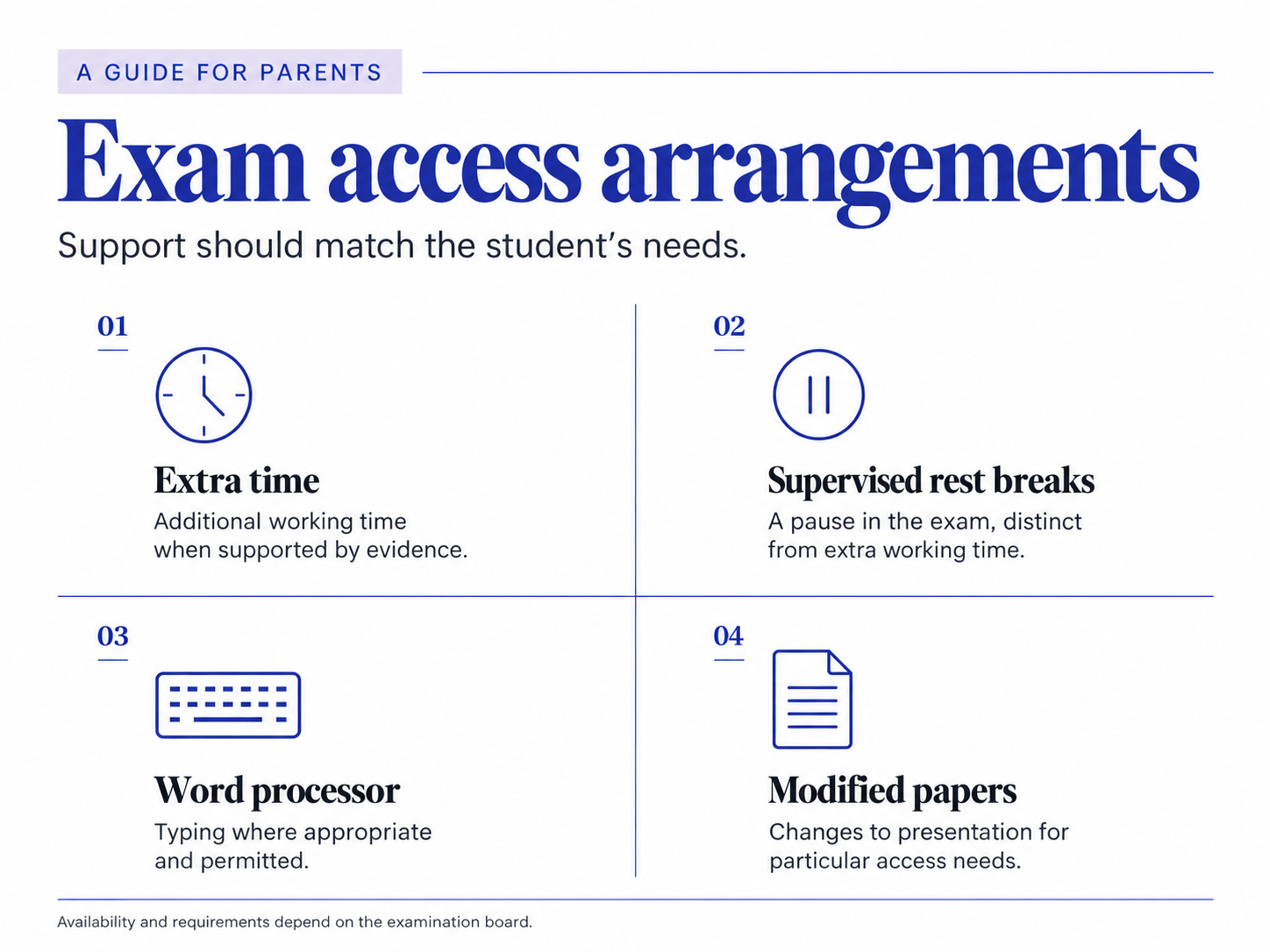
Extra time is one type of exam access arrangement: an adjustment intended to reduce a barrier that prevents a student from demonstrating their knowledge. Other options may include supervised rest breaks, a word processor, modified papers or permitted assistance. The appropriate support depends on the student’s needs and the qualification’s rules.
The purpose is to make the assessment accessible while preserving what it tests. A diagnosis does not automatically entitle a student to extra time, and receiving an arrangement does not guarantee a higher grade.
For illustration, 25% extra time adds 15 minutes to a one-hour paper. Whether that allowance is appropriate is a separate question that must be supported by evidence. A student who needs to pause to manage a medical condition may require rest breaks instead of additional working time. The Cambridge Handbook explains the requirements for extra time and supervised rest breaks.
When difficulty with timed exams is worth discussing
An unfinished paper on its own does not explain why a student ran out of time. The task may have been unfamiliar, preparation may have been insufficient, or the student may need help with exam technique. Persistent patterns deserve a closer look, especially when teachers notice similar difficulties in class.
Examples to raise with the school include:
- Reading and rereading questions takes so long that little time remains to answer them.
- Written work is consistently much harder to complete than explaining the same ideas aloud.
- Writing is unusually slow, effortful or physically uncomfortable.
- The student frequently loses their place or struggles to sustain attention through a task.
- Difficulties continue despite appropriate teaching, practice and support.
These observations are starting points for a conversation, not a checklist for a diagnosis or approval. Ask your child what happens during a paper: where do they get stuck, what feels difficult, and which support has helped? Their account adds context to the work teachers see.
Speak with the school before booking an assessment
Contact the learning support team, special educational needs coordinator or examinations officer. For the IB Diploma Programme, involve the programme coordinator. The school can explain the requirements for the exact qualification and examination session, and whether the evidence it already holds is sufficient.
Useful questions include:
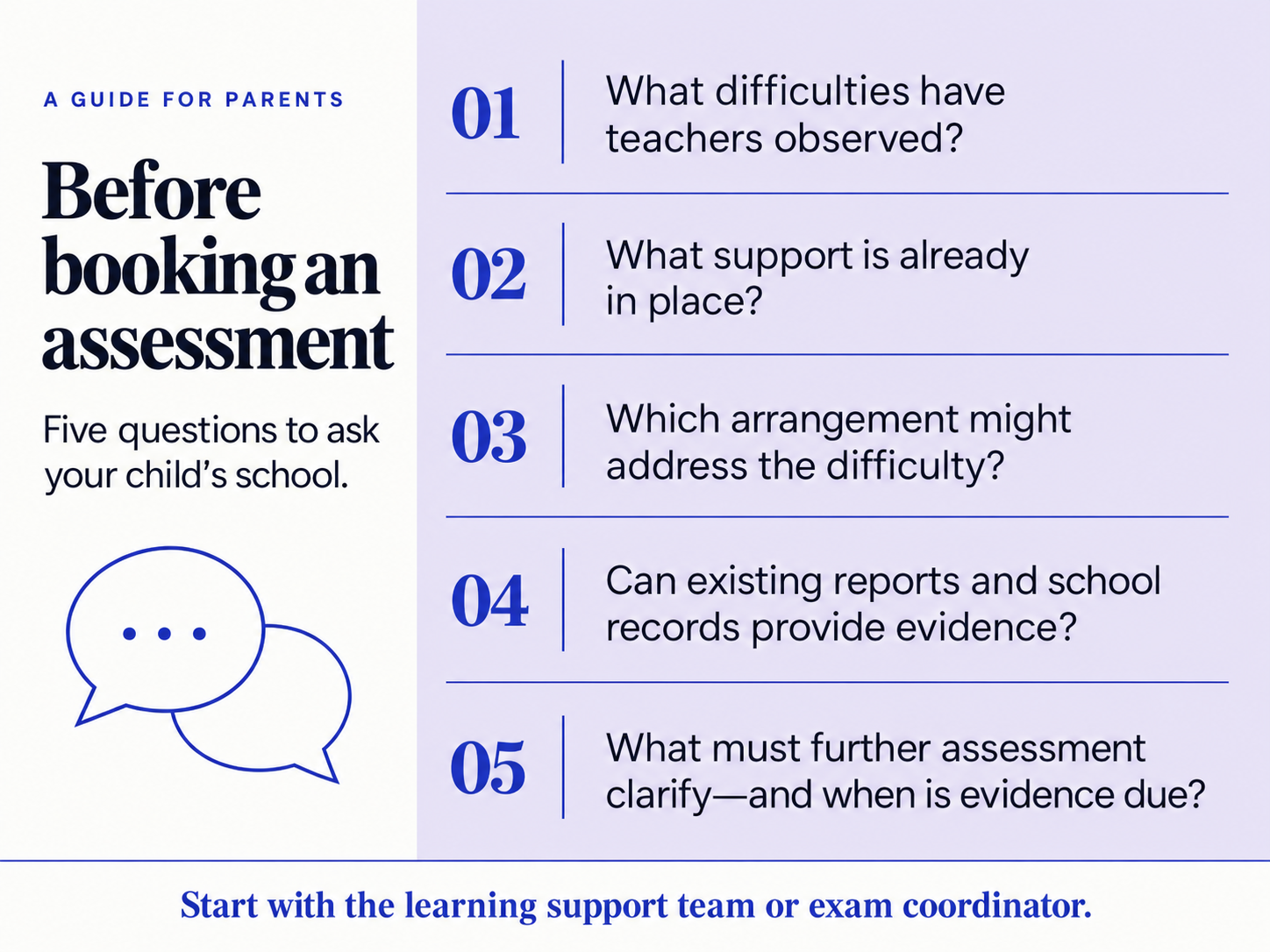
- What difficulties have teachers observed in class and timed assessments?
- What support is already in place, and how does my child use it?
- Which arrangement might address the difficulty?
- Can existing school records or professional reports support the request?
- If further assessment is needed, what specific questions should it answer?
- What is the school’s internal deadline for evidence?
Share any previous assessments, medical reports and support plans. This helps avoid arranging testing that repeats information the school already has. It also gives an assessor a clearer referral question if further investigation is appropriate.
What a psychoeducational assessment can clarify
A psychoeducational assessment explores how a student learns and what may be contributing to their difficulties. Depending on the referral question, it may examine academic skills, cognitive abilities, attention, memory and processing, alongside developmental history, school information and relevant emotional or behavioural factors.
The value lies in understanding the pattern. For example, slow completion of a written paper might involve difficulty reading the questions, producing written answers or managing the demands of the task. Those possibilities require careful evaluation; they should not be treated as the same problem simply because the paper was unfinished.
The findings can inform classroom support, learning strategies, further referrals and recommendations about examination arrangements. For a family, that means understanding what help may be useful throughout the school year as well as during exams.
At CALM International, our psychoeducational assessment service includes reviewing relevant history, assessment, a written report with recommendations and a feedback discussion with the family.
When a full assessment may not be necessary
A full assessment is not automatically the next step for every concern about extra time. The school may already have relevant evidence, an existing report may need a targeted update, or the concern may be better addressed by a treating medical professional. Discuss the purpose and scope with the school and the proposed assessor first.
How assessment findings support an access arrangement request
A useful report explains the difficulty and its practical effect on learning and assessment. It should make clear who conducted the assessment, which measures were used, what the results mean and why any recommended support is appropriate. The IB’s guidance on supporting documentation sets out its report requirements.
A recommendation for extra time carries more meaning when it explains the barrier it is intended to address. The school also needs to understand how the student works in practice. Teacher observations, timed work and records of support can add context that a report alone cannot provide.
An assessment report contributes evidence. The assessor does not grant examination arrangements, and a recommendation is not a promise of approval.
What differs between Cambridge IGCSE and IB exams
The shared principle is that support should address an evidenced need. The procedures and criteria differ, so the school must check the relevant awarding body’s requirements.
For Cambridge IGCSE, the school or examination centre follows Cambridge’s current access arrangements procedures. Cambridge distinguishes access arrangements from requests for modified question papers. Parents should obtain the applicable evidence requirements and deadlines from their centre. See Cambridge’s access arrangements guidance.
For the IB, some inclusive access arrangements require IB authorisation, while others can be implemented by the school under the policy. Additional time requires authorisation; rest breaks do not. The programme coordinator manages requests requiring approval. See the IB Access and inclusion policy.
If your child takes Pearson Edexcel International GCSE, ask the school about Pearson’s procedures. Cambridge guidance should not be assumed to apply. Likewise, support previously provided for one qualification should be reviewed when a student moves to another.
When to begin the conversation
Raise persistent concerns when they become apparent. Starting before the examination year gives the school and family more time to understand the difficulty, try support and review its usefulness. You do not need to wait for a disappointing mock result to ask for help.
If your child is already in the final examination year, contact the school now. Ask what can still be arranged and what evidence is needed. Do not assume that support is unavailable, or book an urgent assessment before confirming that it will address the school’s requirements.
If testing is recommended, ask the provider about appointment availability, the expected assessment process and report timing. Share the school’s deadline at the outset so everyone can discuss a realistic schedule.
If the school has recommended further assessment, or you are unsure how to understand your child’s learning difficulties, CALM International can discuss whether a psychoeducational assessment is an appropriate next step.
When enquiring, share your child’s age, qualification, the concerns raised by teachers, any previous reports and the school’s evidence requirements or deadline. This helps us understand what you need from the assessment.
Contact CALM International to discuss your child’s assessment needs.
This article provides general information for parents and educators. Confirm current examination requirements with your child’s school or examination centre.
Sources and further reading
1. Cambridge International Education. Access arrangements. Official overview of access arrangements, modified papers and the centre’s procedures.
2. Cambridge International Education. Cambridge Handbook 2026. Section 1.3 covers access arrangements, including extra time and supervised rest breaks. Schools should use the handbook applicable to the examination year.
3. International Baccalaureate. Access and inclusion policy. Published September 2022; updated November 2023. Sections 2–3 cover individual needs and supporting evidence; section 4 sets out arrangements and authorisation requirements. Read alongside the current programme assessment procedures.
4. CALM International. Psychoeducational Assessments.