
After-school meltdowns can happen when a child has difficulty managing the transition from a demanding school day to home. Tiredness, hunger, worries, social pressures or the next demand may contribute. Start with safety, a calm response and a predictable return-home routine. Repeated, severe or worsening outbursts deserve professional advice, even if teachers report that your child seems fine.
Perhaps pickup goes smoothly, but everything changes at the front door. A question about homework leads to tears. A sibling touching the school bag sparks shouting. You hear “nothing happened” even though the afternoon feels impossible.
The contrast can be confusing. It is worth exploring what happens across the whole day rather than deciding that someone must be getting the story wrong.
Why can a child seem fine at school but struggle at home?
Behaviour depends partly on context. Raising Children Network’s guide to self-regulation notes that children may manage well at school or sport yet find regulation harder at home. Tiredness, illness and changes in routine can also affect their responses.
That difference does not tell you exactly why your child is upset. A teacher may see successful participation while a parent sees the difficult transition afterwards. Both observations matter.
Ask specific questions: Was lunch eaten? Was there an unfamiliar activity? Did the difficulty begin in the car, during a sibling disagreement or when homework appeared? Describing the sequence gives you something concrete to discuss.
Is “after-school restraint collapse” a diagnosis?
Treat this phrase as a description, not a diagnosis. It is commonly used to describe children appearing to hold things together at school and becoming overwhelmed afterwards. It does not identify a single cause or establish a mental health condition.
“They feel safe with you” may be a comforting possibility, but it should not become the only explanation. It cannot rule out a difficult school experience, unmet needs at home or a concern needing assessment.
You do not need to settle on a label before helping. A more useful starting question is: “What makes this part of the day hard, and what would make it more manageable?”
What might contribute to after-school meltdowns?
Look for patterns without turning them into conclusions. The NHS guide to anger in children lists friendship problems, bullying, schoolwork difficulties and feeling stressed or anxious among possible contributors to anger. Sometimes the reason is unclear to the child too.
| What you notice | A useful question | A practical next step |
|---|---|---|
| Upset begins soon after pickup | Has your child eaten, rested or had a drink? | Offer an ordinary snack and water; review the day’s routine. |
| Noise or conversation seems unwelcome | Does your child want quieter company or space? | Reduce competing noise and offer a simple choice. |
| Distress starts when homework appears | Is starting difficult, or is a particular task confusing? | Bring the actual task and your observations to the teacher. |
| Certain school days are harder | What differs about those days? | Ask about specific lessons, activities and transitions. |
| The pattern began after a change | What changed at school or home? | Discuss the change with your child and relevant adults. |
These are prompts for investigation, not a diagnostic checklist. A child might be hungry and worried; changing snack time alone would not resolve the worry.
What can we change about the return-home routine?
Raising Children Network’s school-age behaviour guidance recognises that long school days can leave children tired and grumpy. It suggests allowing a snack and quiet play before moving into activities. Children may also need time before talking about school.
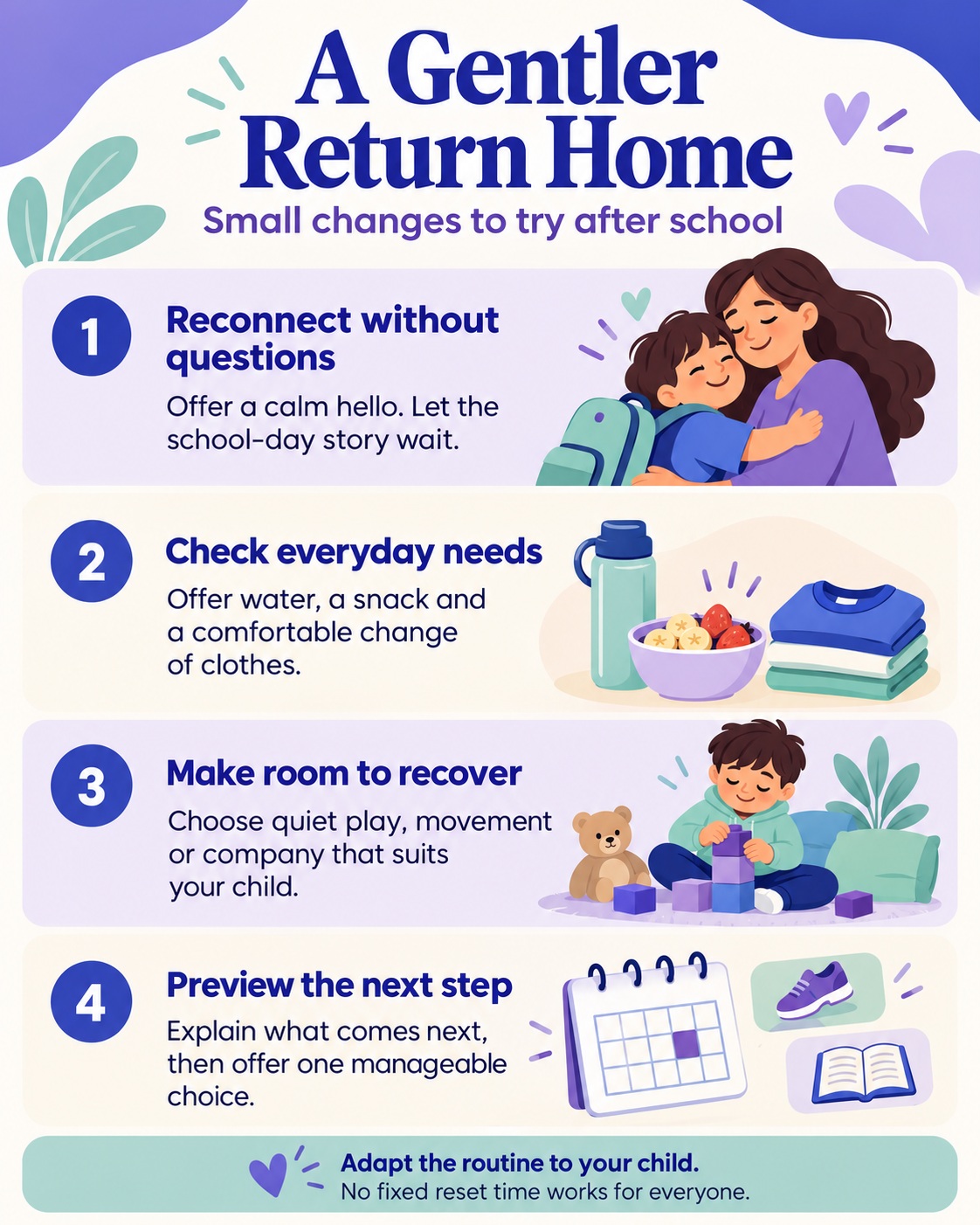
Try a small, repeatable sequence that fits your family:
- Reconnect: Offer a warm hello without requiring an immediate account of the day.
- Check everyday needs: Make water, a snack and a comfortable change available.
- Allow recovery: Offer quiet play, movement or company according to your child’s preference.
- Preview the next step: Explain what happens next and offer one manageable choice.
For example: “We’re going home for a snack. After that, we’ll look at the reading together. Would you like company or some quiet first?”
There is no fixed reset time that every child needs. A long commute, siblings, work and childcare may limit your options. Choose a change you can sustain rather than designing an ideal afternoon nobody can follow.
The broader Raising Children Network guidance on family routines supports predictable, age-appropriate routines with room for relaxation. Involve your child in planning when everyone is calm.
What should I do during an after-school meltdown?
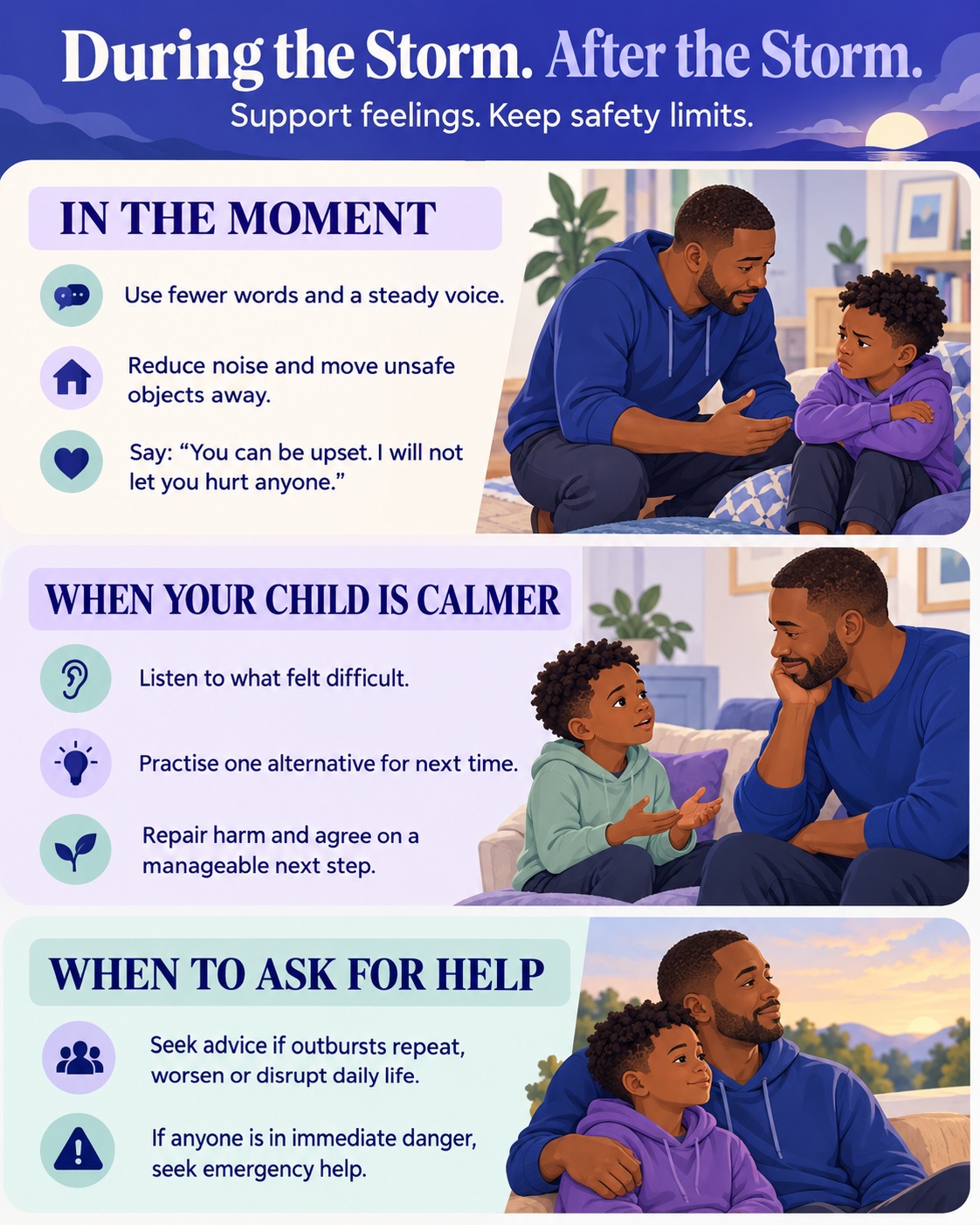
Make safety the first priority. Reduce competing noise where possible, move unsafe objects out of reach and give other children space. Use a steady voice and short sentences. Avoid crowding a child who wants space, while maintaining supervision appropriate to their age and safety needs.
The American Academy of Pediatrics’ guidance on children’s stress responses describes an approach of helping a child settle, connecting with their emotions and then reasoning together. A lengthy explanation may be poorly timed when your child is overwhelmed.
An illustrative response is:
“This feels really hard. You can be upset. I will not let you hurt anyone. We can talk when things feel calmer.”
You do not need to find a perfect sentence. If talking increases distress, say less. Offer closeness if welcome; avoid insisting on a hug or demanding eye contact.
For children aged roughly three to eight, Raising Children Network’s calming guidance recommends noticing the emotion, naming it, pausing, offering support and addressing the issue afterwards. Adapt your response to your child rather than treating these as a script that must work immediately.
Does understanding the emotion mean allowing hurtful behaviour?
No. You can acknowledge distress and maintain a safety boundary at the same time. The feeling deserves attention; hitting, threats or damage still need a response.
Separate the immediate safety limit from the later conversation. During an outburst: “I’m moving your brother away so everyone is safe.” Afterwards: “You were very upset. Throwing the toy hurt him. Let’s work out what you can do next time and how we can put this right.”
The NHS advice on talking about feelings recognises that an angry child may not listen straight away and may need space before a conversation. Postponing that conversation is different from abandoning it.
If you shouted too, repair your part: “I raised my voice. I’m sorry. Next time I’ll pause before speaking.” Keep the focus on practising a safer response rather than assigning a character label such as “naughty” or “dramatic.”
What should we talk about once our child is calmer?
Make the discussion brief and specific. Ask about one moment rather than the entire afternoon: “What was hardest when we got home?” Some children may prefer drawing, writing or talking alongside an activity.
Invite a small experiment: “Tomorrow, should we put your bag away before your sibling joins us?” Agree how your child can ask for a pause and what the adult will do when they ask.
Notice attempts, including imperfect ones: “You told me you needed space before you shouted.” The aim is to build usable skills and understand obstacles, rather than expecting a child never to feel upset.
What if screens or homework are part of the argument?
Consider the specific transition. Does distress begin when a screen is offered, when it is stopped or when a difficult task replaces it?
The American Academy of Pediatrics’ screen-time guidance recommends planning limits ahead and recognising that tiredness, hunger and stress can make transitions harder. Decide the arrangement in advance rather than negotiating a new rule during every outburst.
For homework, note whether the difficulty involves starting, reading instructions, writing or understanding the work. Ask the teacher what independent completion should look like and what support is appropriate. Avoid assuming either laziness or a learning disorder from the argument alone.
CALM’s guide to signs that a psychoeducational assessment may be useful covers persistent learning concerns. An after-school outburst by itself does not establish a need for comprehensive testing.
How can we work with the school when teachers see no problem?
Bring observations that can be compared, rather than asking the school to confirm a label. For example: “On three afternoons this week, tears began when reading started. Could we compare what reading looks like in class and at home?”
Useful meeting questions include:
- When does our child seem comfortable, and when do they need more support?
- What happens at lunch, break and transitions?
- Is the difficulty linked to particular work, people or days?
- What adjustment can we try, who will coordinate it and when will we review it?
If your child reports bullying, take the concern seriously and use the school’s safeguarding or anti-bullying process. NHS guidance on bullying recommends a calm, private conversation and agreeing next steps with the young person. Safety concerns should not be treated only as a need for better coping skills.
For international-school families, include relevant changes such as a new language of instruction, curriculum or transport routine. These are contextual questions, not assumptions about every internationally mobile child.
When do after-school meltdowns need professional support?
Seek advice when outbursts recur, intensify, cause substantial distress or interfere with ordinary family life. Consider how your child is between episodes, whether enjoyable activities are being lost and whether sleep, eating or school participation has changed.
AACAP’s guide to tantrums and outbursts notes that recurrent or severe tantrums in school-age children warrant help. Age and development matter; there is no single frequency or duration rule that parents should use to diagnose a child.
Ask a family doctor or paediatrician about pain, illness, sleep or other medical concerns. A suitably qualified mental health professional can explore emotional and behavioural difficulties. NHS guidance on childhood anxiety includes irritability and outbursts among possible signs, alongside other experiences. Those behaviours alone do not prove anxiety, ADHD or autism.
For immediate danger, serious injury or a situation in which you cannot keep someone safe, contact local emergency services or attend an emergency department. Do not wait for a routine enquiry response.
What information should we bring to an appointment?
Bring a few representative examples: what happened just before the outburst, what your child did or said, how adults responded and what happened afterwards. Include approximate timing, relevant school feedback and occasions when the same transition went more smoothly.
For example: “Tuesday: difficult pickup after a late activity; shouting began when the bag was unpacked; quieter company helped; reading remained difficult later.” This records a sequence without claiming to know its cause.
You do not need a complete diary before asking for help. AACAP’s help-seeking guidance supports considering professional advice when emotional or behavioural concerns persist or adults involved in the child’s life are concerned.
Frequently asked questions
Are after-school meltdowns always a sign of anxiety or ADHD?
No. Timing alone does not identify a cause. Consider everyday needs, context, development and the wider pattern before drawing conclusions.
Should I ask about school as soon as my child gets home?
Offer connection without requiring an immediate report. Let your child know you will listen when they are ready, and choose a quieter time if pickup questions repeatedly lead to distress.
Can older children and teenagers need help calming down too?
Yes. Give age-appropriate privacy and involve them in decisions. Raising Children Network’s guidance for pre-teens and teenagers recommends support during strong emotions and problem-solving afterwards.
Do we need a diagnosis before asking for support?
No. Describe what is happening and ask which initial consultation is suitable. The next step might involve practical changes, therapy, medical advice or a more focused evaluation.
Discuss your child’s after-school difficulties with CALM International
If afternoons have become a repeated struggle, CALM International offers Child & Adolescent Therapy, Family Therapy and School Wellness services.
Share your child’s age, location, what happens after school and any teacher or medical feedback. Ask which professional may be suitable, whether caregiver involvement would help and how coordination with the school could work in your circumstances.
Make an enquiry with CALM International to discuss a suitable next step for your child.
Sources
- Raising Children Network. Self-regulation in children and teenagers.
- NHS. Helping your child with anger issues.
- Raising Children Network. School-age behaviour: what to expect and how to respond.
- Raising Children Network. Routines for families.
- American Academy of Pediatrics / HealthyChildren.org. Why Kids Act Out: Tips to Help Your Child Cope With Stress.
- Raising Children Network. Helping children calm down: 3–8 years.
- NHS. Talking to your child about feelings.
- American Academy of Pediatrics / HealthyChildren.org. Screen Time & Temper Tantrums: Helpful Tips for Parents.
- Central and North West London NHS Foundation Trust. Bullying.
- American Academy of Child and Adolescent Psychiatry. Temper Tantrums and Outbursts.
- NHS. Anxiety disorders in children.
- American Academy of Child and Adolescent Psychiatry. When To Seek Help For Your Child.
- Raising Children Network. Helping pre-teens and teenagers calm down.
- CALM International. Child & Adolescent Therapy; Family Therapy; School Wellness; Signs Your Child Needs a Psychoeducational Assessment.