
Selective mutism is an anxiety disorder in which a child can speak in some situations but is unable to speak in others. A child who talks freely at home may find speaking to a teacher or classmate impossible. Persistent difficulty that affects participation, relationships or basic needs deserves assessment. Pressure, punishment and demands to “just say it” are not a solution.
Your child describes imaginary adventures at the dinner table. Yet their teacher has barely heard their voice. Perhaps you assumed they needed time to settle, or wondered whether they were being unusually shy.
The contrast is worth understanding without blaming the child, family or school. You do not need to arrive with a diagnosis before asking for help.
What is selective mutism, and does “selective” mean a choice?
No. The NHS overview of selective mutism explains that the child is unable to speak in particular social situations rather than deliberately refusing. The expectation of speaking can trigger intense anxiety and a frozen response.
This can be difficult for adults to reconcile with fluent speech elsewhere. “But I heard you talking yesterday” does not address the barrier in this situation.
Imagine knowing an answer but being unable to get your voice out when attention turns towards you. That illustration is not every child’s experience, but it can help adults replace assumptions about rudeness with curiosity about the difficulty.
How is selective mutism different from shyness or settling into school?
A quiet start in a new setting does not establish selective mutism. The important questions concern the pattern, persistence and impact, not how outgoing a child seems compared with classmates.
Alder Hey Children’s Hospital’s guidance distinguishes selective mutism from ordinary shyness or stubbornness. Children may look frozen when addressed, struggle with greetings or registration, or speak only to particular familiar people.
| Question to explore | What it helps you understand |
|---|---|
| Does speaking become easier with familiarity? | How the child is adapting, without assuming a timetable every child must follow. |
| Is the difficulty predictable with particular people or places? | Whether there is a repeatable pattern rather than one quiet afternoon. |
| Can the child communicate needs and participate? | The practical impact, even when behaviour is quiet and compliant. |
| What languages and communication skills are involved? | Whether language knowledge or another communication need requires consideration. |
This table is a conversation guide, not a diagnostic test. Ask for advice if you are concerned rather than using a duration threshold to decide whether your child deserves support. A clinician can consider settling-in alongside the wider history.
Can a child whisper, gesture or speak to one friend and still need help?
Yes. The difficulty is not necessarily total silence in every school interaction. The Royal College of Speech and Language Therapists describes children who manage a little speech or whispering, alongside children who find written or gestured communication difficult too.
Do not assume that an occasional word means the problem has disappeared. Equally, do not assume that pointing or writing will always be available when a child is anxious.
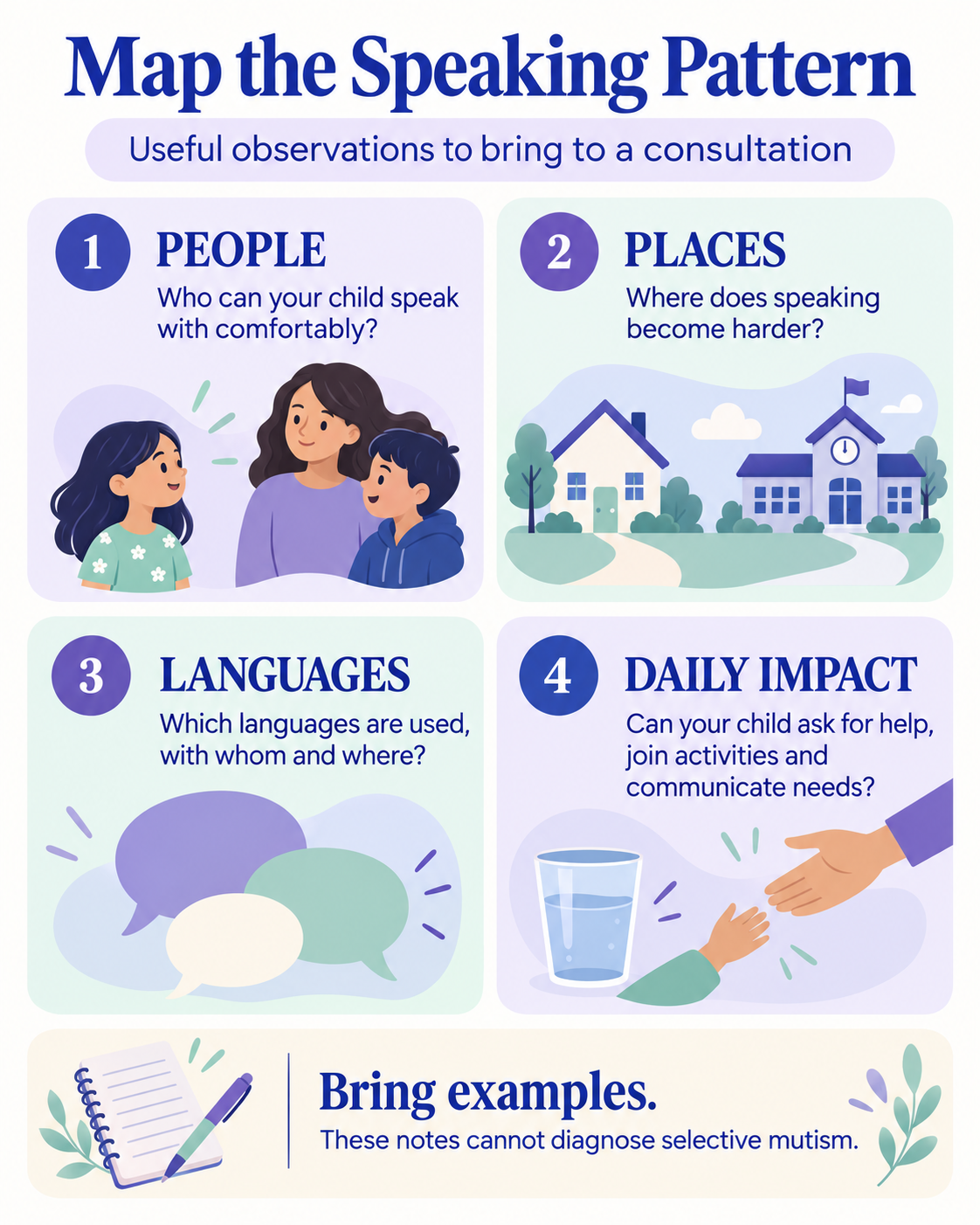
Useful observations might be: “They talk to one friend outdoors but not when an adult joins,” or “They can point to a picture in a quiet room, but become still during whole-class questions.” These examples describe what happens without assigning a cause.
Why does a quiet classroom presentation still deserve attention?
The issue is access to everyday life, not simply the volume of speech. Children and Family Health Devon’s guidance describes difficulties asking for help, getting a drink, using the toilet or explaining that the child feels unwell. Some children cannot answer questions despite knowing the answer.
Ask about the school day beyond reports of good behaviour. Can your child get adult attention when necessary? Join a preferred activity? Communicate pain or confusion?
For example, a useful school question is: “If our child needed the toilet during a lesson, what could they do, and how would the adult notice?” A clear answer matters more than reassurance that the child never causes disruption.
How should bilingual or internationally mobile children be assessed?
Learning a new language can include a quieter period. Silence in a language a child does not yet know well must not automatically be labelled selective mutism.
The American Speech-Language-Hearing Association’s clinical guidance recommends considering multilingual development and asking how the child uses their languages with different people and in different settings. The question includes whether the home language is used comfortably outside the home, not only whether the child speaks English in class.
Prepare a simple account of languages used at home, previous schooling and recent changes. An illustrative note might be: “Comfortable speaking Mandarin with cousins at home; quiet with unfamiliar Mandarin-speaking adults; still developing English classroom vocabulary.” That description leaves room for several explanations.
Ask how the assessor will work across languages and whether an appropriately qualified interpreter or language professional is needed. There is no reason to abandon a home language based on this article.
For the separate question of language learning and academic difficulties, see CALM’s EAL or learning difference guide.
Who can assess selective mutism in children?
Assessment may involve a speech and language therapist or speech-language pathologist, a psychologist or psychiatrist, a medical professional and school staff, depending on the child’s needs and local arrangements.
The Communication Health Support Association’s parent information, linked from ASHA, describes considering hearing, language understanding, speech and communication patterns. A child may not speak at the appointment. The professional may seek observations or recordings from a comfortable setting instead.
Ask the provider before attending:
- What experience do you have assessing children with this pattern?
- How will you gather information if my child cannot speak with you?
- What teacher input and language history would be useful?
- Which other professionals might need to be involved?
Agree how any recording will be obtained, stored and shared. Avoid secretly filming your child or staging a speaking performance to prove their ability.
Does this automatically mean autism, trauma or a learning difficulty?
No. One communication pattern cannot establish those explanations. The wider developmental, medical and emotional picture needs professional consideration.
Devon’s selective mutism guidance notes that selective mutism and autism can coexist, and cautions against automatically assuming trauma. A new or sudden change in communication, especially alongside illness, injury, regression or a distressing event, should be discussed promptly with a medical professional.
Do not make comprehensive learning testing the automatic starting point solely because a child is quiet. Ask what question an assessment needs to answer and what information would change the support plan.
How can parents respond without increasing speaking pressure?
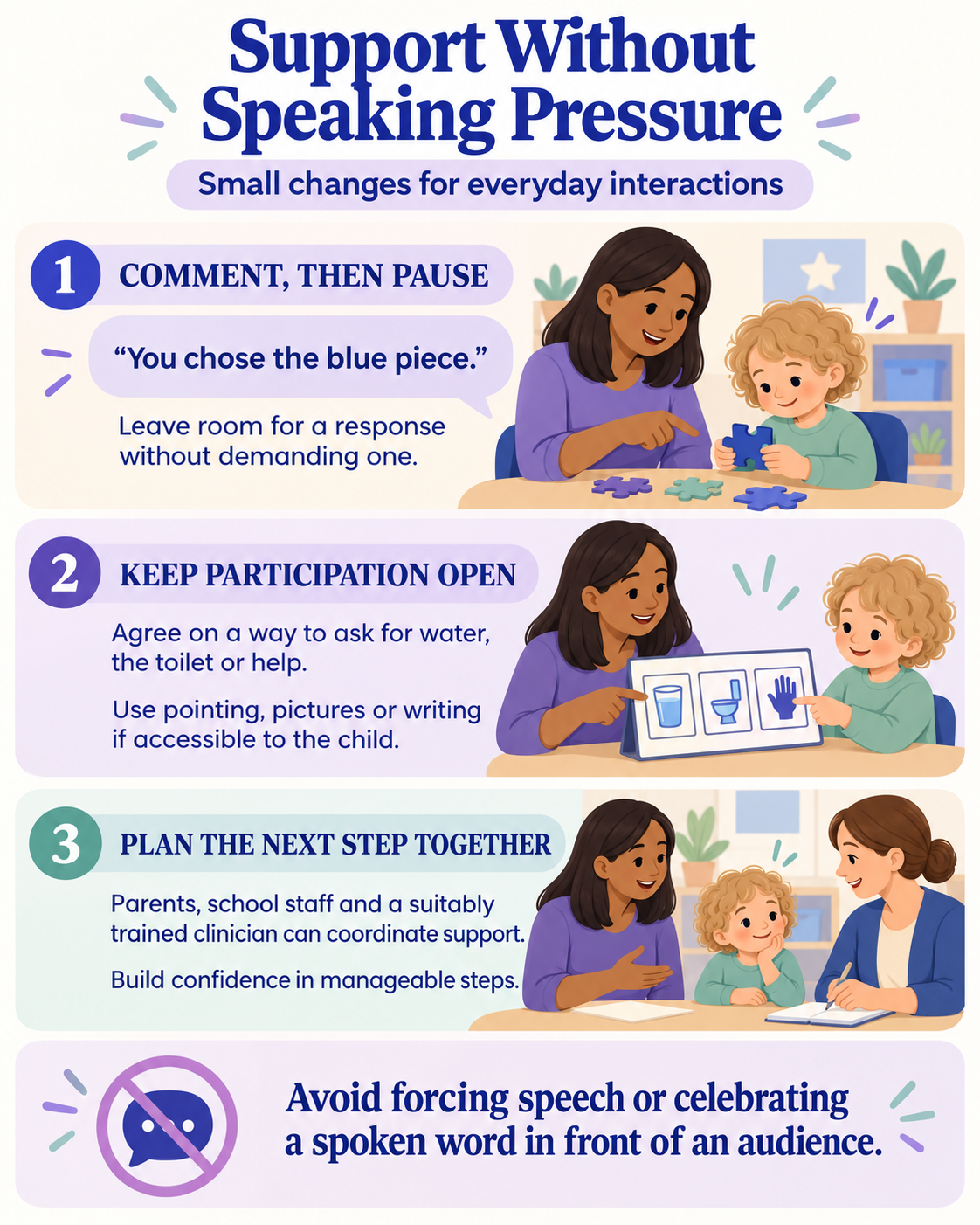
Cambridgeshire’s NHS speech and language guidance suggests reducing pressure, commenting rather than asking many questions, and looking at a shared object rather than demanding direct eye contact.
During a puzzle, “You found the blue piece” leaves room for interaction without turning the moment into a test. “Tell me what colour it is. You know this” can make the expectation much more noticeable.
Tell relatives what would help before a visit: “Please include them in the activity without asking them to perform a greeting. We’re getting advice about making communication easier.” This is an illustrative explanation; use language that fits your child’s understanding and privacy preferences.
Keep warmth and interest available. Reducing pressure does not mean ignoring your child or assuming they have nothing to contribute.
Should we answer for our child or insist that they try?
Neither a blanket demand nor a blanket promise to handle every interaction gives you an individual plan. Begin by protecting access to needs and participation, then seek guidance on building communication gradually.
Leeds Community Healthcare’s advice supports alternative communication and warns against pressure, bribery and negative labels. It recommends responding naturally when a child uses their voice.
If a shop assistant asks a question and your child freezes, reduce the spotlight. You might say, “We’re choosing together,” and continue the interaction calmly. Later, discuss with the treating professional how similar situations could become manageable practice opportunities.
The aim is a supported route towards communication, not an indefinite rule that the child must never face a speaking situation. The timing and size of those steps should suit the child.
What should the school put in place now?
Kent Community Health NHS Foundation Trust’s leaflet, updated in September 2026, emphasises a plan for accessing the toilet and first aid. It also notes that positive attention can increase anxiety.
Agree practical arrangements with your child, relevant staff and, where involved, the clinician. Questions for a meeting include:
- Who is the child’s familiar contact, and who covers absences?
- What accessible signal can they use for water, the toilet, pain or help?
- How can they join learning without surprise speaking demands?
- What will staff do if the agreed signal is difficult to use?
- Who coordinates the plan, and when will everyone review it?
Give substitute teachers the relevant information. Discuss privacy with your child in an age-appropriate way; a public class announcement about their difficulty may create unwanted attention.
Written work, drawing or pointing may help show understanding when accessible. Ask how the school will distinguish subject knowledge from the ability to give an oral answer. Any formal assessment arrangements require the school’s own process.
What treatment approaches might be discussed?
The NHS treatment overview describes reducing speaking-related anxiety and using gradual behavioural approaches, including graded exposure. Treatment may involve parents and school staff alongside professionals.
A plan might adjust the audience, place or task in manageable steps rather than beginning with a whole-class presentation. The treating professional should explain the purpose, how your child will be supported and what to do if a step is too difficult.
Shropshire Community Health’s guidance also emphasises a supportive school environment and preparation for changes. Consistency across adults matters; a carefully planned session can be undermined by a surprise demand elsewhere.
Ask how progress will be reviewed across real situations, rather than counting a single spoken word as success or failure. Medication questions, if relevant, require assessment by an appropriate medical prescriber; they cannot be answered from a newsletter.
What should we bring to the first consultation?
Make brief notes about people, places, languages and practical impact. Include settings where your child communicates comfortably, what happens when the audience changes, and previous support.
An example is: “Talks with a friend during quiet play; stops when the teacher approaches; can point to a water card on some days; has not asked for help during lessons.” Add your child’s perspective if they can share it comfortably.
You do not need a complete diary. Explain what you hope the consultation will clarify: understanding the pattern, arranging the right assessment or agreeing school support. Ask for a written summary of next steps and responsibilities.
CALM’s child psychologist versus school counsellor guide explains the broader question of coordinating school and external support.
Frequently asked questions
Can selective mutism affect a child who is outgoing at home?
Yes. Speaking comfortably with familiar people does not rule out difficulty elsewhere. The contrast across situations is part of what professionals explore.
Should I make a big celebration when my child speaks at school?
Avoid turning the moment into a public event. Respond naturally and ask the treating professional how your child prefers progress to be acknowledged.
Can older children need help too?
Yes. Difficulties can continue beyond the early years. Involve older children in choices about privacy, goals and communication support rather than assuming they should have outgrown the problem.
Do we need a diagnosis before speaking to CALM?
No. Describe the concern and ask whether a clinician with suitable experience is available, what initial consultation is appropriate and whether another service is needed.
Discuss your child’s communication difficulties with CALM International
CALM International offers Child & Adolescent Therapy and School Wellness services.
Share your child’s age, location, languages, where they can speak comfortably and what becomes difficult at school. Ask whether suitable selective mutism assessment or treatment expertise is available, and whether referral to a speech and language therapist or another specialist is appropriate. Confirm the clinician’s experience and the arrangements for working with your child’s school before booking.
Make an enquiry with CALM International to discuss a suitable next step for your child.
Sources
Sources checked on 2 November 2026. International guidance informs general information; school procedures and referral routes vary by country. The conversation examples, table and meeting questions are illustrative and cannot diagnose a child.
- NHS. Selective mutism.
- Alder Hey Children’s Hospital. What is Selective Mutism?.
- Royal College of Speech and Language Therapists. Selective mutism.
- Children and Family Health Devon. Our guide to selective mutism.
- American Speech-Language-Hearing Association. Selective Mutism: Practice Portal.
- Communication Health Support Association, linked from ASHA. Selective Mutism. Reviewed 1 May 2026.
- Cambridgeshire and Peterborough Children’s Health. Selective mutism.
- Leeds Community Healthcare. Selective mutism.
- Kent Community Health NHS Foundation Trust. Selective mutism. Updated 15 September 2026.
- Shropshire Community Health. Selective Mutism.
- CALM International. Child & Adolescent Therapy; School Wellness; EAL or Learning Difference; Child Psychologist vs School Counsellor.