Most parents notice something before they fully understand what they are seeing. Their child is clearly bright, curious, thoughtful, and capable in many situations, yet school results tell a different story. Homework that should take thirty minutes stretches into three hours. Reading becomes a battle. Emotional meltdowns happen over seemingly manageable assignments. Teachers repeatedly mention “inconsistent effort,” “careless mistakes,” or “not working to potential.”
At first, many parents assume the issue is motivation, discipline, screen time, or poor study habits. Sometimes those factors do play a role. But sometimes the problem is not effort at all. Sometimes a child’s brain is processing information differently in ways that have not yet been properly identified.
This is often the point where parents begin wondering whether a psychoeducational assessment might help.
A psychoeducational assessment is a comprehensive evaluation conducted by a qualified psychologist. It examines how a child thinks, learns, remembers, processes information, and functions academically. It helps identify underlying learning difficulties, attention-related conditions, cognitive processing challenges, or neurodevelopmental differences that may be affecting school performance and emotional wellbeing.
For families where children face multiple pressures at once, assessments can be especially valuable. This includes children who are balancing:
- High academic expectations
- Multilingual learning environments
- Relocation and transition stress
- Changing curricula
- Social adaptation across cultures
All of these factors can make it harder to distinguish between ordinary adjustment difficulties and a genuine learning-related concern.
This guide explains the most common signs your child may need a psychoeducational assessment, what these signs can mean, and when it is worth speaking to a clinician.
It is partly a diagnostic tool, but only in the hands of a qualified psychologist, who is trained to interpret the results and diagnose a learning difficulty or neurodevelopmental condition. However, it is also a good and practical starting point for parents who feel that something is off and want clarity about what to do next.
What Is a Psychoeducational Assessment?
Before looking at the signs, it helps to understand what a psychoeducational assessment actually does.
A psychoeducational assessment is not an intelligence test, and it is not a pass-or-fail exercise. The goal is not to label a child, although if diagnoses are present, they should be highlighted. The goal is to understand how a child learns and why certain tasks may feel disproportionately difficult despite effort and ability.
The assessment evaluates areas such as:
- Verbal reasoning
- Non-verbal reasoning
- Working memory
- Processing speed
- Fluid Intelligence
- Reading fluency and comprehension
- Writing skills
- Mathematical reasoning
- Attention and executive functioning
- Social, emotional and behavioural functioning where relevant
The findings help determine whether a child may have any developmental challenges, including but not limited to dyslexia, dyscalculia, dyspraxia, ADHD, autism spectrum-related differences, executive functioning difficulties, processing speed challenges, specific learning disorders, or a unique cognitive profile affecting learning.
Importantly, the assessment also provides practical recommendations for support at school and home. These include accommodations, learning strategies, classroom adjustments, and intervention planning.
The Most Common Signs Your Child May Need a Psychoeducational Assessment
1. Teacher Comments Keep Repeating Every Year
One isolated teacher comment is usually not a major concern.
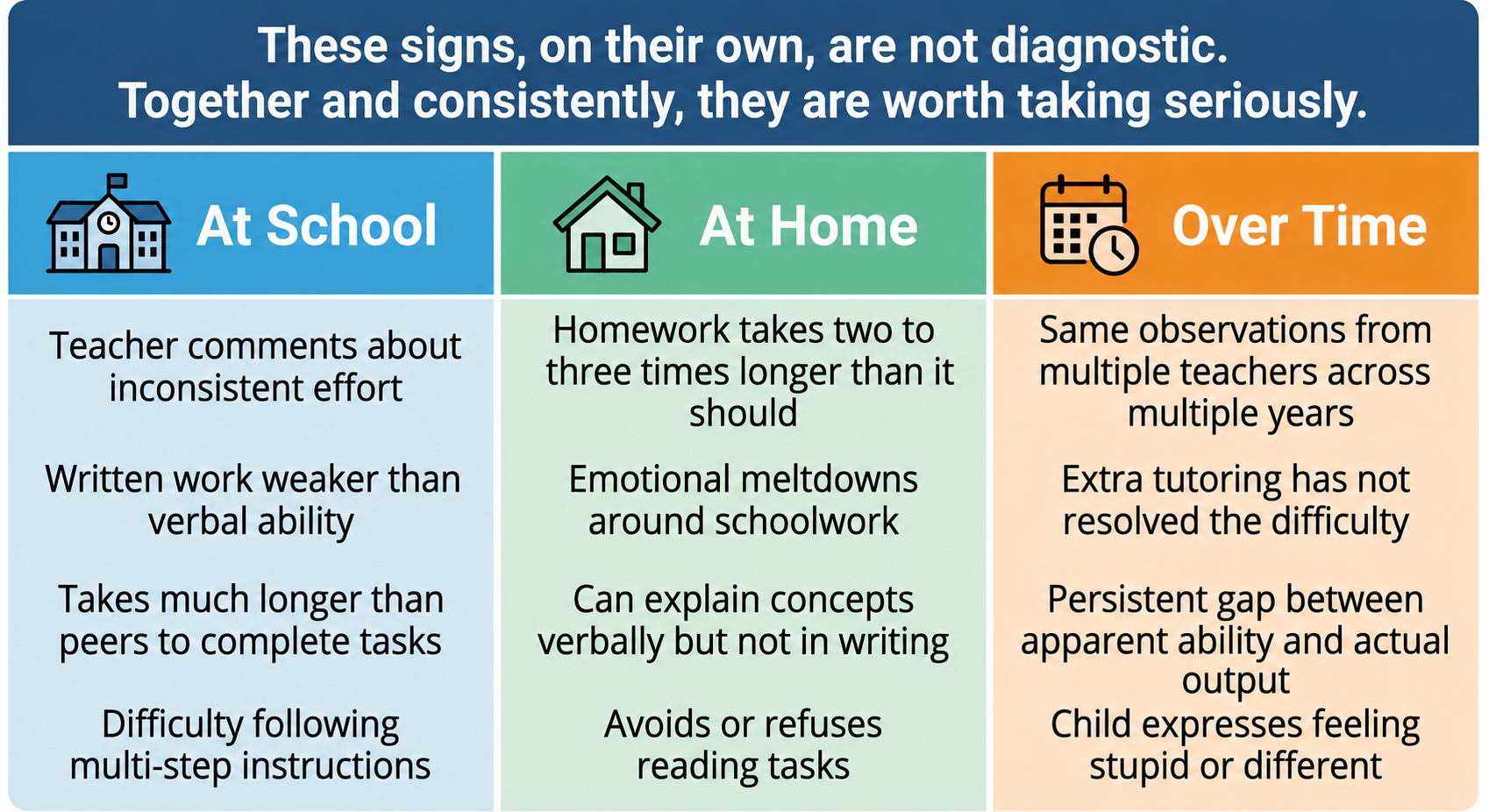
What matters more is repetition across multiple teachers, multiple subjects, and multiple school years.
Pay attention when teacher reports consistently include comments such as:
- “Not working to potential” or “capable of much more”
- “Inconsistent effort” or “frequently distracted”
- “Difficulty staying organised” or “loses track of tasks”
- “Takes longer than peers to complete work”
- “Written work does not reflect verbal ability”
- “Difficulty following instructions”
When the same themes appear repeatedly over time, they often suggest an underlying pattern rather than a temporary issue. Psychoeducational assessments are specifically designed to identify these patterns and determine what may be causing them.
2. Homework Takes Excessively Long Every Day
All children struggle with homework sometimes. The concern is when it consistently becomes exhausting, emotionally overwhelming, or disproportionately time-consuming despite support.
Some common examples:
- A child who understands concepts verbally but cannot organise thoughts in writing
- A child who reads aloud fluently but struggles to explain what they read
- A child who repeatedly loses track of instructions midway through tasks
- A child who requires constant prompting to stay focused
- A child who spends hours completing assignments that peers finish quickly
For many children with unidentified learning difficulties, the issue is not understanding the material. The issue is the mental effort required to process, organise, retrieve, and communicate information. This distinction matters enormously.
3. Your Child Seems Intelligent, But Their School Performance Does Not Match
This is one of the strongest and most common signs.
Parents often describe children who ask insightful questions, have sophisticated vocabulary, show strong creativity, demonstrate deep understanding in conversation, and excel in specific interests. Yet academically, their grades or classroom performance remain inconsistent or unexpectedly weak.
For example: a child may passionately explain scientific concepts at home but struggle to write coherent answers during exams. Another may understand maths verbally but repeatedly make calculation errors on paper.
This gap between apparent ability and actual output is sometimes called an ability-achievement discrepancy. It often signals that something is interfering with the child’s ability to demonstrate what they truly know.
4. Emotional Reactions to Schoolwork Feel Disproportionate
Children with unidentified learning difficulties often spend years feeling confused about why school feels harder for them than it seems to for others.
Over time, this can lead to frustration, anxiety, avoidance, emotional shutdown, low self-esteem, and school refusal.
Parents may notice:
- Regular crying over homework
- Stomach aches or headaches before school
- Emotional meltdowns after school
- Strong resistance to reading or writing tasks
- Statements such as “I’m stupid” or “I can’t do anything right”
These emotional responses are important signals. A child who is constantly working significantly harder than peers while receiving similar or worse results can become emotionally exhausted very quickly. The emotional impact of unidentified learning difficulties is often just as significant as the academic impact.
5. Extra Help Is Not Solving the Problem
Many children improve with tutoring, extra practice, or better routines. The concern is when difficulties persist despite sustained effort and support.
Some examples:
- Reading remains slow and effortful beyond expected developmental stages
- Spelling difficulties remain severe despite regular practice
- Written expression stays significantly weaker than verbal communication
- Maths difficulties persist despite repetition and tutoring
- Instructions need constant repeating
- Organisational problems continue despite reminders and systems
When support improves effort but not outcomes, it may indicate that the underlying issue has not yet been properly identified.
6. Attention and Focus Difficulties Affect Daily Functioning
Attention difficulties do not always look like hyperactivity.
Some children with ADHD are disruptive and impulsive. Others appear quiet, compliant, and daydreamy, especially girls with inattentive ADHD presentations.
Parents and teachers may notice:
- Difficulty sustaining attention
- Forgetting instructions quickly
- Unfinished work and careless mistakes
- Losing items constantly or lacking organizational skills in various domains
- Zoning out during lessons
- Appearing to listen but not retaining information
- Difficulty transitioning between tasks or environments
Children are often mislabelled as lazy, careless, or disorganised when the actual issue is impaired attention regulation. A psychoeducational assessment can help clarify whether attention difficulties are contributing to academic struggles.
7. Social Difficulties Feel Different From Ordinary Shyness
Some children struggle socially in ways that go beyond introversion. They may misunderstand social cues, struggle with reciprocal conversation, find peer interaction confusing, prefer rigid routines, or appear socially immature compared to peers.
In diverse or transitional environments, these patterns can sometimes be mistaken for cultural adjustment or relocation stress. An assessment helps determine whether the difficulties are primarily adjustment-related, anxiety-related, or connected to broader social communication differences.
Parent Checklist: Should I Consider a Psychoeducational Assessment?
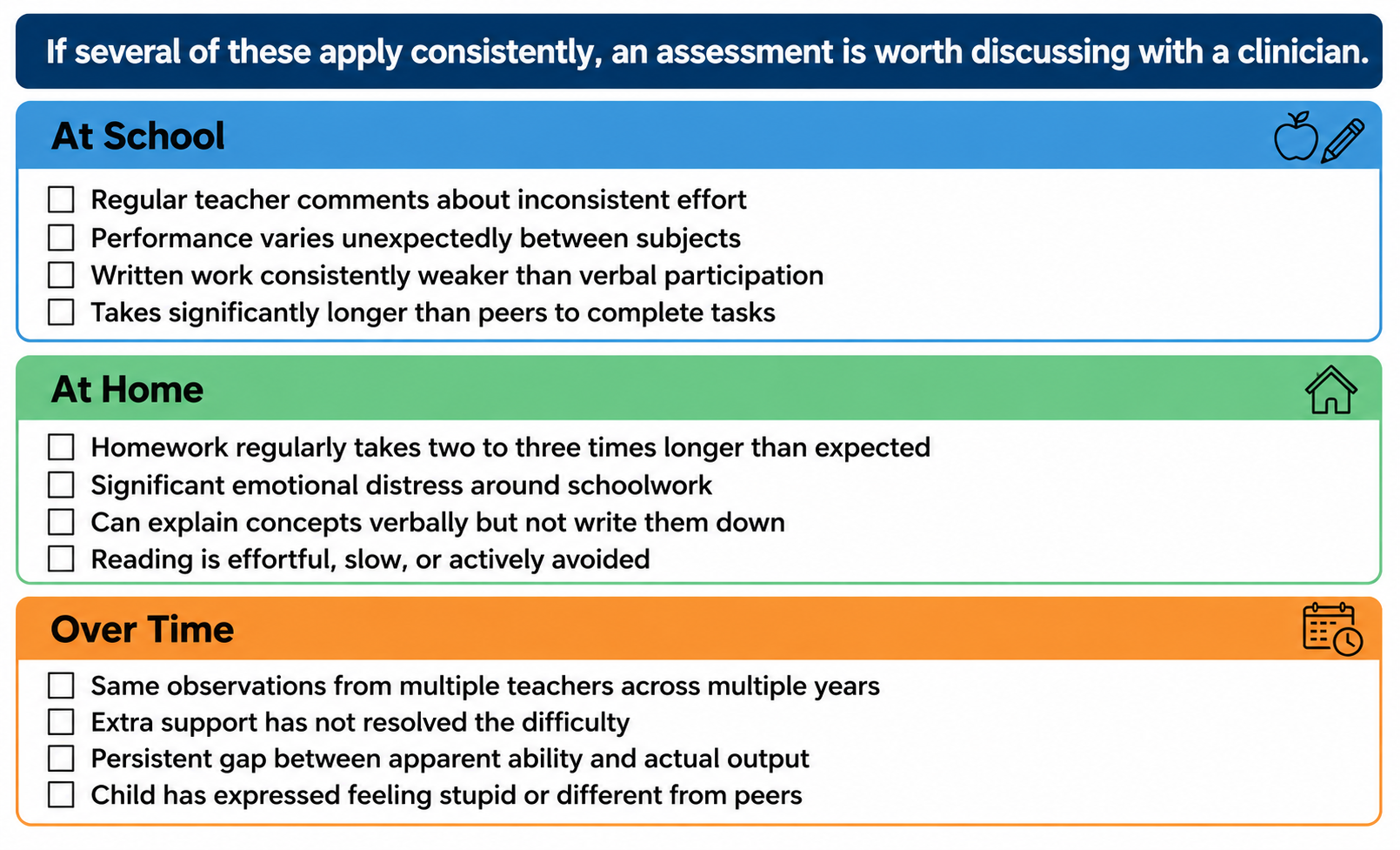
If several of these apply consistently over time, it is worth discussing an assessment with a clinician.
At School
- Teacher comments about inconsistent effort appear regularly
- Written work is much weaker than verbal participation
- Performance varies unpredictably between subjects
- Difficulty following multi-step instructions
- Tasks take significantly longer than peers
At Home
- Homework takes two to three times longer than expected
- Emotional distress around schoolwork is frequent
- Your child understands concepts verbally but struggles to write them down
- Reading is slow, effortful, or avoided
- Organisation and task management are unusually difficult
Over Time
- The same concerns appear across multiple teachers and years
- Extra tutoring has not resolved the issue
- There is a persistent gap between ability and academic output
- Your child expresses feeling “stupid,” “different,” or incapable despite obvious strengths
What Happens If Difficulties Are Never Properly Identified?
This is one of the most important questions parents can ask.
Children do not simply grow out of many learning-related difficulties. Without understanding what is happening, they often continue working harder than peers for years while believing they are failing because they are lazy, careless, or unintelligent.
Over time, this can affect confidence, motivation, emotional wellbeing, academic identity, relationships with teachers and parents, and willingness to try new challenges.
By the time some children are finally assessed, the original learning difficulty is no longer the only issue. Years of frustration and misunderstanding may already have shaped how they see themselves, and impact on emerging personality.
Early identification changes this trajectory. Assessment is not about limiting a child with a label. It is about understanding them accurately so they can receive appropriate support and stop blaming themselves for struggles they cannot fully control.
Why Context Matters in Psychoeducational Assessment
Some children navigate multiple layers of complexity simultaneously. A child may be learning in a second or third language, adapting to a new curriculum, relocating frequently, adjusting socially across cultures, or experiencing disrupted educational continuity.
These factors can sometimes resemble learning difficulties or mask them entirely.
For example, a bilingual child struggling with reading comprehension may be experiencing normal language acquisition challenges, dyslexia, or both simultaneously. Distinguishing between these possibilities requires assessment by clinicians experienced in multilingual and internationally mobile populations.
At CALM International, our clinicians understand how educational transitions, language acquisition, cultural background, and school environment interact with learning and emotional wellbeing. We assess the full context, not just the presenting difficulty.
When Should Parents Seek Professional Advice?
Parents do not need to wait until school performance becomes severe before seeking guidance.
In many cases, the earlier concerns are identified, the easier it is to provide effective support before patterns of anxiety, avoidance, or low self-esteem become deeply established.
Consider speaking with a clinician if:
- Concerns have been present consistently over time
- Difficulties persist despite support
- School struggles are affecting emotional wellbeing
- Your child appears significantly more exhausted than peers
- There is a clear mismatch between intelligence and academic performance
Sometimes parents feel relieved simply from finally understanding what has been happening. Clarity changes the way parents, teachers, and children respond to struggle.