Many girls with inattentive ADHD are overlooked because they do not fit the common stereotype of ADHD. Rather than appearing hyperactive or disruptive, they may be quiet, compliant, and working incredibly hard to keep up. Understanding the signs of inattentive ADHD in girls can help parents and educators recognise children who may otherwise go unnoticed and unsupported.
When most people picture a child with ADHD, they picture a boy who cannot sit still — the one bouncing off the walls, blurting out answers, and constantly attracting attention.
That picture is not wrong. But it is incomplete.
What it leaves out are the children who have ADHD and are missed entirely, often for years, because they do not look like the stereotype. These are frequently the quiet ones: the daydreamer by the window, the conscientious girl whose report cards say “lovely to have in class,” or the child who is not disruptive, not failing outright, and therefore never triggers concern.
Meanwhile, they may be working twice as hard as their peers simply to keep up, gradually concluding that the problem must be them.
This article explores why inattentive ADHD is so often overlooked, particularly in girls and well-behaved children, what the condition actually looks like, and the signs worth paying attention to before another year goes by.
What Inattentive ADHD Looks Like
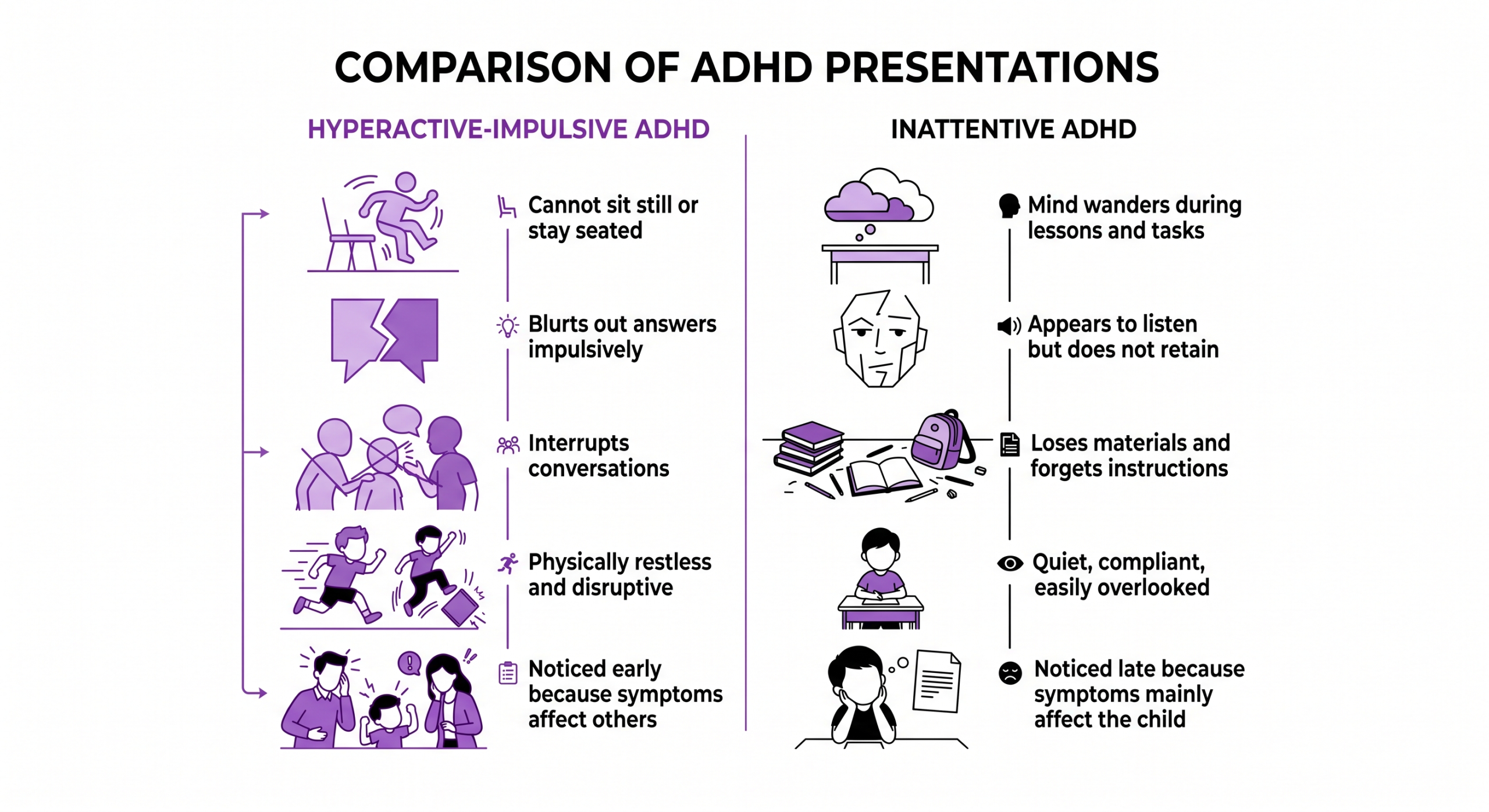
ADHD has more than one presentation. The hyperactive-impulsive type is the one most people recognise — visible restlessness, impulsivity, and difficulty staying seated. There is also a predominantly inattentive presentation, where hyperactivity is minimal or absent and the difficulties lie primarily within the child’s attention system. A third presentation combines features of both.
Inattentive ADHD does not announce itself.
Instead of the child who cannot stop moving, you may see the child whose mind cannot stay anchored. They lose track of instructions halfway through. They start tasks and drift away from them. They forget materials, misplace assignments, overlook important details, and struggle to sustain attention on mentally demanding work.
Their attention is not absent. Rather, it is difficult to regulate. It shifts away from the task at hand, settles on irrelevant details, or becomes difficult to sustain when effort is required.
As a result, activities that require prolonged concentration—such as reading, lengthy assignments, revision, or multi-step tasks—can be disproportionately exhausting.
The challenge is that these difficulties often remain invisible. A child quietly losing the thread of a lesson does not usually attract concern. They are not disrupting the class. They are simply slipping through the cracks.
Why Girls and Well-Behaved Children Are Often Overlooked
Two factors account for many missed ADHD diagnoses: presentation and compensation.
The first is straightforward. Inattentive ADHD is simply less visible than hyperactive ADHD. Many girls with ADHD present primarily with inattentive symptoms, which means there may be little to prompt a referral for assessment.
Teachers may describe them as:
- Quiet
- Dreamy
- Forgetful
- Disorganised
- Easily distracted
- Capable but inconsistent
While these observations may be accurate, they do not always capture the extent of the underlying difficulty.
The second factor is compensation.
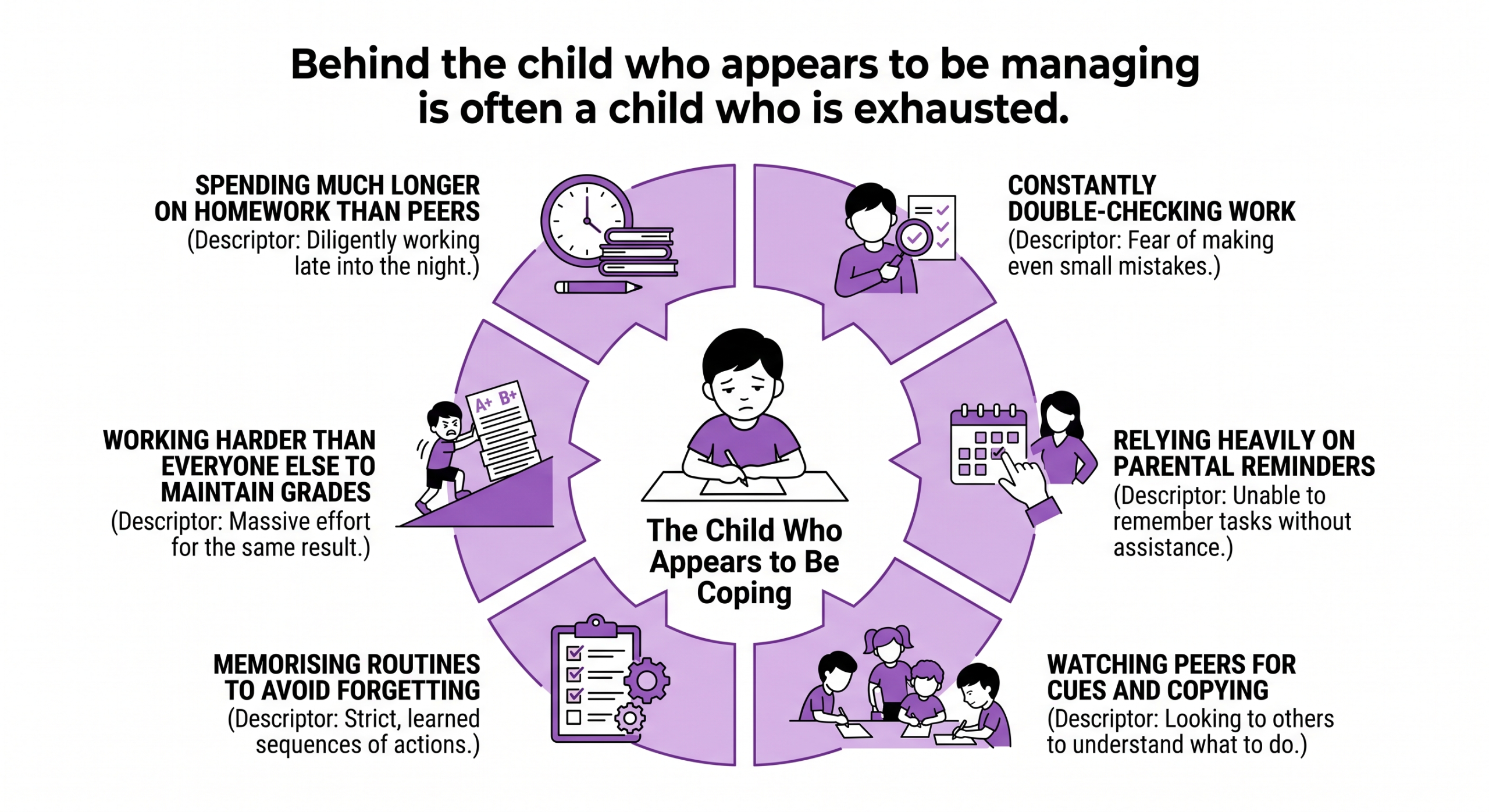
Many bright children develop strategies that help them conceal their struggles. They may appear organised, capable, and successful from the outside while investing significantly more effort than their peers behind the scenes.
Common compensatory strategies include:
- Spending much longer on homework than classmates
- Constantly double-checking work
- Relying heavily on reminders from parents
- Watching peers for cues and copying what they do
- Memorising routines to avoid forgetting tasks
- Working harder than everyone else to maintain acceptable grades
The result is a child who appears to be coping.
Their grades remain acceptable. Their behaviour remains good. Their difficulties remain largely invisible.
This is one reason many girls reach adolescence—or even adulthood—before anyone considers ADHD. They were never struggling visibly enough to be assessed. Instead, they were quietly working harder and harder to stay level until increasing academic demands eventually outpaced the strategies that had been holding everything together.
Understanding whether what you are seeing is ADHD or situational overwhelm from perfectionism or workload is not always straightforward. Read ADHD or Perfectionism? Differentiating ADHD from Situational Overwhelm in Children for a fuller picture.
Social expectations can also play a role. A quiet, compliant child often fits what adults expect from a well-behaved student, particularly a girl. As a result, the difficulties are frequently interpreted as personality traits rather than signs of something that deserves closer attention.
The Cost of a Late or Missed Diagnosis
It is tempting to assume that a child who appears to be managing is doing fine.
However, coping and thriving are not the same thing.
A child who is compensating constantly is paying for it somewhere. Often, the cost shows up emotionally long before it becomes obvious academically.
Over time, a missed diagnosis may contribute to:
- Anxiety
- Chronic stress
- Perfectionism
- Emotional exhaustion
- Reduced self-esteem
- Academic burnout
- A growing sense of inadequacy
Many children begin to develop an internal narrative that sounds something like:
“If I’m smart, why is this so difficult?”
“Everyone else seems to manage.”
“I must be lazy.”
“I must not be trying hard enough.”
Those beliefs can become deeply ingrained, particularly when children receive feedback that focuses on outcomes rather than effort.
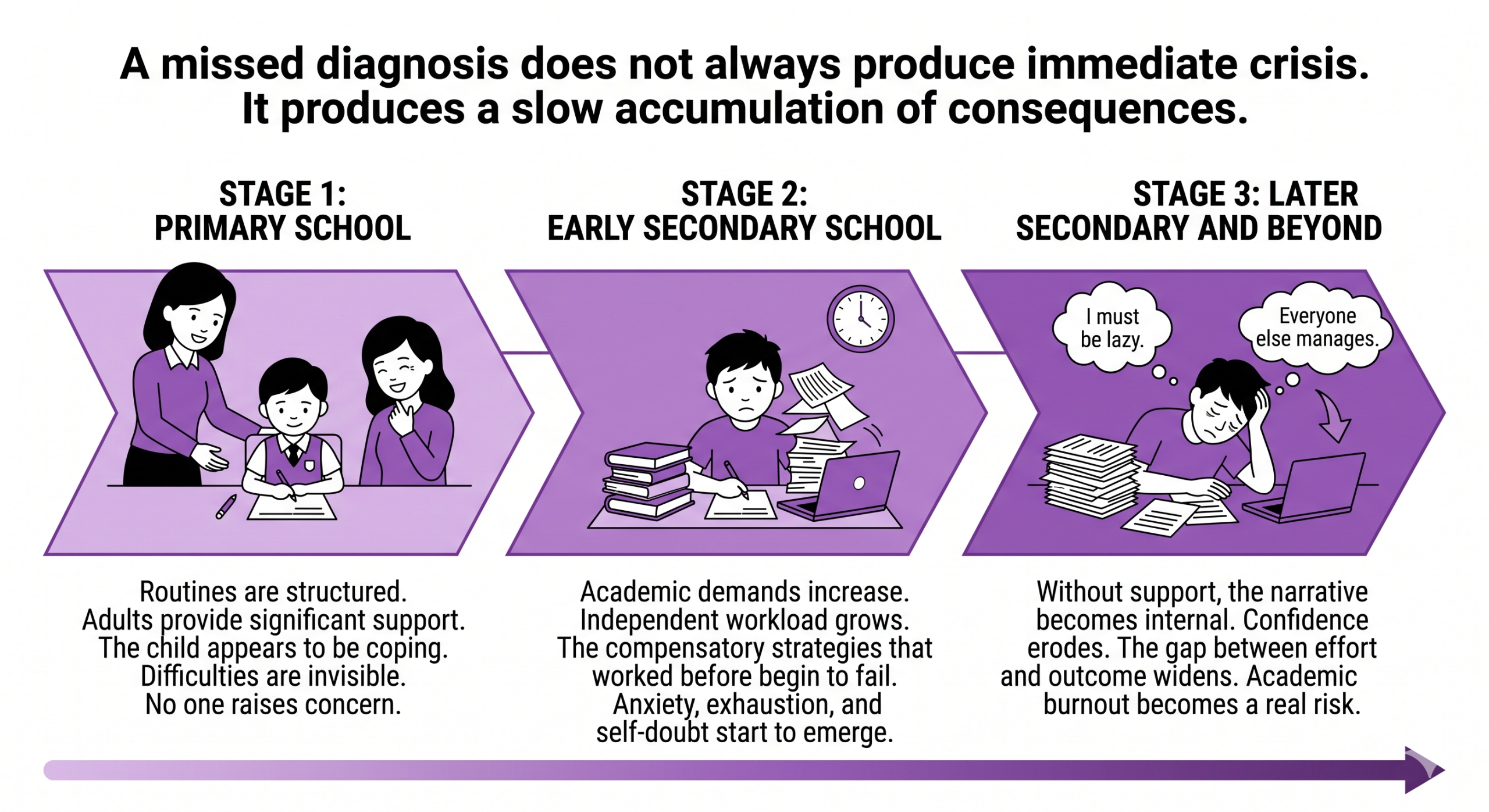
The academic consequences often emerge later. In primary school, routines are structured and adults provide significant support. As children move into secondary school, they are expected to manage multiple deadlines, organise their own workload, and work more independently.
Unfortunately, these are precisely the areas where ADHD-related difficulties often become most apparent.
A child who once appeared to be coping may suddenly begin to struggle. Because nobody recognised the ADHD, those struggles are often misinterpreted as a motivation problem at exactly the moment the child needs understanding the most.
The cost of a missed diagnosis is not necessarily dramatic failure. More often, it is years of unnecessary effort, eroded confidence, and support that never arrived because nobody realised it was needed. If you are starting to recognise this pattern in your child, read signs your child needs a psychoeducational assessment as a practical starting point.
Signs Worth Paying Attention To
None of these signs alone means a child has ADHD. However, a persistent pattern across settings and over time is worth taking seriously.
Some common signs of inattentive ADHD include:
- Drifting off during lessons, conversations, or tasks
- Appearing to listen but struggling to retain instructions
- Chronic disorganisation despite genuine effort
- Frequently losing materials, homework, or belongings
- Making careless mistakes on work they understand
- Taking much longer than peers to complete assignments
- Avoiding tasks that require sustained concentration
- Strong verbal understanding but inconsistent written output
- Holding it together at school but becoming emotionally overwhelmed at home
- Increasing frustration, discouragement, or self-doubt
One pattern parents often notice before teachers do is that the child seems perfectly fine at school but falls apart once they get home. Maintaining attention and self-control throughout the day requires considerable effort, and home becomes the place where that effort can finally stop.
What a Psychoeducational Assessment for ADHD Looks For
Because inattentive ADHD can resemble anxiety, learning difficulties, stress, or simple disorganisation, a comprehensive assessment is essential.
A clinician does not diagnose ADHD from a single test or a single conversation. Instead, they build a picture from multiple sources of information.
A comprehensive assessment may include:
- Developmental history
- Parent interviews
- Teacher feedback
- Standardised assessments
- Evaluation of attention and executive functioning skills
- Academic information
- Emotional and behavioural screening
A good assessment also actively considers alternative explanations. Anxiety can affect concentration. Learning differences can affect performance. Major life changes can affect attention and organisation.
The goal is not simply to determine whether ADHD is present. The goal is to understand why a child is struggling and what type of support is most likely to help.
At CALM International, our psychoeducational assessments evaluate attention, executive functioning, memory, processing speed, and academic achievement alongside emotional and behavioural functioning. For children who have been quietly compensating for years, this kind of comprehensive picture is often the first time anyone has looked at the full extent of what they are managing. Findings are presented in a clear report with specific recommendations for school and home, and our clinicians are available to liaise directly with schools to help translate those recommendations into practical support.
If you are a parent who recognises the patterns described in this article, a consultation is the right first step.
How Understanding Changes Things
One concern many parents have is that a diagnosis has come too late.
Fortunately, understanding does not have an expiration date.
For children who have spent years believing they are lazy, careless, or not trying hard enough, simply having an explanation can be profoundly relieving. It reframes the story from “something is wrong with me” to “my brain works differently, and there are ways to support it.”
Support may include:
- School accommodations
- Organisational strategies
- Executive functioning support
- Parent guidance
- Psychological intervention
- Additional treatment options discussed with a qualified professional
The specific recommendations vary from child to child, but the foundation is the same: understanding what is happening and responding appropriately.
Key Takeaways
- Inattentive ADHD often looks very different from the stereotype most people associate with ADHD.
- Many girls with ADHD are quiet, compliant, and academically capable, making their difficulties easier to miss.
- Children frequently develop compensatory strategies that hide the extent of their struggles.
- A missed diagnosis can contribute to anxiety, low self-esteem, and unnecessary academic stress.
- Early recognition allows children to access support before difficulties significantly affect confidence and wellbeing.
Final Thoughts
The children who get missed are not the ones who did not need help.
More often, they are the ones who needed it quietly.
Many girls with inattentive ADHD spend years appearing capable on the surface while privately struggling with organisation, concentration, and self-confidence. Their difficulties may not be obvious, but they are no less real.
Recognising those struggles early can change the trajectory of a child’s experience at school, at home, and in the way they understand themselves.
Sometimes the children who need the most understanding are the ones asking for it the least.