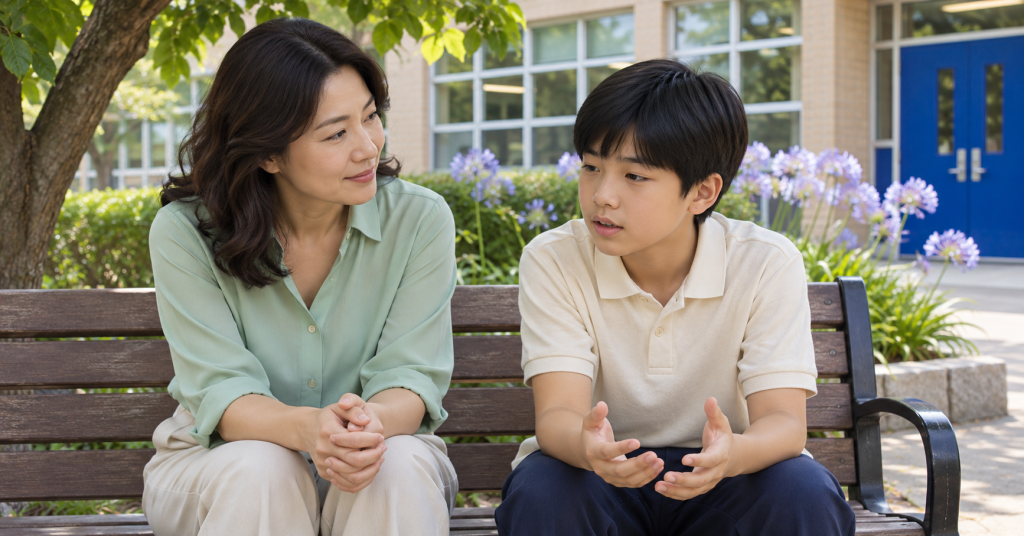
If you think your child is being bullied, start with a calm conversation, check their immediate safety and contact the appropriate school staff with specific examples. Bullying involves unwanted aggressive behaviour, a power imbalance and repetition or a likelihood of repetition. A single serious incident still needs action, even before anyone agrees on a label. Emotional support and practical protection should happen together.
Perhaps your child no longer wants to take the school bus. A friendship group has suddenly closed ranks, or your teenager becomes visibly tense whenever a group chat pings. You want to help without making the situation worse.
This guide explains what to explore, what to ask the school and when clinical support may help. It is general information; school procedures and reporting routes vary between countries and institutions.
What is bullying, and how is it different from friendship conflict?
StopBullying.gov’s definition includes unwanted aggression, a real or perceived imbalance of power, and repeated behaviour or the potential for repetition. Power can come from physical strength, popularity or access to embarrassing information. Deliberate exclusion and spreading rumours can be part of the pattern.
A disagreement between friends does not automatically establish bullying. Equally, calling something “drama” does not establish that the children have equal power or feel equally able to respond. Explore what happened and whether your child feels able to get away, disagree or ask for help safely.
| Situation to explore | Useful questions | What to avoid assuming |
|---|---|---|
| A friendship disagreement | Can both children disagree or step back without threats? | That every argument is bullying. |
| Repeated name-calling or humiliation | Who is involved, how often does it happen, and what happens if your child objects? | That it is harmless because someone calls it a joke. |
| Deliberate group exclusion | Is someone using the group to control, threaten or repeatedly isolate your child? | That all changes in friendship have the same explanation. |
| Online targeting | Is content being shared, repeated or used to intimidate? Is it linked to school relationships? | That behaviour outside the school gates has no school-day impact. |
These are discussion prompts, not a test. Children do not have to demonstrate a perfect definition before adults help with hurtful or unsafe behaviour.
What signs might suggest my child is being bullied?
The American Academy of Pediatrics’ parent guidance describes possible changes such as avoiding school, unexplained injuries, missing possessions, sleep difficulties or a sudden loss of friends. These can have other explanations, so they should open a conversation rather than settle the cause.
Look at changes from your child’s usual pattern. “They have always preferred a small friendship group” tells you something different from “They stopped sitting with anyone after the class trip.” A child may also keep attending school or maintain grades while struggling socially.
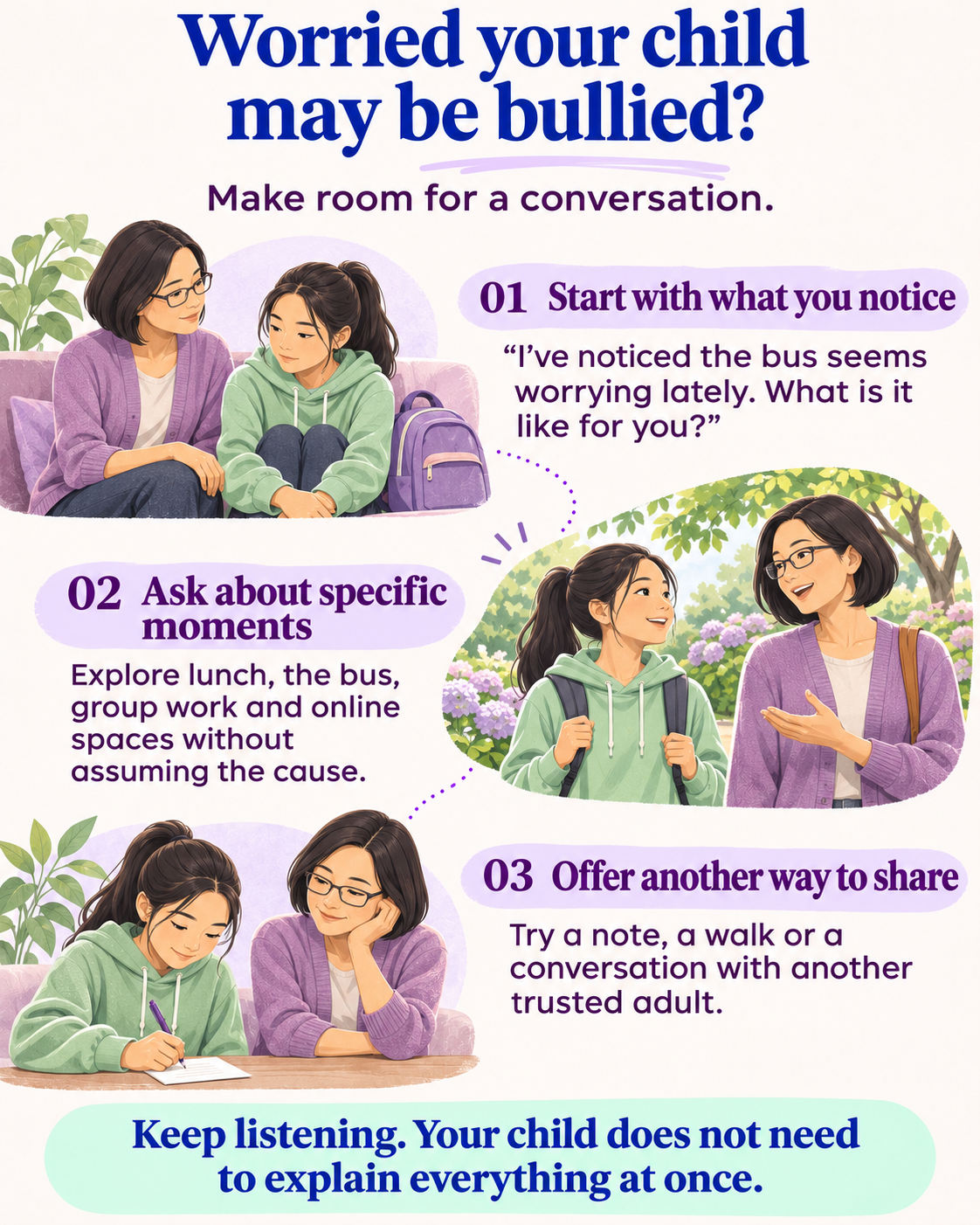
Ask about specific parts of the day: the bus, changing rooms, lunch, group work and online spaces. “Where do you feel comfortable?” may be easier to answer than “Are you being bullied?” Do not dismiss recurring pain as emotional; seek medical advice for new, persistent or concerning symptoms.
Why might a child not tell their parents?
StopBullying.gov’s warning-signs guidance notes that children may fear retaliation, humiliation or rejection by peers. Some worry that adults will judge them or remove their control over what happens next. An absence of a disclosure does not establish that everything is fine.
Choose a private, unhurried moment. You might say: “I’ve noticed you seem worried about the bus. I may have misunderstood, but I’d like to know what it’s like for you.” If your child says nothing is wrong, keep the invitation open without conducting the same interview every evening.
Offer other routes: writing a note, talking during a walk or speaking with another trusted adult. Explain that you will take concerns seriously and discuss next steps with them where possible. Avoid promising complete secrecy, because a serious safety concern may need to be shared with appropriate adults.
What should I say if my child tells me they are being bullied?
Begin by listening. UNICEF’s guidance on cyberbullying conversations emphasises a supportive, nonjudgemental response and understanding the context before acting. A calm first response can help your child keep talking.
An illustrative response is: “Thank you for telling me. You don’t deserve to be treated that way. Let’s work out what would help you feel safer.” Then ask a few open questions: “What happened next?” “Has something like this happened before?” “What are you worried will happen if an adult gets involved?”
Check whether there is an immediate threat or an injury needing care. You do not need to resolve every detail in that conversation. Tell your child what you propose to do, who you intend to contact and what information needs to be shared.
Avoid promising an outcome you cannot control, such as removal of another pupil by tomorrow. Offer a commitment you can keep: listening, contacting the appropriate adults and following up.
What should parents avoid doing?
StopBullying.gov’s guidance on supporting children advises against blaming the child, telling them simply to ignore the behaviour or encouraging physical retaliation. It also cautions that directly approaching the other family can make matters worse.
Resist posting allegations in a parent group chat or demanding that your child confront the other pupil. These actions can widen the audience and make it harder to manage privacy and safety. Use the school’s designated reporting route and describe the behaviour you want addressed.
Confidence-building or practising a response may be useful within an individual plan, but your child should not carry responsibility for stopping another person’s behaviour. Ask what adults will change as well as what your child can do to get help.
How can I record concerns without making my child relive them?
Keep a brief, factual record. Note dates, places, what was said or done, who was present, any injury or damage and who was told. Separate your child’s account from your own observations and interpretations. You can write “My child reports…” without suggesting you doubt them.
For example: “Monday, lunch queue: my child reports that two pupils blocked the entrance and called them a name. They told the duty teacher. At home they asked to avoid lunch the next day.” This is more useful than a broad label such as “School is toxic.”
Ask whether your child wants help recording what happened. Let them correct your notes, use their own words and stop when they need a break. Collect representative information rather than requiring an exhaustive diary before seeking help. Keep records private and share them only with relevant professionals.
What should I ask the school to do?
Contact the class teacher, pastoral lead or designated safeguarding staff, depending on the concern and the school’s process. Ask for the current anti-bullying policy and who will coordinate the response.
A useful first message is: “Our child has reported repeated incidents at lunch and on the bus. We would like to share the details and agree on immediate safety arrangements while you look into them. Who should coordinate this, and when can we review the plan?”
StopBullying.gov’s response guidance recommends protecting children, gathering accounts separately and avoiding forced public apologies or immediate reconciliation. A school can investigate fairly while still taking practical steps to reduce risk.
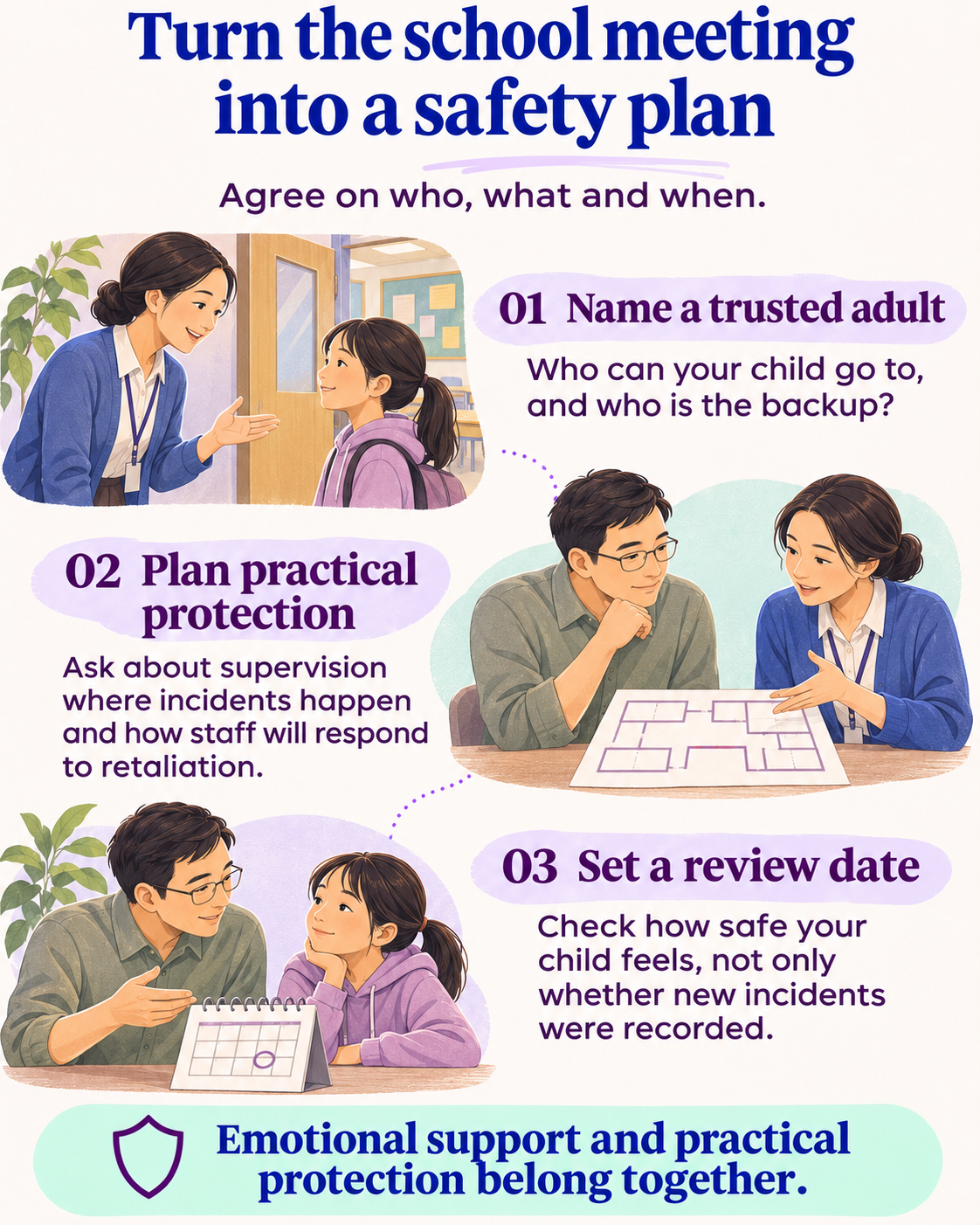
Ask for a plan that answers:
- Who can your child approach, and who covers that adult’s absence?
- What supervision or arrangements are needed in the places of concern?
- How can your child report another incident discreetly?
- What will staff do if there is retaliation or the behaviour moves online?
- When will you receive an update, and when will everyone review the plan?
Your child may prefer one trusted contact to having to repeat the account to several adults. Ask how substitute staff or transport supervisors will receive relevant information. If a teacher sees no problem, ask what happens during less structured times and what information would help staff observe the pattern.
Should children be asked to mediate or “make friends again”?
Not automatically. StopBullying.gov distinguishes bullying from conflict between equals and cautions against peer mediation for bullying. A pressured face-to-face meeting can leave a child feeling less safe.
If the school proposes a joint meeting or restorative process, ask how it has assessed the power imbalance, whether participation is voluntary and what protection will be in place. The immediate aim is safety and an end to harmful behaviour, not a compulsory friendship.
A useful question is: “What can be done to protect our child without requiring them to negotiate directly with someone they fear?” A child can be supported to participate in school without being expected to trust another pupil immediately.
What if the bullying happens online?
Online and school concerns can connect. Ask about group chats, gaming and social platforms without assuming the phone itself is the cause. Focus first on safety and support.
The Australian eSafety Commissioner’s parent guide advises collecting evidence such as usernames, dates and URLs, reporting to the platform and reviewing privacy settings. Its formal reporting scheme is Australia-specific; families elsewhere should check local routes.
For ordinary abusive messages, save relevant evidence before blocking or removing access where it is safe to do so. Avoid repeatedly exposing your child to the content. If sexual images of a minor are involved, do not download, screenshot or forward the images; seek appropriate safeguarding or police advice and record account details or URLs instead.
Agree how your child can stay connected to supportive friends. Avoid making disclosure feel like automatic punishment through loss of every device or friendship channel. Discuss practical changes together, including who can contact them and which adult can help with reports.
What matters for international-school families?
Bring the school’s policy into the conversation rather than assuming procedures match a previous country or curriculum. Ask which staff member is responsible and how incidents on transport, during trips or involving online classmates are handled.
If language, accent, nationality, disability or another personal characteristic is part of the targeting, record the actual words or actions and tell the appropriate staff. A child may need help explaining what happened in a language they feel comfortable using. Ask about interpretation or an alternative way to give their account.
A school move can complicate friendships, but “adjustment” should not be used to dismiss a report of harm. Equally, not every difficult social transition is bullying. Keep both possibilities open while asking for specific protective steps and a review date.
When might my child need psychological support?
Bullying can affect wellbeing and school participation. StopBullying.gov’s overview of effects describes possible emotional, social, physical and academic impacts. These are possibilities, not a prediction about your child’s future.
Seek advice when distress persists, worsens or disrupts sleep, relationships, learning or ordinary activities. The American Academy of Child and Adolescent Psychiatry’s help-seeking guidance supports considering evaluation for substantial emotional or behavioural concerns. You can ask sooner when the situation is severe.
Therapy can address the child’s distress while school staff address safety and conduct. It should not replace action on the harmful environment. Ask how a clinician and school could coordinate relevant recommendations with consent. CALM International’s child psychologist versus school counsellor guide explains these complementary roles.
If there is immediate danger, serious injury or you cannot keep your child safe, seek local emergency help. Any disclosure of self-harm or suicidal thoughts needs prompt professional attention; do not wait for a routine enquiry response.
Frequently asked questions
Can bullying happen without hitting?
Yes. Repeated threats, humiliation, rumours or deliberate exclusion may involve bullying. Explore the behaviour, power imbalance and risk of repetition rather than looking only for injuries.
Should I wait until it happens again?
No. A first report can justify a conversation and practical protection. Serious harm or threats need action immediately, even if the incident has not repeated.
What if my child begs me not to tell the school?
Ask what they fear will happen and discuss the smallest necessary sharing with the appropriate adult. Take their views seriously while explaining that safety concerns may require help. Do not promise secrecy you cannot maintain.
What if the school says it has already dealt with it?
Ask what will be monitored and when you will review it. Include your child’s experience of safety, not only whether another incident was formally recorded. Use the school’s escalation process if concerns continue.
Discuss support with CALM International
CALM International offers Child & Adolescent Therapy and School Wellness services. Families can share their child’s age, location, concerns and the school’s response to discuss a suitable next step. Schools can enquire about relevant consultation or wellness support.
Ask about the clinician’s experience, suitable arrangements for your child and how communication with the school could work. A consultation can support understanding and planning; it cannot substitute for the school’s responsibility to respond to reported harm.
Contact CALM International to discuss support for your child.
Sources
Sources checked on 16 November 2026. Guidance comes from several countries; definitions, legal duties and formal reporting routes vary. Conversation examples and meeting questions are illustrative.
- StopBullying.gov. What Is Bullying.
- American Academy of Pediatrics / HealthyChildren.org. Why Bullying Hurts All Children—and What Parents Can Do About It.
- StopBullying.gov. Warning Signs for Bullying.
- UNICEF Parenting. How to Talk to Your Child About Cyberbullying.
- StopBullying.gov. Support the Children Involved.
- StopBullying.gov. Respond to Bullying.
- eSafety Commissioner. Cyberbullying: Guide for Parents and Carers.
- StopBullying.gov. Effects of Bullying.
- American Academy of Child and Adolescent Psychiatry. When to Seek Help for Your Child.
- CALM International. Child & Adolescent Therapy; School Wellness; Child Psychologist vs School Counsellor.