Reading homework takes much longer than expected. Your child can explain a story aloud but struggles to read the words independently. Spelling practice ends in frustration, and you are wondering whether more practice is enough, or whether something needs a closer look. A dyslexia assessment explores a child’s reading and spelling difficulties, considers their learning history, and helps identify appropriate support. It can clarify whether the findings are consistent with dyslexia and turn concerns into practical next steps.
What is Dyslexia?
Dyslexia is a learning difficulty that mainly affects reading and spelling. It does not mean a child has low intelligence. Some children find reading aloud slow and effortful, while others have persistent difficulties with spelling and written work.
These challenges can also affect how a child feels about learning. Frustration, withdrawal or avoiding schoolwork may be part of the picture. However, those behaviours alone do not establish dyslexia.
When should parents consider an assessment?
Start by speaking with your child’s teacher or learning support team if reading or spelling is consistently difficult. Ask what they are noticing, what support has been tried, and whether your child is making progress.
An assessment may be useful when difficulties continue despite additional support, or when the reasons for the struggle remain unclear. Hearing or vision concerns should also be checked where relevant.
Good grades do not necessarily settle the question. Some children develop coping strategies that make their difficulties less obvious until schoolwork becomes more demanding. The amount of effort and support behind a result can be worth discussing alongside the result itself.
Is Dyslexia screening the same as a diagnostic assessment?
A screening identifies signs that further investigation may be needed. It does not provide a formal diagnosis. A diagnostic assessment examines the child’s difficulties in greater depth and brings together evidence to reach a professional conclusion.
If your child has completed a school screening or online questionnaire, bring the results to the consultation. Ask what they indicate and whether further assessment would be useful.
What happens during a Dyslexia assessment?
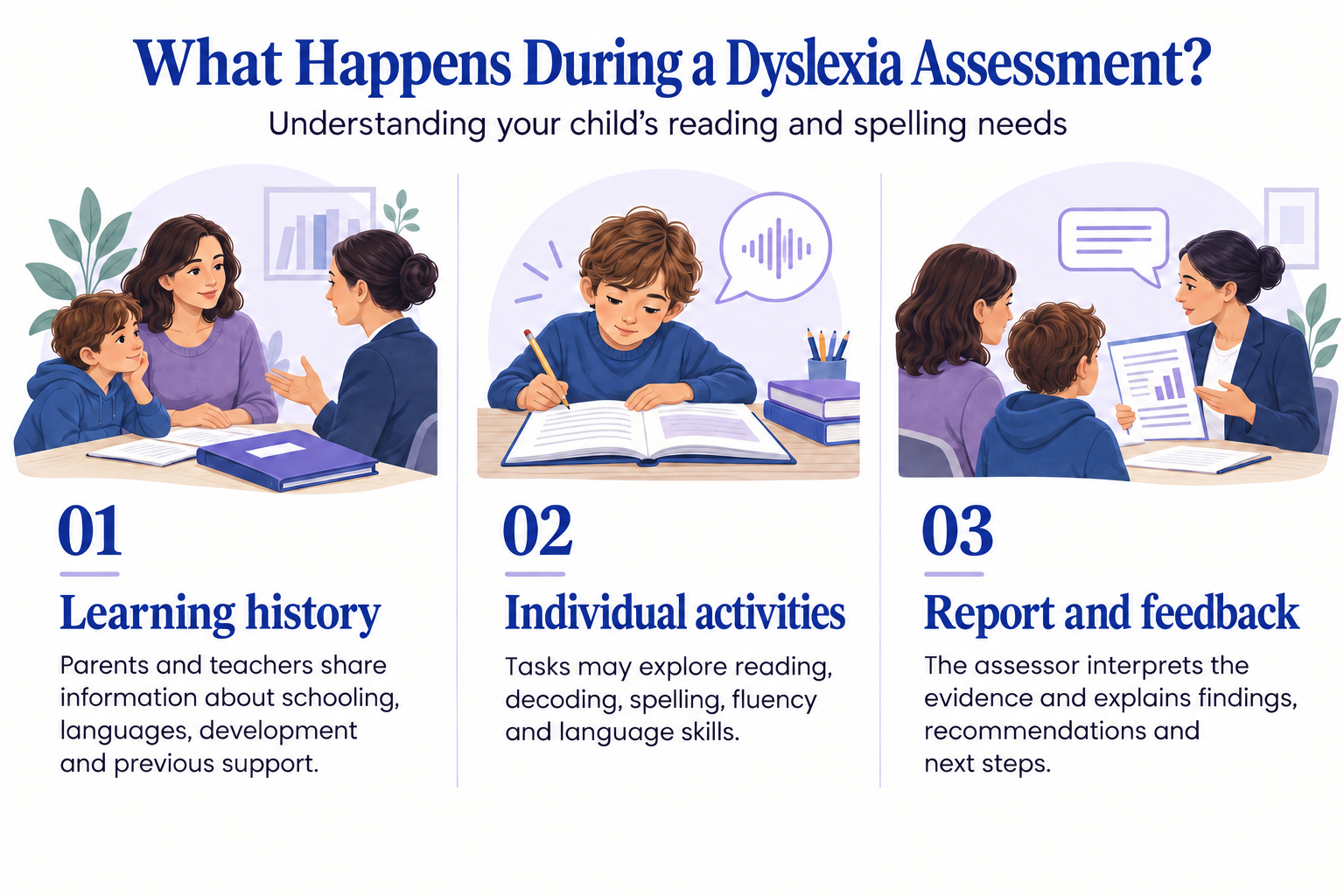
1. The assessor gathers background information
Parents and teachers provide information about development, schooling, family literacy history and previous support. This helps the assessor interpret test results in context.
Before your appointment, gather school reports, examples of written work and details of any tutoring or learning support. Let the assessor know about previous testing so they can plan appropriately.
2. Your child completes individual activities
The assessment may include the following areas. The exact selection depends on the child and the questions being investigated.
Area | What it explores |
Word reading | Accuracy and ease when reading individual words |
Decoding | Using letter–sound knowledge to read unfamiliar words |
Reading fluency | How accurately and efficiently the child reads |
Spelling | Applying knowledge of sounds and written patterns |
Phonological processing | Recognising and working with the sounds in speech |
Rapid naming | Quickly naming familiar symbols or objects |
Language and comprehension | Understanding spoken language and written text |
For example, your child might read words from a list, spell spoken words, or name familiar pictures or letters. Some decoding tasks use made-up words so the assessor can examine how a child works out unfamiliar words without relying on memory. These activities help separate different aspects of reading; doing well on one task does not answer every assessment question.
Ask the provider whether the proposed evaluation focuses on literacy or also includes broader learning concerns. You do not need to choose individual tests yourself, but you should understand why the recommended assessment suits the concerns you have raised.
3. The assessor interprets the findings
The conclusion draws on the overall evidence rather than a single reading score. The written report should explain the findings and recommend suitable support or further assessment where needed.
When reviewing the report, ask: “What should we prioritise first, and how will we know whether it is helping?”
What can the assessment tell you?
An evaluation can establish whether the evidence supports dyslexia, identify particular reading and spelling needs, and guide the starting point for intervention. It can also document difficulties for discussions about educational support.
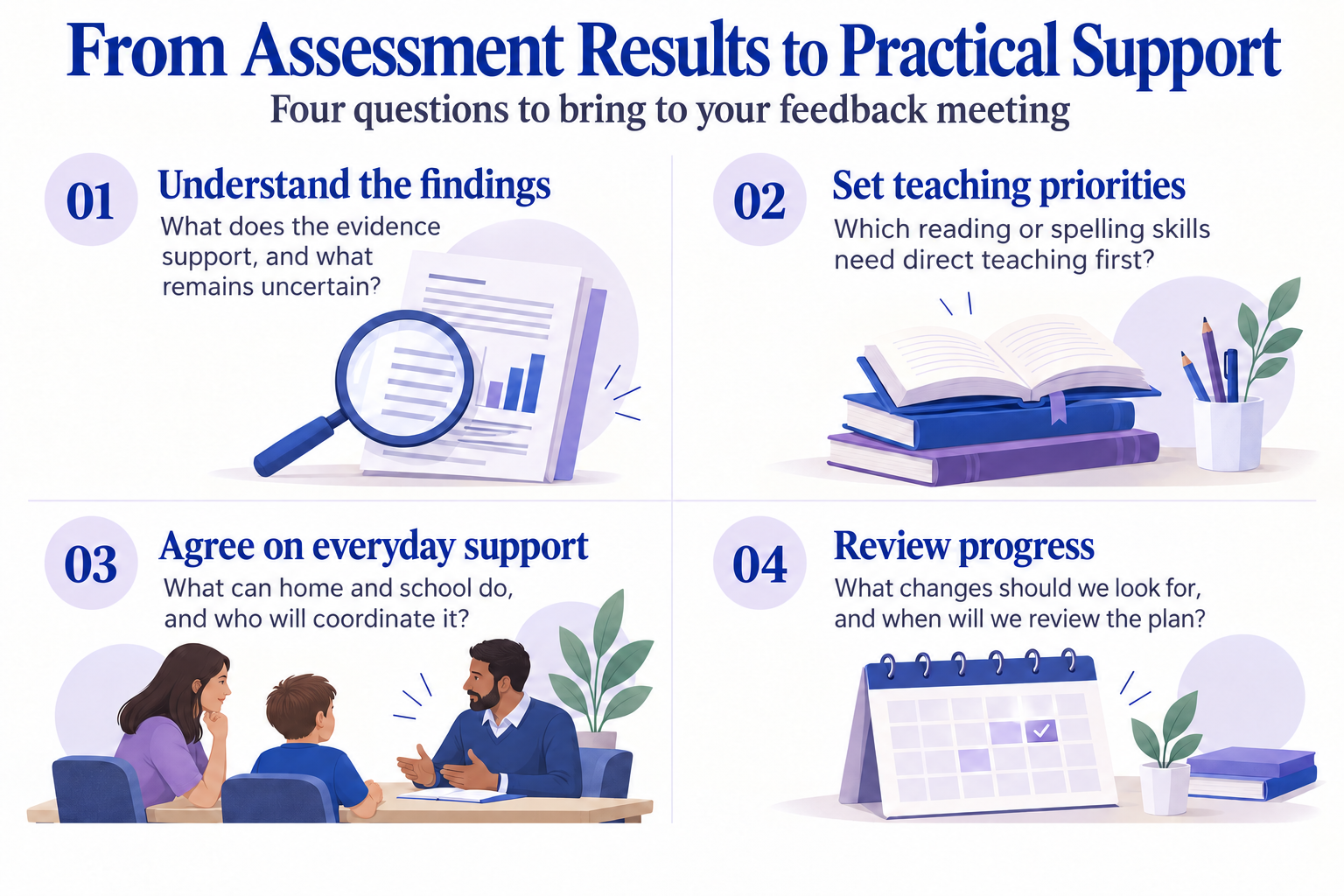
The most useful conversation goes beyond the diagnostic label. Ask which skills need direct teaching, what the school can do, and how home practice can reinforce that work.
It is also reasonable to ask the assessor to explain unfamiliar terms. You should leave understanding what the findings mean for your child’s everyday learning.
Turning findings into practical decisions
Use the feedback meeting to connect the report to situations you recognise. If your child can discuss a book but struggles to read it independently, ask which findings help explain that experience. If homework regularly takes an entire evening, ask which demands are creating difficulty and what changes to discuss with the teacher.
Useful questions include:
- Which reading or spelling skills should teaching focus on first?
- What can my child manage independently, and where is help appropriate?
- How should we balance reading practice with access to age-appropriate stories and ideas?
- What changes should we look for over the next school term?
Write down the agreed priorities. A manageable plan with named responsibilities is easier to follow than a long list of recommendations with no clear starting point.
What can an assessment NOT tell you?
Ask the assessor to distinguish what the evidence supports from what remains uncertain. The British Dyslexia Association explains that reports may recommend further assessments; a literacy-focused evaluation does not automatically answer every question about a child’s development or wellbeing.
If the findings do not support dyslexia, ask what they do suggest and what support remains appropriate. The purpose of the appointment is still to understand the difficulty that brought you there.
An assessment also cannot promise a particular future grade or a fixed timetable for progress. Request clear goals and a review plan rather than treating the report as a prediction of your child’s potential.
What about bilingual children and international-school students?
For multilingual children, reading performance must be understood alongside language exposure and teaching history. A child learning through English may still be developing the vocabulary needed for schoolwork; a multilingual child can also have dyslexia.
Tell the assessor which languages your child uses, when they began learning each one, and where they have received reading instruction. School moves and curriculum changes are relevant too. Difficulties across languages can be informative, but only in light of the teaching and opportunities the child has had in each language.
Read more: How to Tell EAL Struggles Apart from a Learning Difference.
How can you prepare your child?
Explain that they will meet someone who wants to understand how they learn and what could make schoolwork easier. This is not a pass-or-fail exam.
You might say: “You’ll do some activities to help us understand which parts of reading feel difficult and how we can help.”
Ask the provider about appointment length, breaks and what to bring. Share any worries your child has in advance, and follow the assessor’s preparation guidance.
Bring relevant reports and a short list of your main concerns. Concrete examples are useful: “She needs someone beside her throughout reading homework” gives the consultation a clearer starting point than “She is behind.” Tell the provider if your child has recently been assessed elsewhere and give them the dates and reports.
What happens after a Dyslexia assessment?
Arrange a discussion with the school about the recommendations and agree on priorities, responsibilities and a review date.
You could organise that meeting around three questions: What will change in teaching? What will change in everyday classroom tasks? How will we review progress? Ask who will coordinate the plan and how updates will be shared with you.
Reading intervention should address the skills identified. The International Dyslexia Association highlights explicit, systematic instruction in areas such as decoding and spelling, alongside vocabulary, comprehension and writing. Ask how the proposed teaching will meet your child’s specific needs and how progress will be monitored.
If you are seeking exam access arrangements, speak with the school before booking. A dyslexia diagnosis does not automatically guarantee extra time; eligibility depends on the applicable requirements and evidence.
Questions to ask before booking a Dyslexia assessment
Before committing, send the provider a short description of your concerns, your child’s age and language background, and any school referral. Then clarify:
Question | What you need to establish |
Who conducts and interprets the assessment? | Their relevant qualifications and experience with children like yours |
What questions will it address? | Whether the scope covers your concerns and the school’s request |
How is multilingual experience considered? | How language and educational history inform the evaluation |
What does the fee include? | Testing, report, feedback, school communication and any additional charges |
When will we receive the report? | Whether the timeline fits a planned school meeting or application |
Will the report meet our intended purpose? | Any requirements to confirm directly with the school or examination body |
A clear quotation and explanation help you compare services meaningfully. If one assessment is much shorter or cheaper than another, ask how their scope and deliverables differ before deciding.
Discuss your child’s learning needs with CALM International
If reading or spelling continues to be a struggle, you do not need to decide which assessment to book on your own.
CALM International offers psychoeducational assessments to help families understand their child’s learning needs. Contact our team to discuss your concerns and ask whether an assessment exploring reading and spelling would be appropriate.
Our process begins with an initial consultation to review concerns and relevant background information, followed by appropriate testing, a report with recommendations, and a feedback discussion. In your enquiry, include your child’s age, current location, languages used and the main difficulties you or the school have noticed. This gives our team a useful starting point for discussing the next step.
Make an enquiry about your child’s learning needs or email enquiry@calmintl.com.
Sources
- NHS — Dyslexia in children
- British Dyslexia Association — Is my child dyslexic?
- British Dyslexia Association — Diagnosis
- International Dyslexia Association — Testing and Evaluation
- British Dyslexia Association — Assessments: Before, During and After
- CALM International — EAL or a Learning Difference?
- International Dyslexia Association — Structured Literacy
- British Dyslexia Association — Dyslexia and Exam Adjustments
- CALM International — Psychoeducational Assessments