
Knowing when to raise a concern about a student is one of the most important judgements a teacher makes. Escalate too quickly, and a student may feel exposed or embarrassed before a conversation has even had a chance to happen naturally. Wait too long, and a situation that could have been addressed early becomes significantly more serious.
Teachers are generally not trained clinicians, and they should not have to make these judgements alone. But they do need a clear understanding of the signs that warrant escalation, the process for raising concerns effectively, and the common hesitations that can get in the way of acting when action is needed.
This article sets out a practical framework for teachers navigating this question, including the specific situations that require immediate escalation, those that call for a more measured referral, and the barriers that most often prevent teachers from acting on concerns they have already identified.
For a broader understanding of the teacher’s role in student mental health and where the limits of that role lie, read our guide on teacher wellbeing and student mental health.
Why Escalation Is Part of Good Teaching Practice
There is sometimes a cultural hesitation in schools around escalating concerns, rooted in a reluctance to overreact, a desire to protect student privacy, or an assumption that things will improve on their own. These instincts are understandable, but they can work against a student’s best interests.
Early escalation is almost always better than late escalation. When concerns are raised promptly, the professionals who receive them have more options available. They can observe, assess, and intervene at a stage when the student is more likely to be receptive to support. Waiting until a situation has become acute significantly narrows what is possible.
Escalation is also not a betrayal of a student’s trust. It is an act of care carried out within a professional framework. Teachers who explain this to students, where appropriate, often find that students respond better than expected. Most young people, even those who ask for confidentiality, understand at some level that they need more support than a single trusted adult can provide.
Understanding escalation as a core part of good teaching practice, rather than a last resort, helps teachers feel more confident acting on concerns before they become crises.
Situations That Require Immediate Escalation
Some situations do not allow for a measured or gradual response.
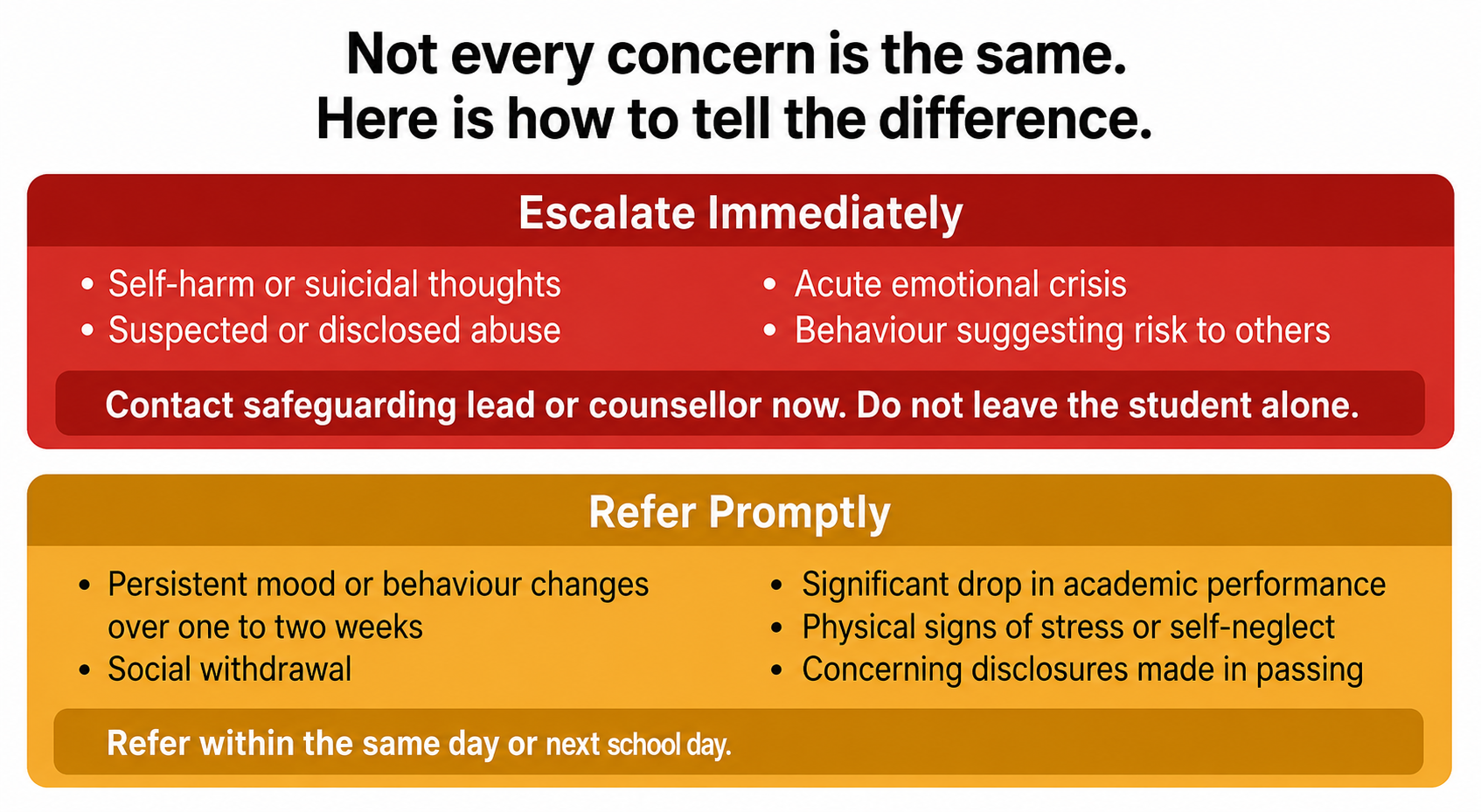
The following circumstances require a teacher to escalate to a senior colleague, designated safeguarding lead, or school counsellor without delay, and in some cases directly to emergency services.
Disclosure of Self-Harm or Suicidal Thoughts
If a student discloses that they are harming themselves, have harmed themselves recently, or are having thoughts of suicide or self-harm, this requires immediate escalation. The teacher should not attempt to assess the level of risk themselves, should not promise confidentiality, and should not leave the student alone while escalation is taking place.
The appropriate response is to remain calm, acknowledge what the student has shared without expressing alarm, stay present with them, and contact the school’s designated safeguarding lead or counsellor as quickly as possible. If the student is in immediate physical danger, emergency services should be contacted directly, as well as the student’s parents or legal guardian.
Disclosure or Suspected Abuse
If a student discloses that they are being abused at home or by another adult, or if a teacher suspects abuse based on physical signs, behavioural changes, or things a student has said, this must be escalated immediately through the school’s safeguarding process. Teachers are not responsible for investigating abuse. They are responsible for reporting it to the designated safeguarding lead, who will then follow the appropriate legal and institutional protocols.
Teachers should not probe for further details, should not contact the family themselves if abuse within the family is suspected, and should record what they observed or heard as accurately as possible using the student’s own words where relevant.
Acute Distress or Emotional Crisis in School
If a student is in a state of acute distress, whether crying uncontrollably, refusing to leave a space, or showing signs of dissociation or panic, the teacher should seek immediate support from a counsellor or senior staff member rather than managing the situation alone. Remaining calm and present while help is sought is appropriate. Attempting to de-escalate a clinical situation without training is not.
Behaviour That Suggests Risk to Others
If a student makes statements or displays behaviour that suggests a risk to the safety of other students or adults, this requires immediate escalation through the school’s safeguarding and behaviour protocols. Teachers should not attempt to manage this independently and should follow the school’s procedures for securing the safety of all students in the first instance.
Situations That Call for a Prompt but Non-Emergency Referral
Not every concern requires immediate action, but some patterns of behaviour should prompt a teacher to raise a referral within a short timeframe, typically within the same day or the next school day at the latest, rather than waiting to see if things improve.
Persistent Changes in Mood or Behaviour
A single bad day does not necessarily warrant a referral. But when changes in a student’s mood, energy, engagement, or social behaviour persist over a period of one to two weeks or more, it is appropriate to raise this with a school counsellor or pastoral lead. Persistence is a key indicator that something more than a temporary difficulty may be happening.
Teachers should document the specific changes they have observed, including approximate dates, and present this information clearly when making the referral. Vague impressions are less actionable than specific observations.
Withdrawal from Peers and Activities
Social withdrawal is one of the more easily overlooked signs of difficulty, particularly in students who are naturally quiet or introverted. When a student who was previously socially engaged begins to isolate themselves, stops participating in activities they previously enjoyed, or appears to have lost their friendship group, this warrants a prompt referral.
In international school settings, some degree of social adjustment is normal, particularly for students who have recently arrived or changed year groups. But withdrawal that persists beyond the initial settling-in period, or that is accompanied by other signs of distress, should not be attributed to adjustment without further assessment.
Significant Drop in Academic Performance
A sudden or sustained drop in academic performance that is not explained by learning difficulties already known to the school can be an indicator of underlying emotional or mental health difficulties. When this is observed alongside other changes in behaviour or mood, it strengthens the case for a referral. Teachers should note when the change began and whether any events in the school or home context might be relevant.
Physical Signs of Stress or Self-Neglect
Repeated physical complaints without a medical explanation, such as frequent headaches or stomach aches before school, visible weight loss, changes in personal hygiene, or signs of fatigue that go beyond ordinary tiredness, can all indicate that a student is struggling in ways that extend beyond the classroom. These observations should be included in a referral alongside any relevant behavioural or academic context.
Concerning Disclosures Made in Passing
Students sometimes make disclosures indirectly, through a comment in a piece of writing, something said in passing at the end of a lesson, or a reference made while discussing something apparently unrelated. These should not be dismissed as throwaway remarks. Teachers who notice them should follow up gently, make a record, and escalate if the content suggests the student may be in difficulty.
Common Barriers to Escalation and How to Overcome Them
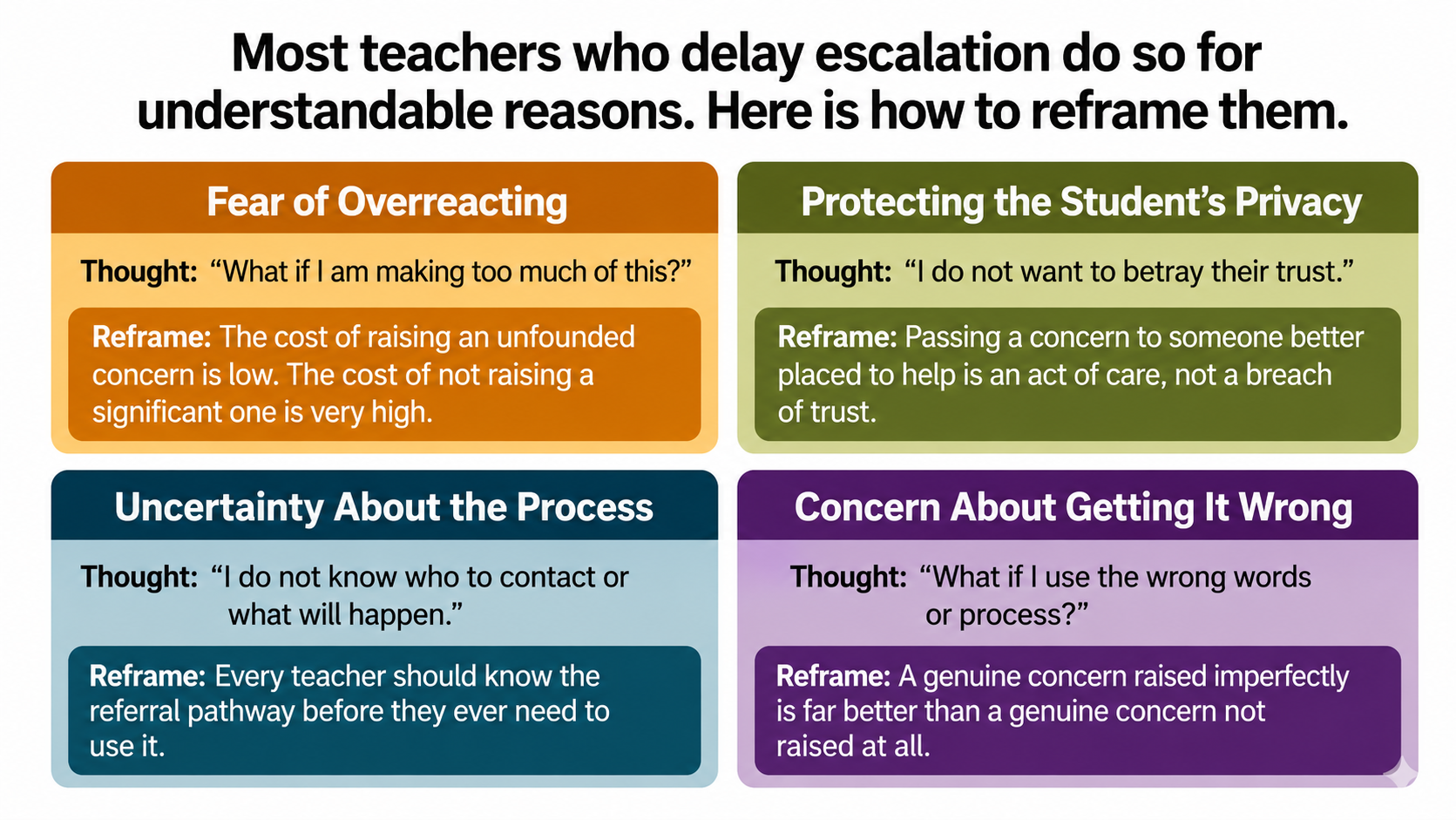
Even when a teacher has a genuine concern about a student, a range of factors can delay or prevent them from escalating. Being aware of these barriers is the first step to addressing them.
Fear of Overreacting
Many teachers hesitate to escalate because they are worried about making too much of something that turns out to be minor. It is worth reframing this concern. The cost of raising a concern that turns out to be unfounded is low. The cost of not raising a concern that was significant is potentially very high. School counsellors and safeguarding leads are trained to assess and triage concerns. It is not the teacher’s job to determine whether a concern meets a particular threshold before raising it.
Wanting to Protect the Student’s Privacy
Teachers who have a trusting relationship with a student may feel that escalating a concern is a betrayal of that relationship. In most cases, the opposite is true. Passing a concern to someone who is better placed to help is an act of care, not a breach of trust. Teachers can and should be transparent with students about the fact that they are doing this, framed in a way that is reassuring rather than alarming.
Uncertainty About the Process
If teachers are unclear about who to contact, what to say, or what will happen after they raise a concern, they are more likely to delay. Schools have a responsibility to ensure that referral processes are clearly communicated to all staff and rehearsed regularly enough that they feel familiar. A teacher who has never had to use the referral pathway before should not be working it out for the first time in the middle of a crisis.
Concern About Getting It Wrong
Some teachers worry that raising a concern incorrectly, using the wrong words or process, will cause harm. In practice, a genuine concern raised imperfectly is far better than a genuine concern not raised at all. The professionals who receive referrals are experienced in working with information that is incomplete or uncertain. They will ask clarifying questions and take it from there.
How to Make an Effective Referral
When the decision to escalate has been made, the quality of the referral matters. The following approach helps ensure the concern is communicated clearly and acted upon promptly.
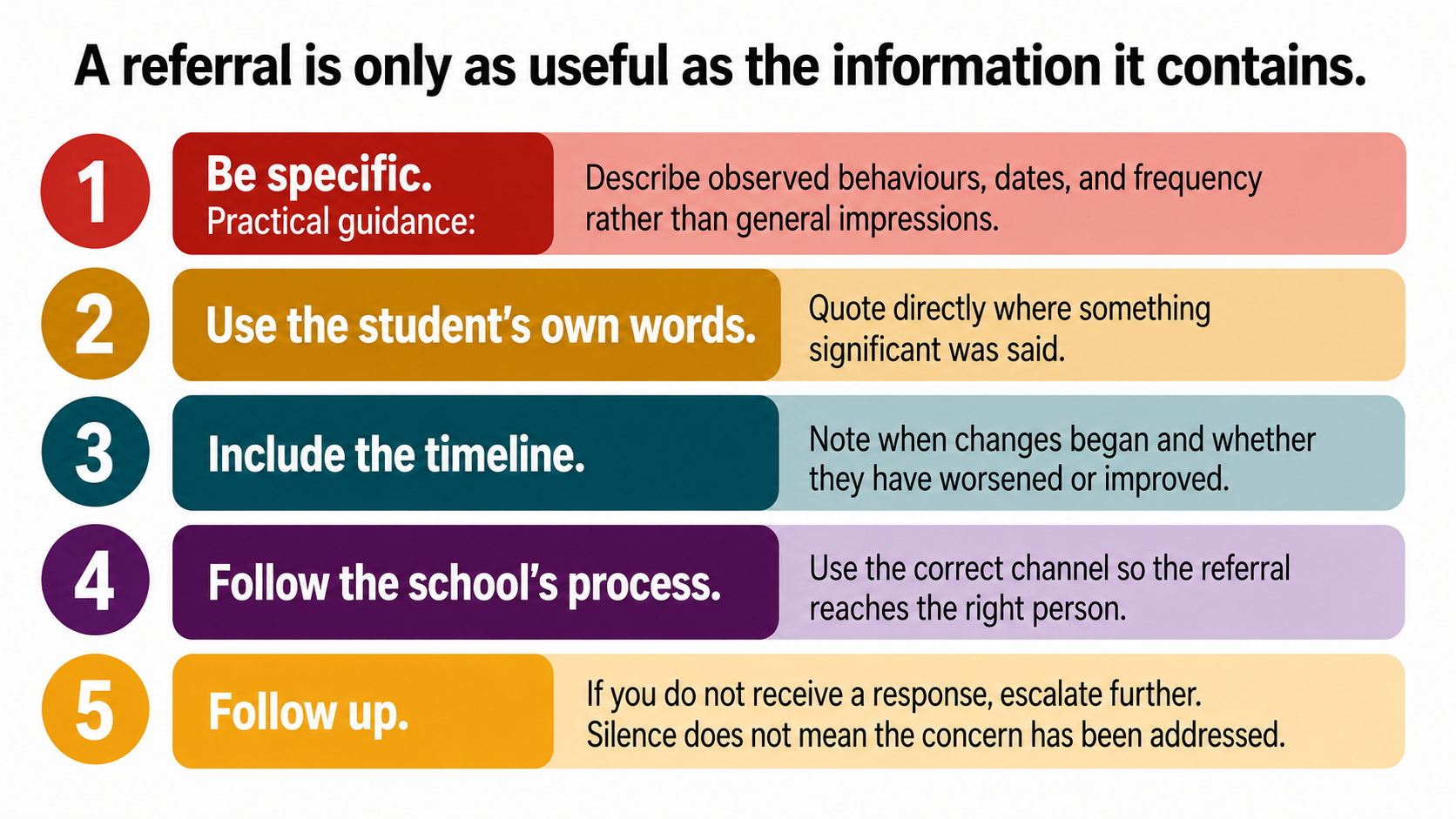
- Be specific. Record what was observed, not what is assumed. Describe behaviours, dates, frequency, and any relevant context rather than offering a general impression.
- Use the student’s own words where possible. If the student said something significant, quote it accurately rather than paraphrasing. This preserves important information and reduces the risk of misrepresentation.
- Include the timeline. Note when changes were first observed and whether they have worsened, improved, or remained stable. This helps the receiving professional understand the urgency and trajectory of the concern.
- Follow the school’s established process. Know in advance who the designated contact is for different types of concern and use the correct channel. This ensures the referral reaches the right person and is documented appropriately.
- Follow up if you do not receive a response. A referral that has been made but not acknowledged should be followed up. Teachers should not assume that silence means the concern has been addressed.
When School-Based Support Is Not Enough
In some cases, a student’s needs exceed what a school counsellor or pastoral team can appropriately address. This may be the case when difficulties are persistent and not responding to school-based support, when the nature of the concern suggests a need for clinical assessment, or when the student’s home situation requires involvement beyond the school’s remit.
When this point is reached, encouraging families to seek external professional support is an appropriate next step. At CALM International, we work with students and families across international school communities, providing clinical assessment and therapeutic support for children and young people experiencing a wide range of difficulties. We also work with schools to help establish clearer processes and more confident staff.
If you are a teacher or school leader who is unsure whether a student’s needs have reached this threshold, or if you are a parent who has been made aware of concerns about your child, a consultation with one of our clinicians can help clarify the picture and identify the most appropriate pathway forward.