
Social challenges in expat children begin with the peer group itself. Peer groups in internationally mobile communities are unlike any other social environment a child will encounter. They are highly diverse and frequently changing. Children arrive from different countries, different educational systems, and different cultural frameworks for how people relate to one another. Friendships form quickly because they have to, and dissolve just as quickly when families move on. The unspoken rules of social interaction that feel intuitive in a stable, monocultural peer group simply do not exist here in the same way.
For most children in these communities, this is hard. For some, it is genuinely unmanageable.
The difficulty is that in a peer group where everyone is navigating transition and diversity, it is very hard to see which children are struggling with ordinary adjustment and which are struggling with something more. A child who cannot read social cues, who dominates conversations, who misses the social rules that seem obvious to others, looks like almost every other new arrival at the start of term.
By the time the difference becomes visible, months or years may have passed. And the child has often accumulated a significant amount of social failure alongside whatever underlying difficulty was present from the beginning.
If you are an expat parent who has watched your child try, and struggle, and try again, this article is for you. It explains what social challenges in expat children actually look like in highly transient, multinational peer groups, why they are so consistently missed, and when a psychoeducational assessment can help clarify what is happening.
What Makes This Peer Group So Different
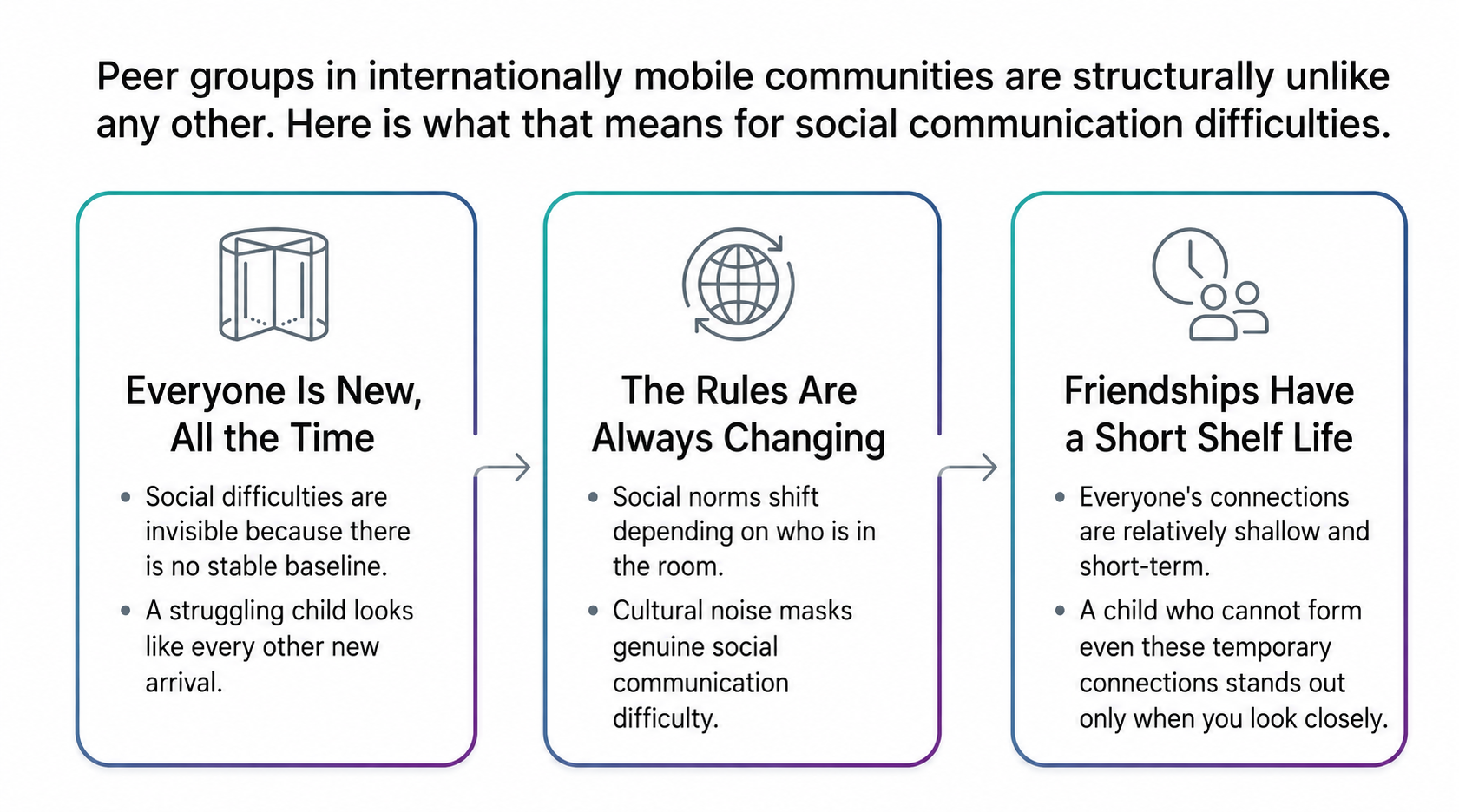
To understand why social challenges in expat children are so hard to identify, it helps to understand what makes these peer groups structurally unusual.
Everyone Is New, All the Time
In a stable school community, children have years to establish their social identities. They have shared history, established friendships, and a settled sense of where they fit. New arrivals stand out precisely because they are new.
In a highly transient international school or expatriate community, the majority of children are in some stage of arrival, settlement, or departure at any given time. There is no stable baseline against which a child’s social behaviour is measured. Everyone is adjusting. Everyone is finding their feet.
This makes social difficulties invisible in a way they would not be elsewhere. A child who struggles to read social cues looks like a child who has not yet settled. A child who dominates conversations looks like a child who is trying hard to connect. A child who cannot sustain friendships looks like a child whose peers keep moving away, which in this environment, they often do.
The Rules Are Always Changing
Social norms are not universal. What counts as appropriate eye contact, how directly people express disagreement, how much personal space is comfortable, how humour works, how silence is interpreted, all of these vary significantly across cultures.
In a multinational peer group, children are navigating a social environment where these norms are constantly in flux. A child who appears socially awkward may simply be applying the rules of one cultural context in a setting where different rules apply. Or they may have a genuine social communication difficulty that is being masked by the general cultural noise of the environment.
Distinguishing between these possibilities is genuinely difficult without clinical assessment.
Friendships Have a Short Shelf Life
In most internationally mobile communities, children learn early that friendships are temporary. Families leave. Peers disappear. The investment in deep, sustained friendship carries a cost that many children in these environments learn, consciously or not, to limit.
This affects what social difficulty looks like. A child who struggles to maintain friendships over time may appear to be navigating the environment in the same way as everyone else, because everyone’s friendships are relatively shallow and short-term. The difference only becomes apparent when the child cannot form even the temporary connections that most of their peers manage, or when they are consistently on the periphery of every social group without ever finding a foothold.
What Social Challenges Actually Look Like Here
Social challenges for expat children present differently in transient, multinational peer groups than in stable, monocultural ones. These are the patterns parents and teachers most commonly report.
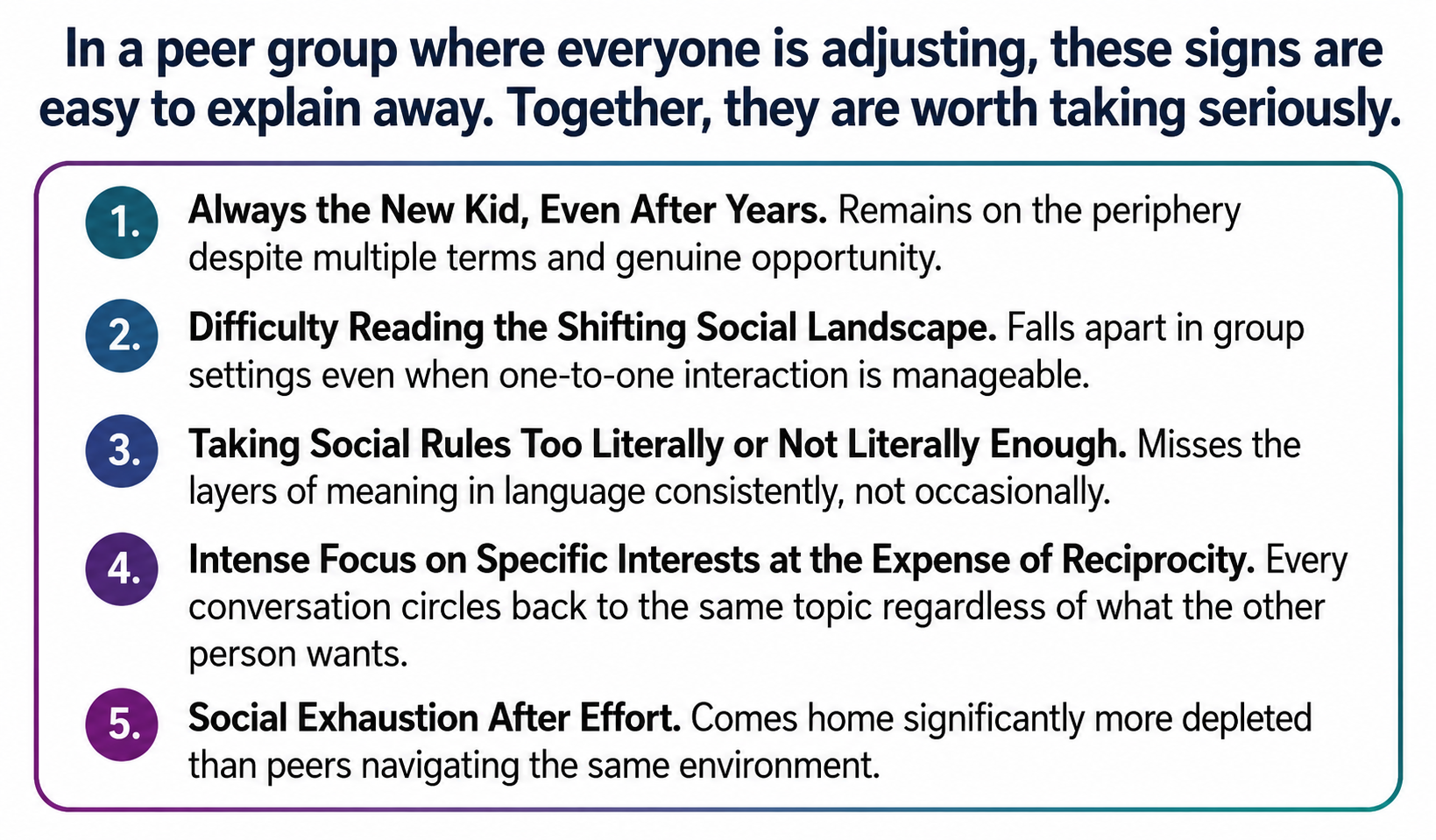
Always the New Kid, Even After Years
Most children who move schools take time to settle socially. Within a term or two, they typically find their place in the peer group. They are not necessarily central, but they are connected.
A child with a social communication difficulty often does not find that foothold, even after multiple terms. They remain on the periphery. They are included in group activities when organised by adults but not sought out by peers spontaneously. They describe having friends but cannot name anyone who would call them a close friend. They are present in the social group but not genuinely part of it.
Ask yourself: Has my child remained on the social periphery across more than one school, more than one peer group?
Difficulty Reading the Shifting Social Landscape
In a multinational peer group, social norms shift depending on who is in the room. A child who can navigate a one-to-one interaction with a familiar peer may fall apart in a group setting where the cultural mix produces more complex, less predictable social dynamics.
Parents may notice:
- Their child copes well with structured social situations but struggles in unstructured ones such as lunch, breaks, or free time
- Their child can maintain a friendship with one individual but cannot participate effectively in a group
- Their child misreads the tone of a social situation, responding seriously to something playful, or playfully to something serious
- Their child says things that are technically accurate but socially jarring, without noticing the reaction they produce
Taking Social Rules Too Literally or Not Literally Enough
In a multinational peer group, some degree of social literalism is normal. Children navigating different cultural frameworks for communication may interpret language more directly than intended, or miss implied meanings that are culturally specific.
But there is a difference between a child who misses a culturally specific idiom and a child who consistently fails to understand that language has layers, that people say things they do not literally mean, that context changes meaning.
A child who takes everything at face value across all cultural contexts, who cannot understand why a joke is funny, who is repeatedly surprised that people did not mean exactly what they said, is showing a pattern that goes beyond cultural adjustment.
Intense Focus on Specific Interests at the Expense of Social Reciprocity
Many children in internationally mobile communities develop deep interests as a source of stability and identity across transitions. Having a passion for a particular subject, sport, or creative pursuit is healthy and common.
The concern is when a child’s interest becomes the exclusive currency of their social interactions. When every conversation circles back to the same topic regardless of what the other person is interested in. When the child cannot read signals that the other person wants to move on. When the intensity of the interest makes peers uncomfortable rather than curious.
In a peer group where everyone is looking for connection across difference, this kind of interaction can initially attract interest. It tends to exhaust peers quickly when they realise the conversation is always one-directional.
Social Exhaustion After Effort
Navigating a highly diverse, frequently changing peer group is cognitively demanding for any child. For a child with a social communication difficulty, it is exhausting in a specific way. They are working significantly harder than peers to decode interactions that others read instinctively.
Parents often notice that their child comes home from school drained in a way that goes beyond ordinary tiredness. They may withdraw into screen time, solitary activities, or intense engagement with their specific interests as a way of recovering from the social demands of the day.
This depletion is a signal worth taking seriously. It suggests that the social environment is more cognitively demanding for this child than it should be.
Why These Difficulties Are So Easily Missed
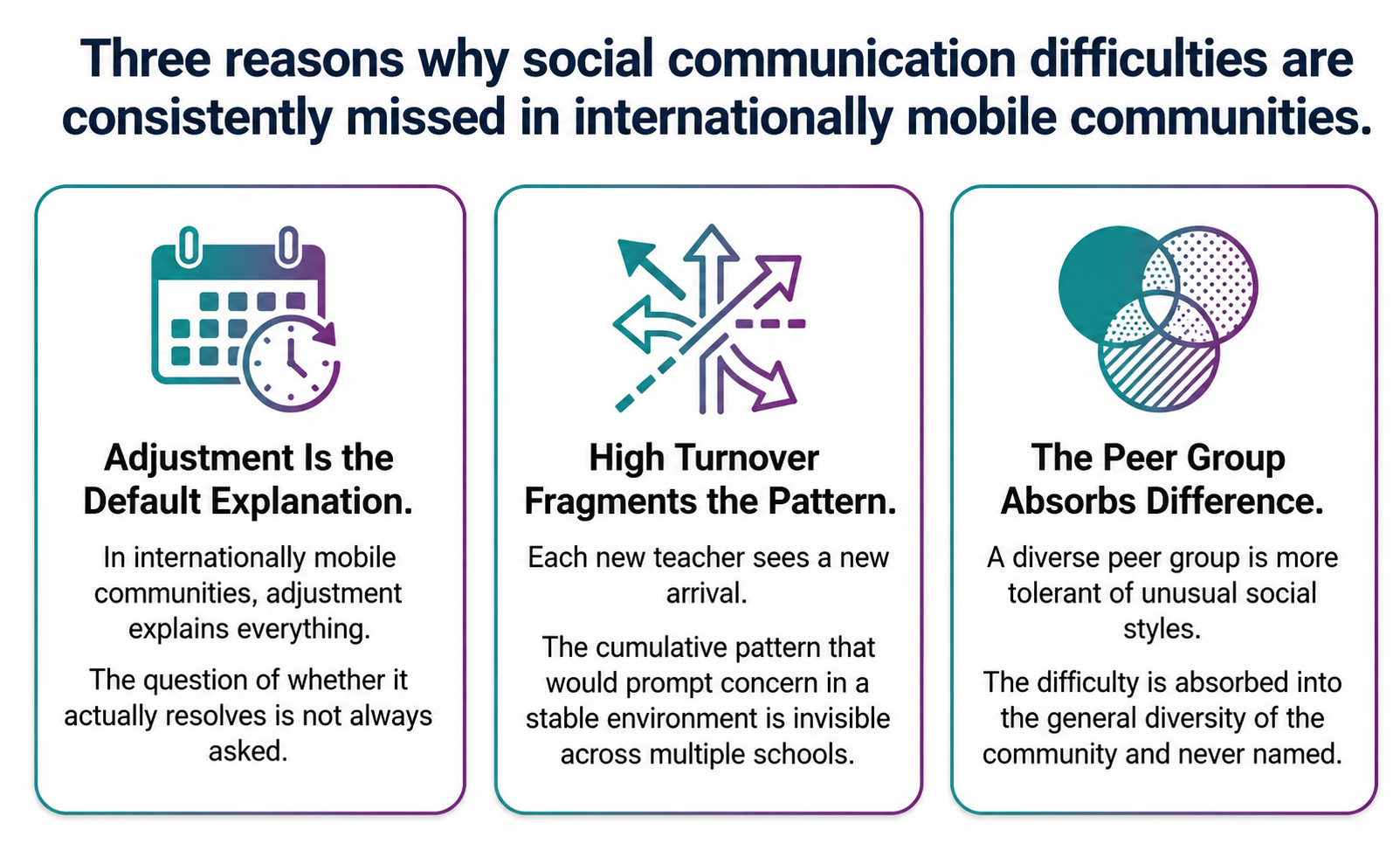
In any other school environment, several of these patterns would prompt earlier attention. But social challenges in expat children are consistently missed or explained away in highly transient communities. Here is why.
Adjustment Is the Default Explanation
In internationally mobile communities, adjustment is the universal explanation for anything unusual. A child who is struggling socially is assumed to be adjusting. A child who seems different is assumed to be navigating cultural difference. A child who cannot sustain friendships is assumed to be dealing with the reality of a transient community.
These explanations are often partially correct. They are also sometimes used to defer attention from a child who needs more than time and patience.
The question is not whether adjustment is happening. It is whether the difficulty resolves as adjustment progresses, or whether it persists in ways that suggest something more needs to be understood.
High Turnover Makes Patterns Harder to Spot
A pattern of social difficulty is most visible when it can be observed over time, across different relationships and different situations. In a community where peer groups change significantly every year, and where the child themselves may change schools every few years, this longitudinal view is hard to construct.
Each new teacher sees the child as a new arrival. Each new school starts the clock again. The cumulative pattern that would prompt concern in a stable environment is fragmented across multiple schools, multiple teachers, and multiple peer groups.
Parents are often the only people who hold the full picture across time. This is one of the most important reasons parent observation matters so much in the assessment of internationally mobile children.
The Peer Group Absorbs Difference
A highly diverse peer group is, in some ways, more tolerant of social difference than a monocultural one. There is no single dominant norm against which a child is measured. Unusual social styles are more likely to be attributed to cultural background than to a developmental difference.
This tolerance is genuine and valuable. It also means that a child can persist in a community for years without their social communication difficulties being named or addressed, because the environment has absorbed those difficulties into the general diversity of the group.
What a Psychoeducational Assessment Can Clarify
At CALM International, our clinicians are experienced in assessing children whose social difficulties have developed within the specific context of internationally mobile, multicultural communities. We understand that this context changes both how difficulties present and how they should be interpreted.
A psychoeducational assessment in this context helps answer specific questions.
- Is what being observed consistent with autism spectrum-related social communication differences, or with social anxiety, language processing difficulties, or ADHD-related impulsivity?
- Is the difficulty primarily a response to repeated transitions, or does it reflect a more persistent underlying pattern?
- How does the child’s cultural background and language history interact with their social functioning?
- What specific support does this child need, in this specific environment?
We do not apply a domestic framework to children whose lives and learning environments are fundamentally different. Assessment findings are interpreted in the full context of the child’s transition history, cultural background, language profile, and school environment.
The goal is not to label the child. It is to understand them accurately, so that the support they receive is genuinely matched to what they need.
What Parents Can Do
You are likely the only person who holds a complete picture of your child’s social functioning across schools, peer groups, and years.
Document and notice the following:
- Has your child remained on the social periphery across more than one school or peer group?
- Do social difficulties persist beyond the ordinary adjustment period at a new school?
- Does your child misread social cues consistently, not occasionally?
- Does your child come home significantly more socially depleted than peers in similar circumstances?
- Has your child expressed distress about peer relationships or described feeling different from everyone else?
- Do teachers across different schools consistently raise similar concerns about peer interaction?
These observations will not diagnose anything. But they represent exactly the kind of longitudinal, cross-context information that a clinician needs to assess an internationally mobile child accurately.
If you are carrying these observations and have not yet discussed them with a clinician, that conversation is worth having.
When to Seek an Assessment
Consider seeking a psychoeducational assessment if:
- Social difficulties have persisted across more than one school or peer group
- Your child remains on the periphery despite genuine effort and opportunity
- The difficulty does not resolve as adjustment progresses
- Your child is significantly more socially depleted or distressed than peers in similar circumstances
- Teachers across different settings have raised consistent concerns about peer interaction
- Your child has expressed that they feel different, that they cannot understand why friendships do not work, or that they have given up trying
At CALM International, we work with expat families navigating social challenges in expat children whose presentations are genuinely complex. A consultation is the right first step if you are unsure whether what you are seeing warrants a formal assessment.