
At CALM International, every psychoeducational assessment ends with a detailed report and a feedback session. We walk families through the findings clearly. We make sure you leave understanding what we found and what it means for your child. But the report is only the beginning.
What happens next, in the weeks and months that follow, determines whether the assessment produces real change. The report maps your child’s cognitive profile with precision. It names what is happening and why. It makes specific recommendations for school and home.
What it cannot do on its own is make sure those recommendations are actually implemented.
That requires a different kind of work. You need to understand the report well enough to advocate for your child. You need to know how to approach the school, what accommodations to ask for, and what to do when the process stalls.
This article is a guide to exactly that. It is written specifically for families navigating international school environments, where provision for students with learning needs varies enormously and where there is no single regulatory framework guaranteeing specific support. If you are still weighing whether an assessment is the right step, this guide to the signs your child may need one may help.
How to Read the Report: Where to Start
A psychoeducational assessment report can run between twenty or fifty pages. You do not need to understand every score and percentile to use it effectively.
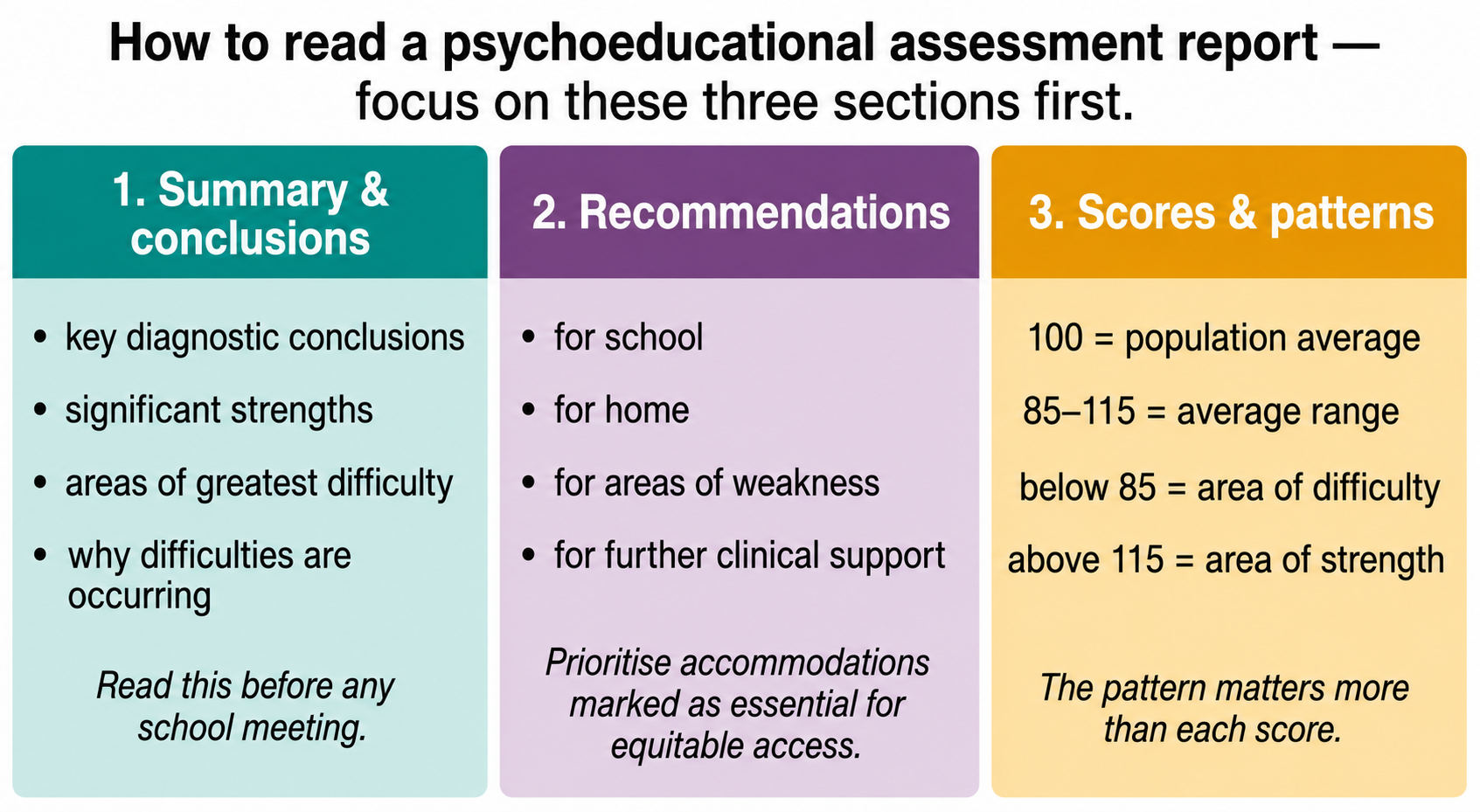
Focus on these three sections first.
The Summary and Conclusions
Most reports end with a summary in accessible language. This section brings together the key findings: diagnostic conclusions, the child’s most significant strengths, the areas of greatest difficulty, and why those difficulties are occurring.
If you read nothing else before a school meeting, read this section.
The Recommendations
This is the most practically important section for school purposes.
Recommendations are usually organised into categories: recommendations for the school, recommendations for home, recommendations for individual areas of weakness, and sometimes recommendations for further clinical support such as therapy or specialist tutoring.
Read school recommendations carefully. Note which ones are described as essential. Accommodations framed as necessary for the child to access learning equitably are the ones to prioritise. These are not optional extras. They are adjustments that allow your child to demonstrate what they actually know.
The Scores and Patterns
You do not need to understand every subtest score. But a basic grasp of how scores work helps.
Most reports use standardised scores where 100 is the population average. Scores between 85 and 115 fall within the average range. Scores below 85 indicate areas of relative difficulty. Scores above 115 indicate areas of relative strength.
What matters more than individual scores is the pattern. A child with very high reasoning scores but very low processing speed scores has a profile that explains a great deal about why they are capable in some contexts but slow and frustrated in others.
The psychologist’s written interpretation of the pattern is where the meaning lives. Look there, not just at the tables.
What Accommodations to Request
Accommodations adjust how a student accesses learning and assessment. They do not change what is being assessed. They remove barriers created by the learning difficulty.
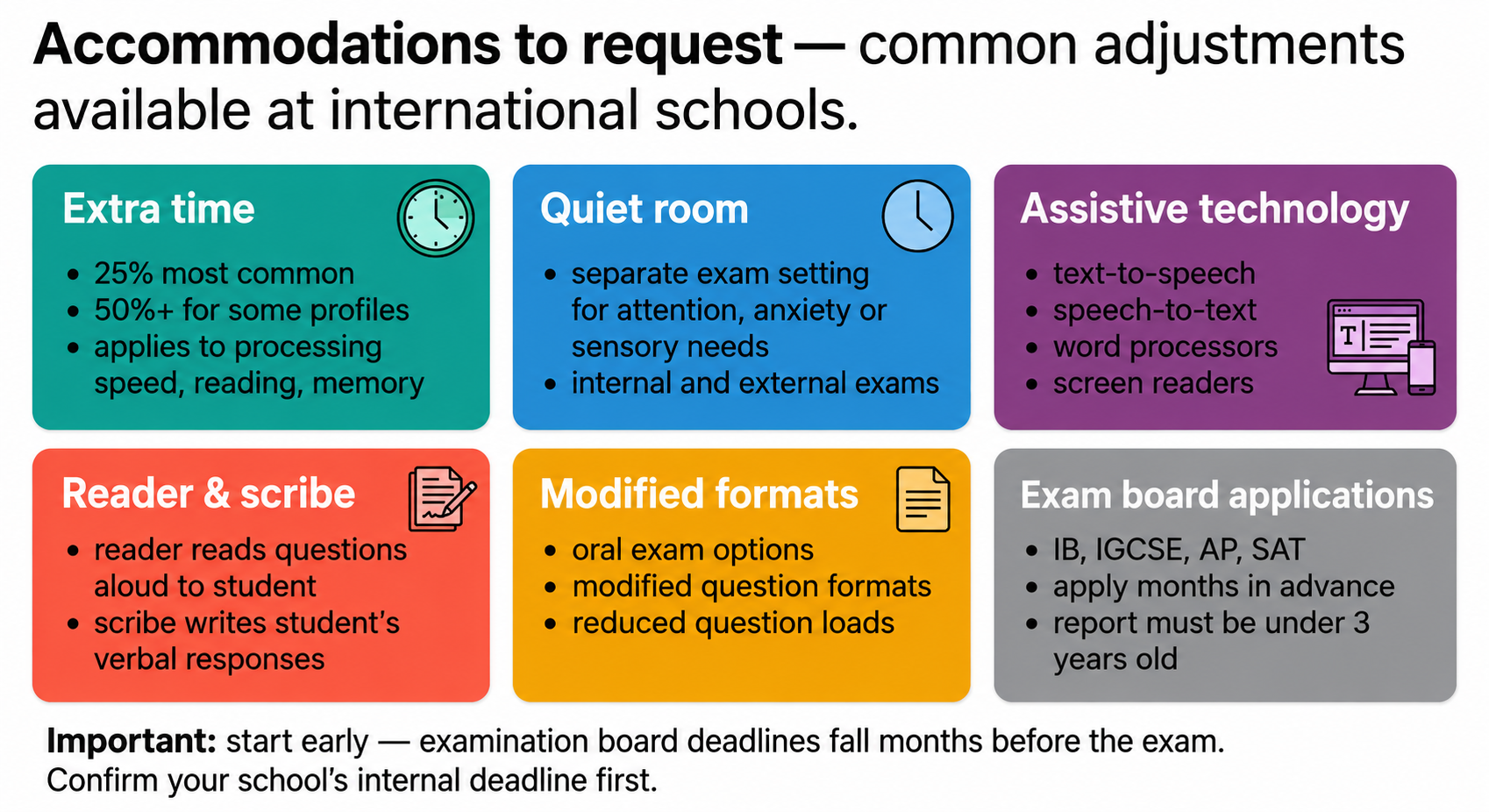
These are the most commonly recommended and requested accommodations in international school settings.
Extra Time
Extra time is one of the most widely used accommodations. It is relevant for students whose processing speed, reading fluency, working memory, or written output is affected.
Twenty-five percent extra time is the most common standard, but some students may be recommended fifty percent or more depending on their profile.
To request extra time for external examinations such as IGCSEs, IBs, or APs, SAT, you will typically need:
- A copy of the assessment report
- A letter from the assessing psychologist summarising the recommendation
- A formal application to the relevant examination board, which your school should be able to assist with.
Important: Examination board deadlines are often months before the exam. Start this process early.
A Quiet Room or Separate Setting
Students with attention difficulties, anxiety, or sensory sensitivities often perform significantly better in a smaller, quieter setting away from a full examination hall.
Most international schools can accommodate this for internal assessments. For external examinations, the same formal application process applies.
Assistive Technology
Assistive technology accommodations include:
- Text-to-speech software for students whose reading difficulties affect access to written material
- Speech-to-text software for students whose writing difficulties prevent them from expressing what they know
- Word processors for students with significant handwriting difficulties
- Screen readers or enlarged text for students with visual processing difficulties
Availability varies significantly between schools. Where a school cannot provide the recommended technology, families may need to source it independently and request that the student be permitted to use their own device.
Reader and Scribe
A reader reads examination questions aloud to a student with significant reading difficulties. A scribe writes down a student’s verbal responses for a student whose written output is significantly affected by their learning difficulty.
These accommodations require trained staff and careful implementation. Not all international schools can provide them. If the school cannot, discuss alternative accommodations that achieve a similar purpose, such as a word processor with voice recognition software.
Modified Assessment Formats
Some assessment reports recommend modifications beyond standard accommodations. These might include oral examination options, modified question formats, or reduced question loads.
These are more complex to implement. They are most readily available in schools with dedicated learning support departments and experienced SEND staff.
How to Approach the School
Find the Right Person
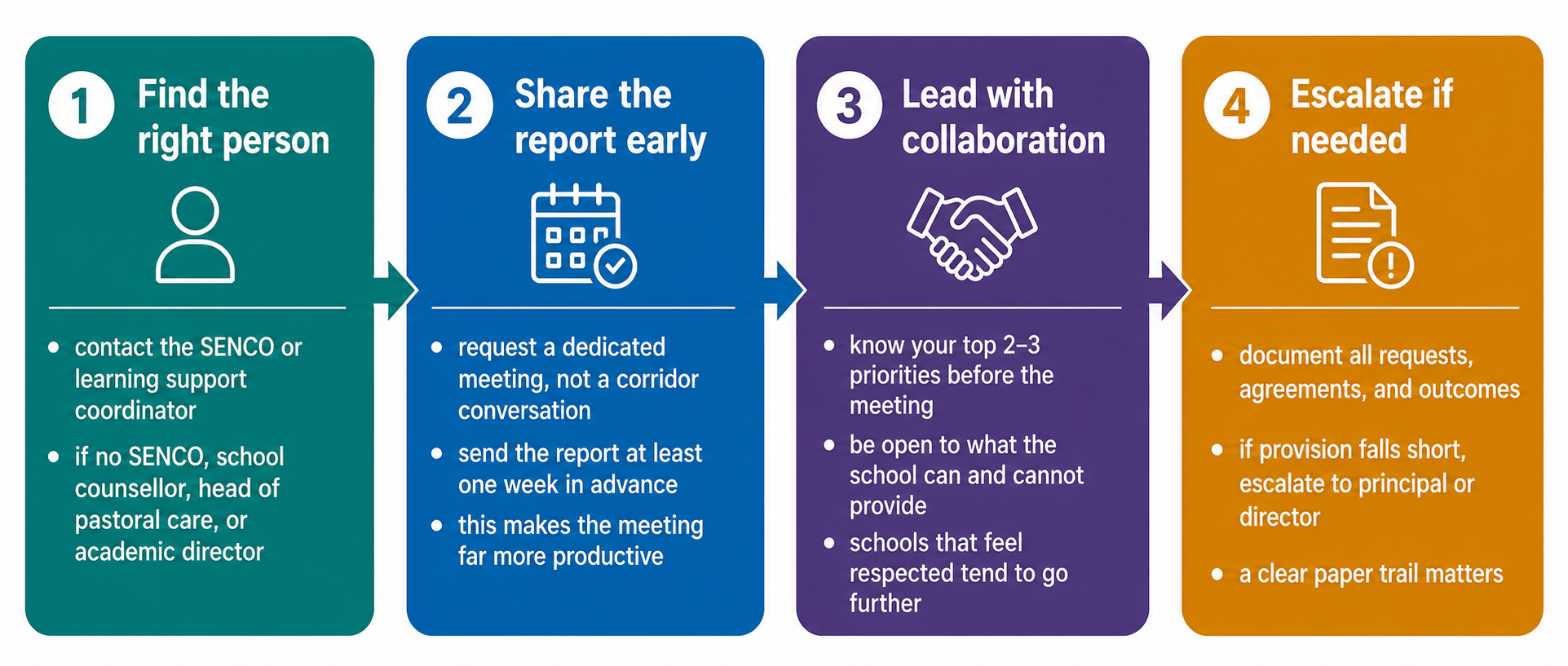
Do not start with the class teacher. In most international schools, the right person is the Special Educational Needs Coordinator, known as the SENCO or learning support coordinator.
If the school does not have a designated SENCO, contact the school counselor, head of pastoral care or the academic director.
Request a dedicated meeting. Do not try to have this conversation at pickup or in a corridor. Send the report in advance, at least a week before the meeting, so the school has time to read it. This makes for a far more productive conversation.
Lead With Collaboration
Come to the meeting knowing which two or three accommodations matter most for your child. Be open to hearing what the school can and cannot realistically provide.
Schools that feel confronted become defensive. Schools that feel respected tend to go further in finding solutions.
This does not mean accepting inadequate provision. It means starting collaboratively and escalating if genuine collaboration is not forthcoming.
Know What You Are Entitled to Ask For
In most international school contexts, there is no single legal obligation requiring schools to implement every recommendation in an assessment report. Entitlement depends on the school’s own policies, the requirements of the examination board, and the strength of the recommendations in your child’s report.
A well-written report from a qualified psychologist, clearly stating that specific accommodations are necessary for equitable access, is your most powerful tool in this conversation.
Plan Ahead for External Examinations
If your child is approaching IGCSEs, IB, AP, or other external examinations, the timeline for requesting accommodations is critical.
Find out your school’s internal deadline for submitting accommodation applications. This is typically earlier than the examination board’s own deadline.
Also confirm that the assessment report is current. Most examination boards require a report that is no more than three years old. Some require it to be more recent.
Follow up to confirm the application has been submitted and acknowledged. Do not assume.
When the School Has Limited Learning Support
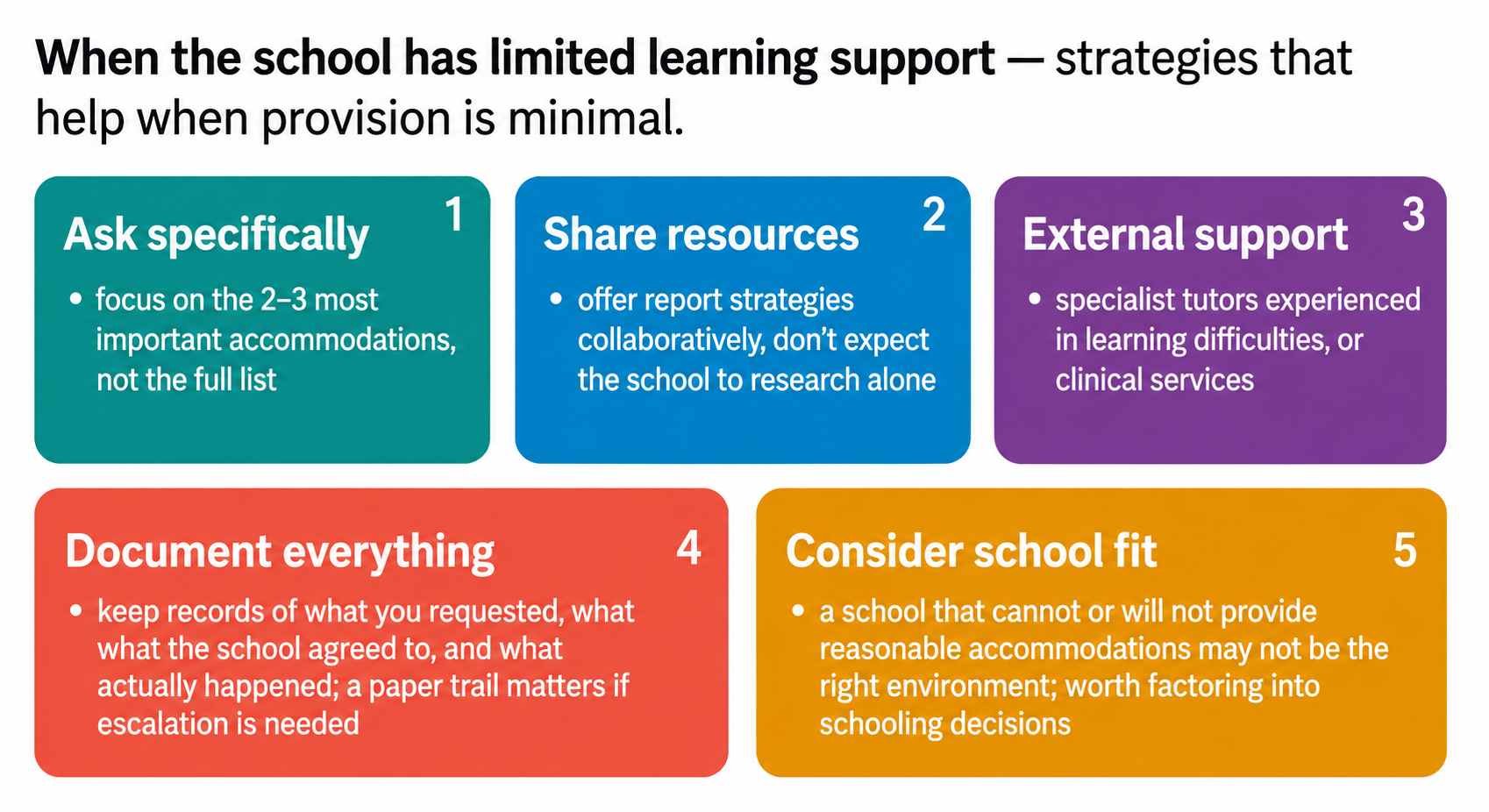
Not all international schools have the same capacity for learning support. These strategies can help families navigate the gap between what an assessment recommends and what a school is currently able to provide
Not all international schools have the same level of provision. Some have well-resourced learning support departments. Others, particularly smaller schools in certain locations, may have very limited capacity.
If you are in a school with limited provision, these approaches may help:
- Ask specifically what the school can provide rather than presenting the full list of recommendations at once. A focused conversation about the two or three most important accommodations is more productive.
- Offer to share resources. If the report includes specific strategies the school may not be familiar with, offering to share them collaboratively can be more effective than expecting the school to research independently.
- Explore external specialist support. Where the school cannot provide specialist teaching or therapeutic support, families may be able to access it externally through private tutors experienced in learning difficulties or through clinical services such as CALM International.
- Document everything. Keep a record of what you requested, what the school agreed to provide, and what actually happened. If provision falls significantly short and the school is not engaging constructively, a clear paper trail matters.
- Consider whether the school is the right fit. A school that cannot or will not provide reasonable accommodations for a student with identified learning needs may not be the right environment. That is worth factoring into decisions about schooling going forward.
Using the Report at Home
One prominent question parents ask is – should we share the report with our child? The answer depends on a number of things including the age of the child, the findings and diagnostic profile. Your psychologist will guide you in how best to approach the child with this information. A rule of thumb is to share findings surrounding strengths and weaknesses and how to strengthen weaknesses, and not necessarily to share diagnoses.
The report is not only for the school. The recommendations for home are equally important and often more immediately actionable.
Home recommendations typically address how to structure homework and study, how to support organisation and planning, how to build on the child’s specific strengths, and which apps or tools may help.
Children who understand why certain things feel difficult, and who have a vocabulary for their own cognitive profile, tend to develop significantly more effective self-advocacy skills. They also tend to have a more positive relationship with their own learning than children who are never told what the assessment found.
When You Need Support Navigating the Process
Translating an assessment report into implemented support can be straightforward. It can also be frustrating and unexpectedly complex, particularly in international school environments where policies vary widely.
At CALM International, we support families beyond the assessment itself. We can:
- Liaise directly with schools on behalf of families
- Help translate report findings into language schools need to implement accommodations
- Advise on examination board application processes
- Provide ongoing support for children and families navigating the practical and emotional dimensions of living and learning with a learning difficulty
If you have received an assessment report and are unsure how to use it, or if you are encountering resistance from your child’s school, a consultation with one of our clinicians is a practical next step.