
Mental health referral pathways in international schools are among the most important and most frequently underdeveloped systems a school can have. When a student begins to struggle, the difference between early effective support and a preventable crisis often comes down to one thing: whether the school has a clear, consistently followed process for identifying concern, assessing risk, and connecting that student to the right help.
This guide is written for school leaders and designated safeguarding leads who want to build or strengthen the systems that sit between a student showing early signs of difficulty and that student receiving appropriate support.
What Is a Mental Health Referral Pathway in a School?
A mental health referral pathway is a structured process that defines how concerns about a student’s psychological wellbeing are identified, assessed, documented, and escalated. An effective pathway specifies who can raise a concern, how urgency is triaged, what documentation is required, and when external clinical involvement is needed.
Without a defined pathway, schools default to informal decision-making. Concerns go unrecorded. Escalation depends on individual staff confidence. Students fall through the gaps, not because nobody cared, but because the system was not designed to catch them consistently. In international school settings, where staff turnover is high and student populations shift year on year, a documented referral pathway is not optional. It is a safeguarding requirement.
The Three-Tier Distress Framework for International School Mental Health Referral
At CALM International, clinicians working with international school communities use a three-tier model to structure triage decisions. Without clear thresholds at each level, staff either over-escalate minor adjustment difficulties or, more dangerously, under-escalate genuine risk.
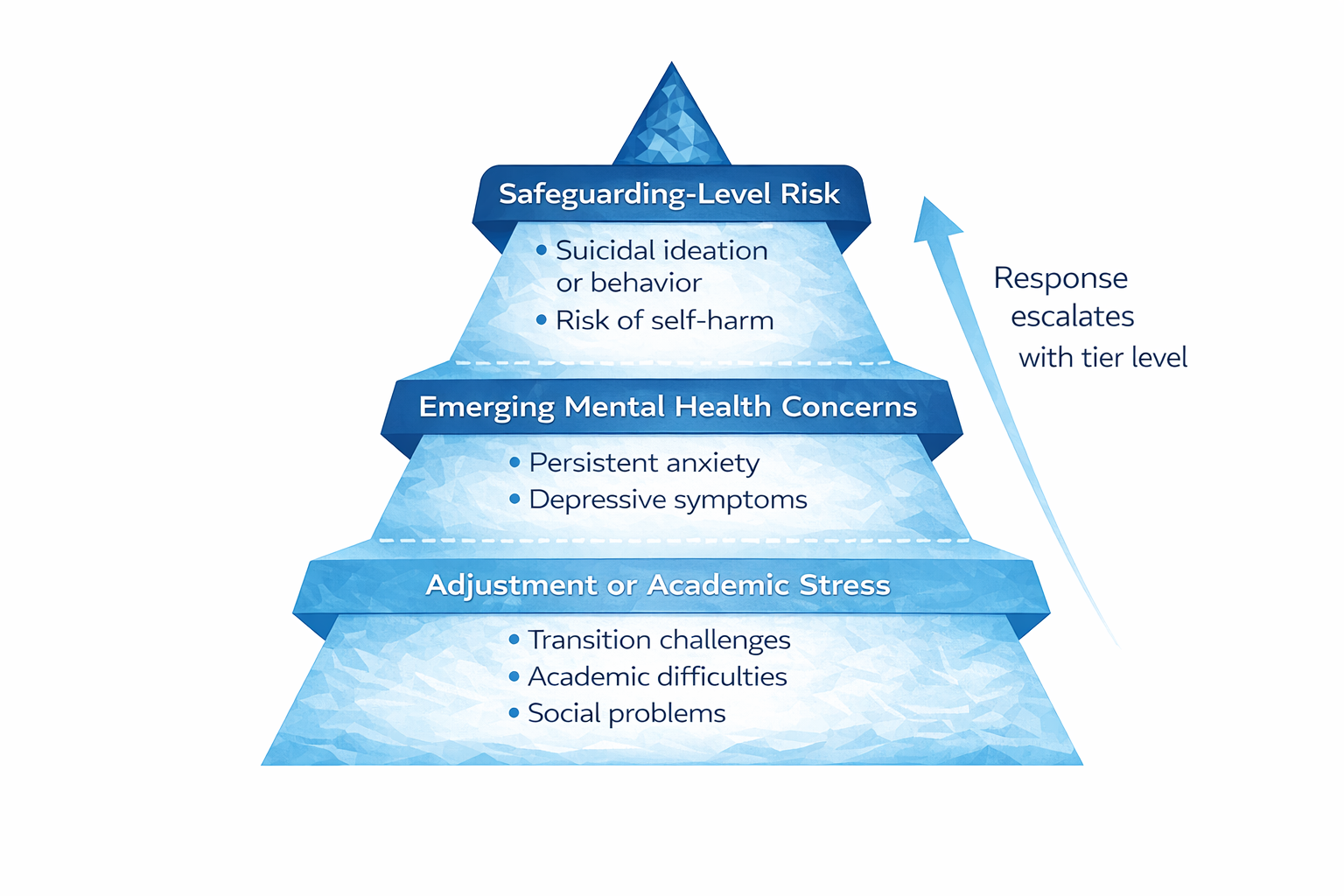
Tier 1: Adjustment or Academic Stress
Short-term mood changes, social withdrawal after a transition, temporary academic decline, and exam anxiety. Normal responses that require monitoring and a supportive teacher relationship, but not formal referral.
Tier 2: Emerging Mental Health Concerns
Persistent low mood beyond a reasonable adjustment period, functional impairment affecting school participation, ongoing school refusal, or escalating anxiety. These warrant a counsellor referral and, depending on trajectory, may require external clinical assessment.
Tier 3: Safeguarding-Level Risk
Indicators of self-harm, suicidal ideation, abuse or neglect disclosures, or behaviour placing the student or others at risk. These require immediate escalation through the designated safeguarding lead, with external clinical involvement frequently necessary.
Five Components of an Effective Mental Health Referral Pathway in International Schools
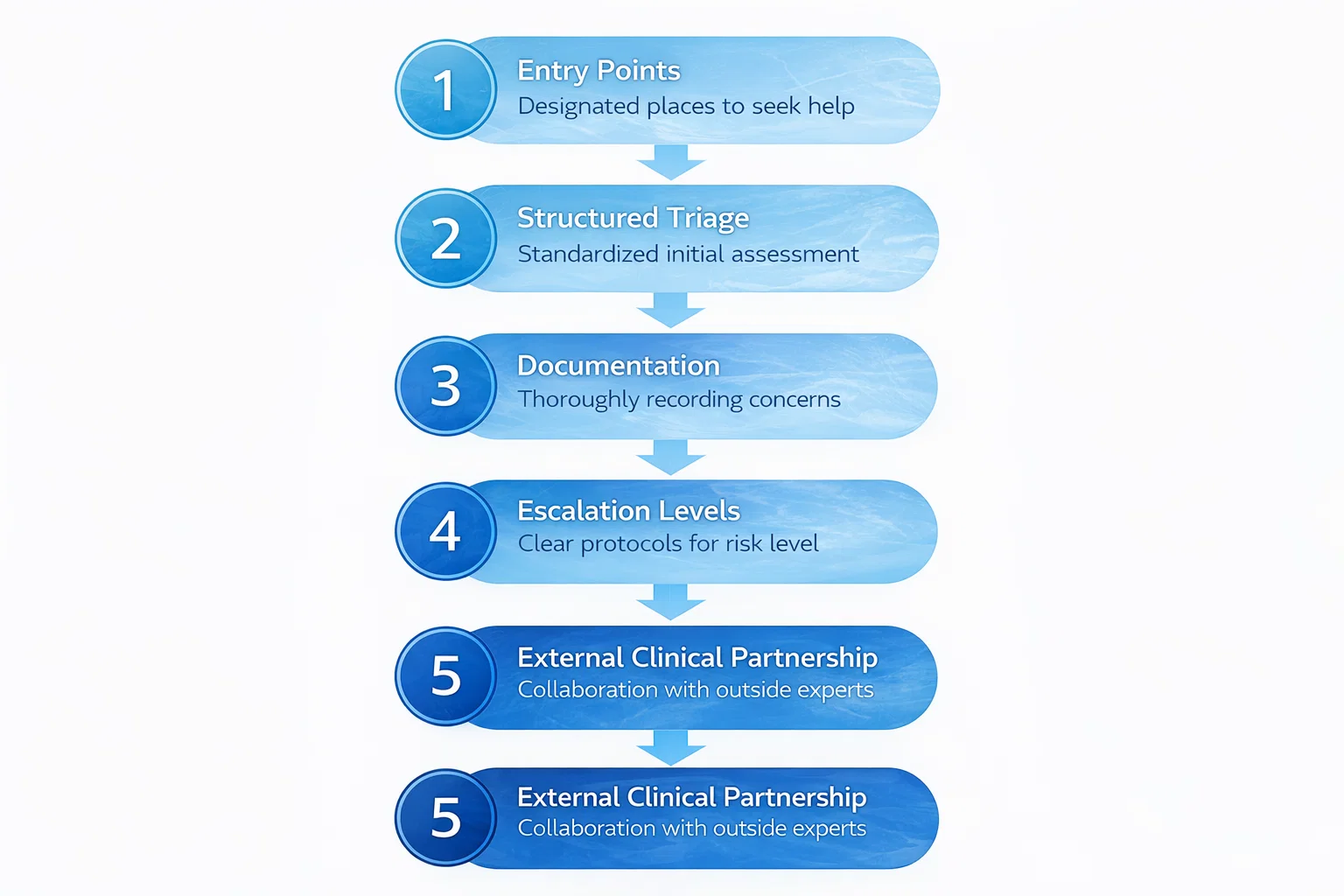
- Entry Points: Anyone can raise a concern, teachers, staff, peers, parents, or students themselves. Restricting entry to formal channels only means the earliest signals never reach the people who can act on them.
- Structured Triage Criteria: Concern assessed against defined criteria by the DSL or counsellor, not left to individual judgement. This is the most common failure point in international school safeguarding systems.
- Standardised Documentation: Date, context, observable behaviours, student statements, and actions taken. Consistent recording protects the student, the institution, and enables pattern recognition over time.
- Clear Escalation Levels: Internal monitoring, parental communication, counselling referral, external clinical assessment, and statutory reporting where applicable. Each level needs defined entry criteria and named responsibilities.
- External Clinical Partnership: Many international schools lack sufficient in-house capacity for complex risk assessment, trauma cases, or significant mood disorders. Access to an external clinician who understands the international school context is a core component, not an optional extra.
At CALM International, we work directly with school leadership and safeguarding teams to provide independent psychological assessment, risk clarification, and consultative guidance aligned with the realities of internationally mobile school communities.
The CALM International Safeguarding Maturity Model
Based on clinical and consultative experience across international school communities, CALM International uses the following four-level framework to assess a school’s safeguarding readiness.
Level | Pattern | Risk Profile |
Reactive | Crisis-driven, no defined pathway, ad hoc decisions | High variability, delayed intervention |
Developing | Informal systems, inconsistent application | Personality-dependent decision-making |
Structured | Defined pathways, staff trained in triage criteria | Reduced ambiguity, more consistent outcomes |
Integrated | Mental health is embedded in safeguarding, external clinical partnership in place | Sustainable risk management |
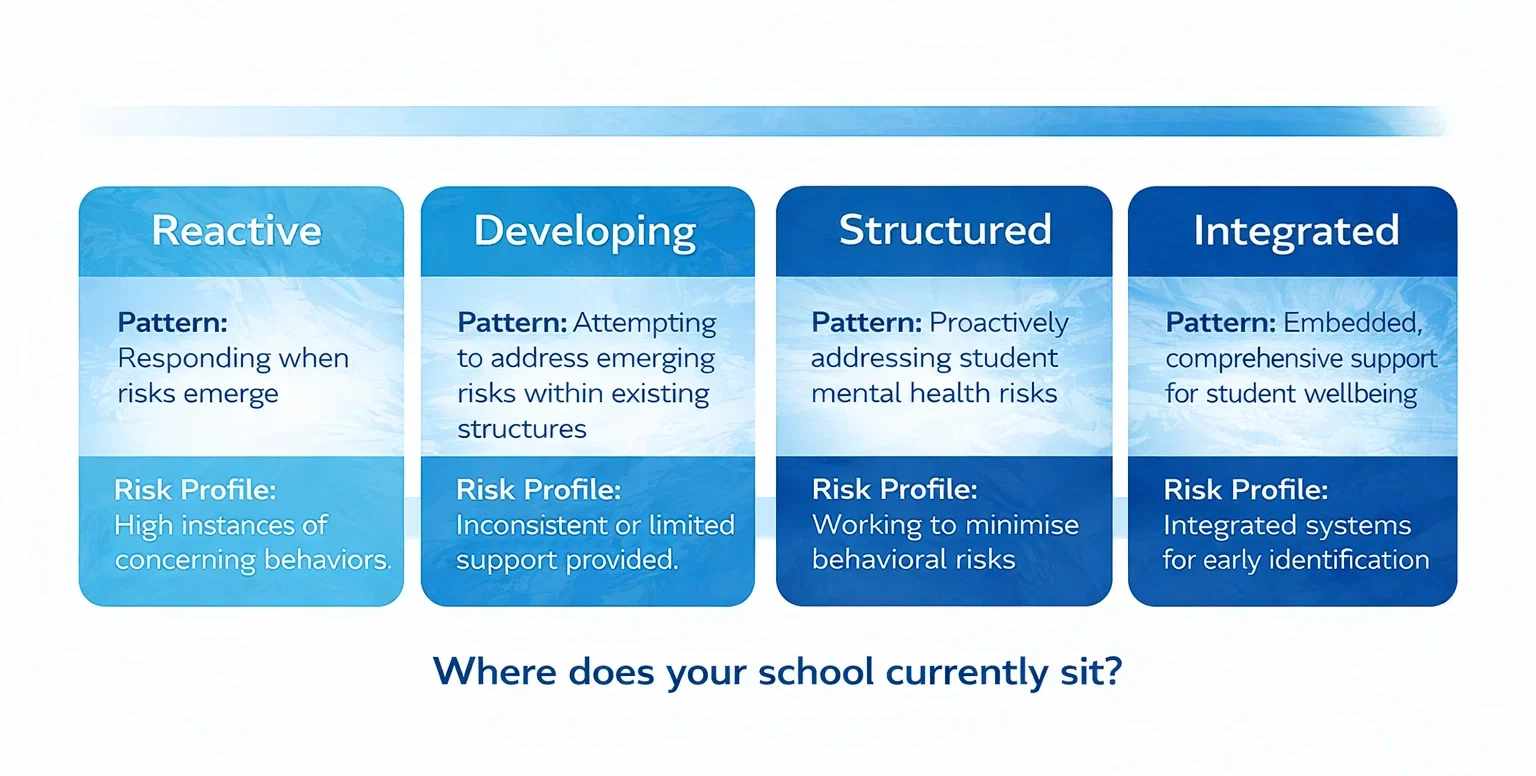
Most international schools operate across multiple levels simultaneously. The value of this framework is in identifying where the most impactful investment of time and resource lies.
From Safeguarding Policy to Student Protection
Policies do not protect students. Systems do. The international schools that manage mental health risk most effectively have invested in clear referral pathways, structured triage, consistent documentation, and reliable external clinical access. These are not expensive or structurally complex to build. They require deliberate design and the institutional will to treat safeguarding as a system rather than a set of good intentions.
For a broader overview of how international schools can approach student mental health systemically, see our guide on Mental Health Support in International Schools.
At CALM International, we work with school leadership teams to audit existing provision, identify gaps, and build referral pathways proportionate to the school’s context. If you are a school leader or DSL who wants to strengthen your safeguarding and mental health systems, a consultation is a practical first step.