
Language barriers and academic stress in international schools are closely linked, yet often misunderstood. Students studying in a non-native language navigate not only curriculum expectations, but also additional cognitive, social, and emotional demands that shape their academic experience.
In academically rigorous settings such as IB, IGCSE, or AP programmes, these language-related demands can intersect with performance visibility, peer comparison, and university preparation pressure. While language acquisition is often approached as a learning adjustment, it can also influence confidence, classroom participation, identity development, and emotional wellbeing.
For some students, the additional cognitive load remains manageable. For others, sustained linguistic strain may contribute to academic stress or performance anxiety that is not immediately visible through grades alone.
Understanding how language transition interacts with academic pressure requires both psychological insight and institutional awareness.
For a broader systems overview, see: Mental Health Support in International Schools: A Practical Guide
How Language Barriers Increase Cognitive Load and Academic Stress
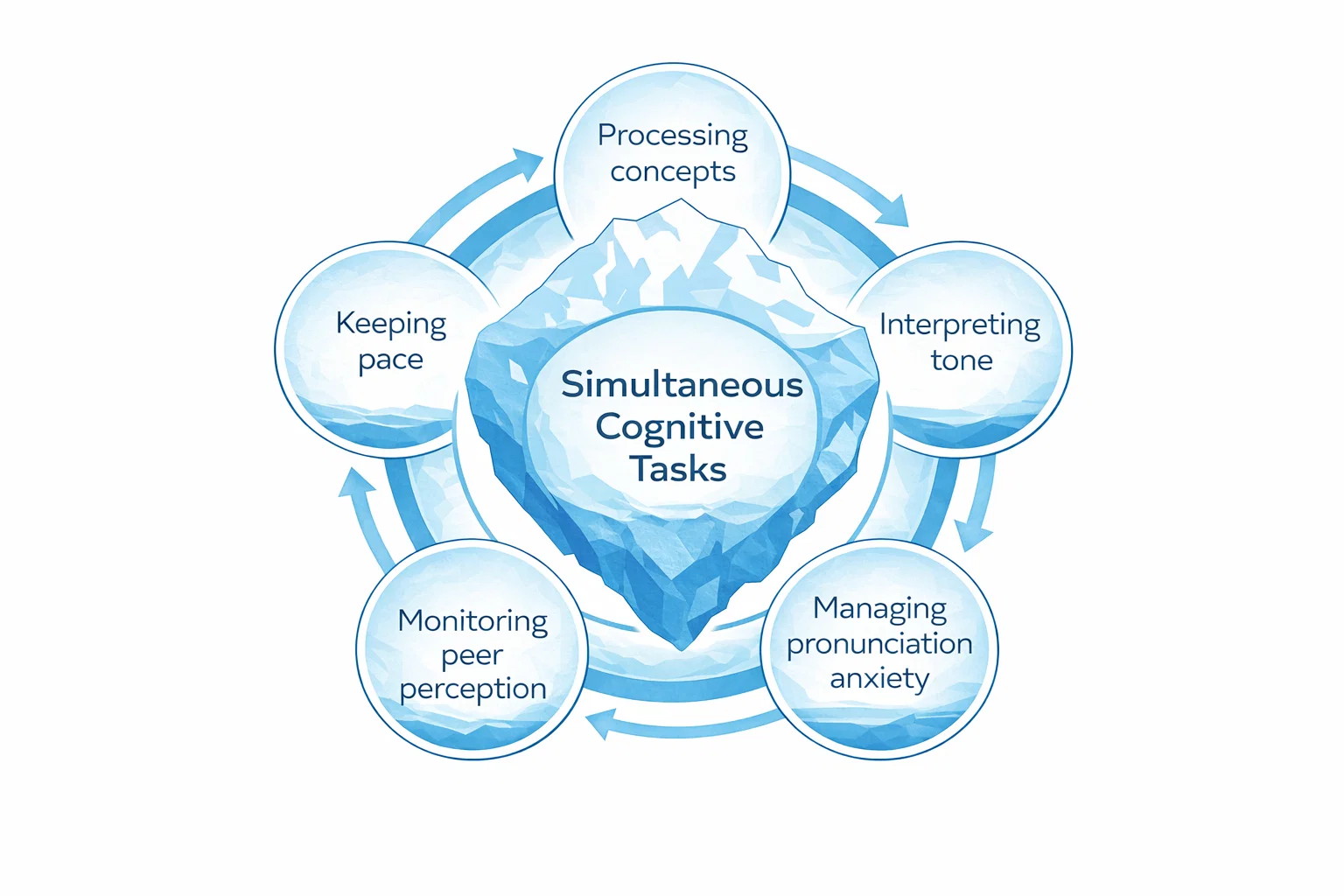
When students learn in a non-native language, they are not only translating vocabulary. They are simultaneously:
- Processing complex academic concepts
- Interpreting tone and nuance
- Managing pronunciation anxiety
- Monitoring peer perception
- Attempting to keep pace with native speakers
This creates additional cognitive load.
Even highly capable students may experience:
- Slower processing speed
- Mental fatigue
- Increased self-monitoring
- Reduced confidence in verbal participation
Over time, persistent cognitive overload may contribute to emotional strain. In international schools, language barriers often amplify academic stress by increasing cognitive demand, reducing participation confidence, and making performance more visible.
How Language Barriers Contribute to Academic Stress and Performance Anxiety
Academic environments such as IB, IGCSE, and AP programmes often emphasise:
- Verbal discussion
- Essay-based assessment
- Presentation skills
- Timed written examinations
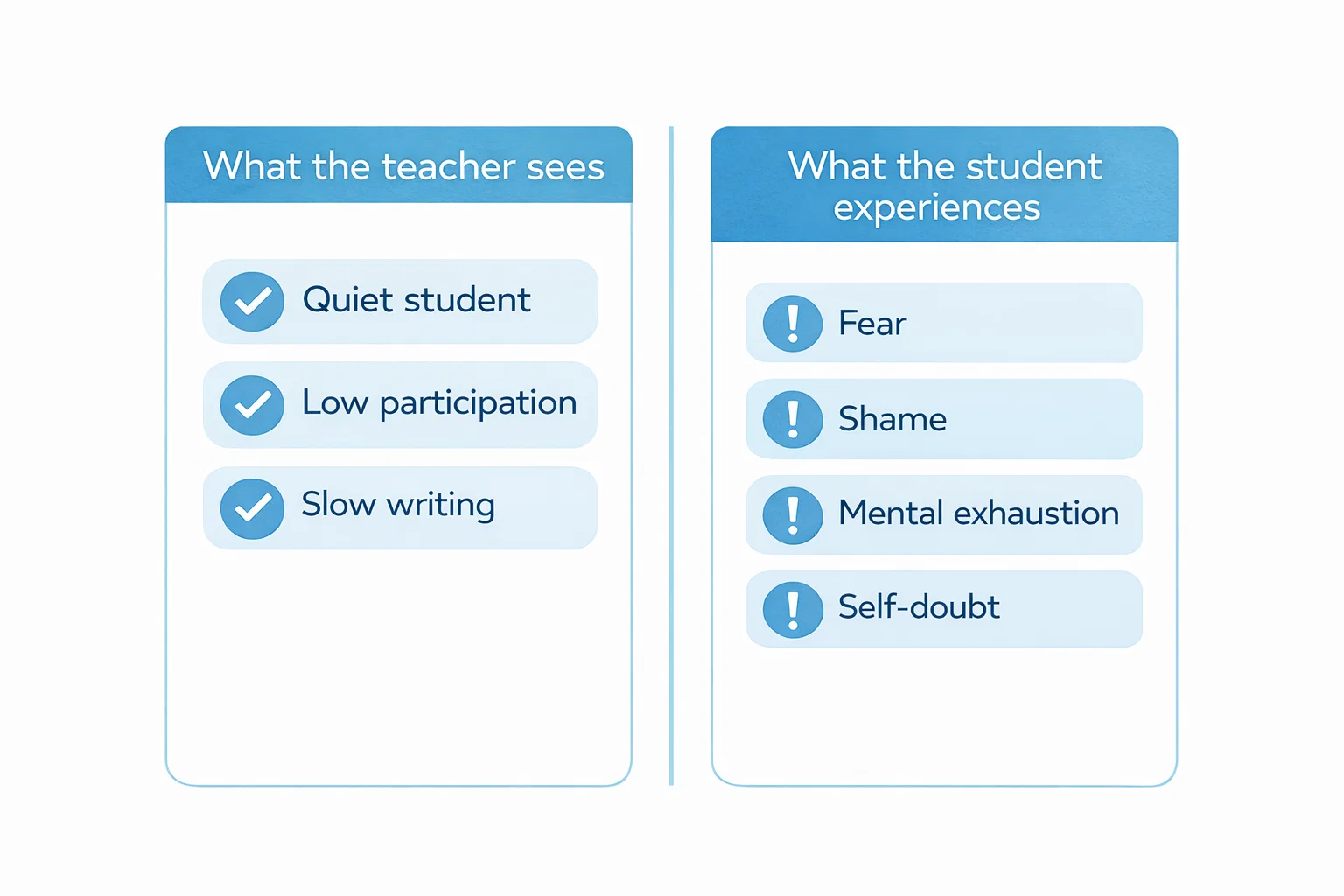
For students navigating language transition, performance becomes highly visible.
Common emotional responses include:
- Fear of public speaking
- Avoidance of classroom participation
- Perfectionism in written work
- Heightened exam anxiety
- Shame around grammatical errors
Performance anxiety may develop not because of intellectual difficulty but because of perceived linguistic inadequacy.
This distinction is critical.
Social Implications of Language Transition
Language affects belonging.
Students studying in a second language may:
- Struggle with humour or cultural references
- Avoid informal peer interaction
- Feel excluded from fast-paced conversations
- Withdraw socially to reduce embarrassment
Social withdrawal can then reinforce academic anxiety, creating a feedback loop:
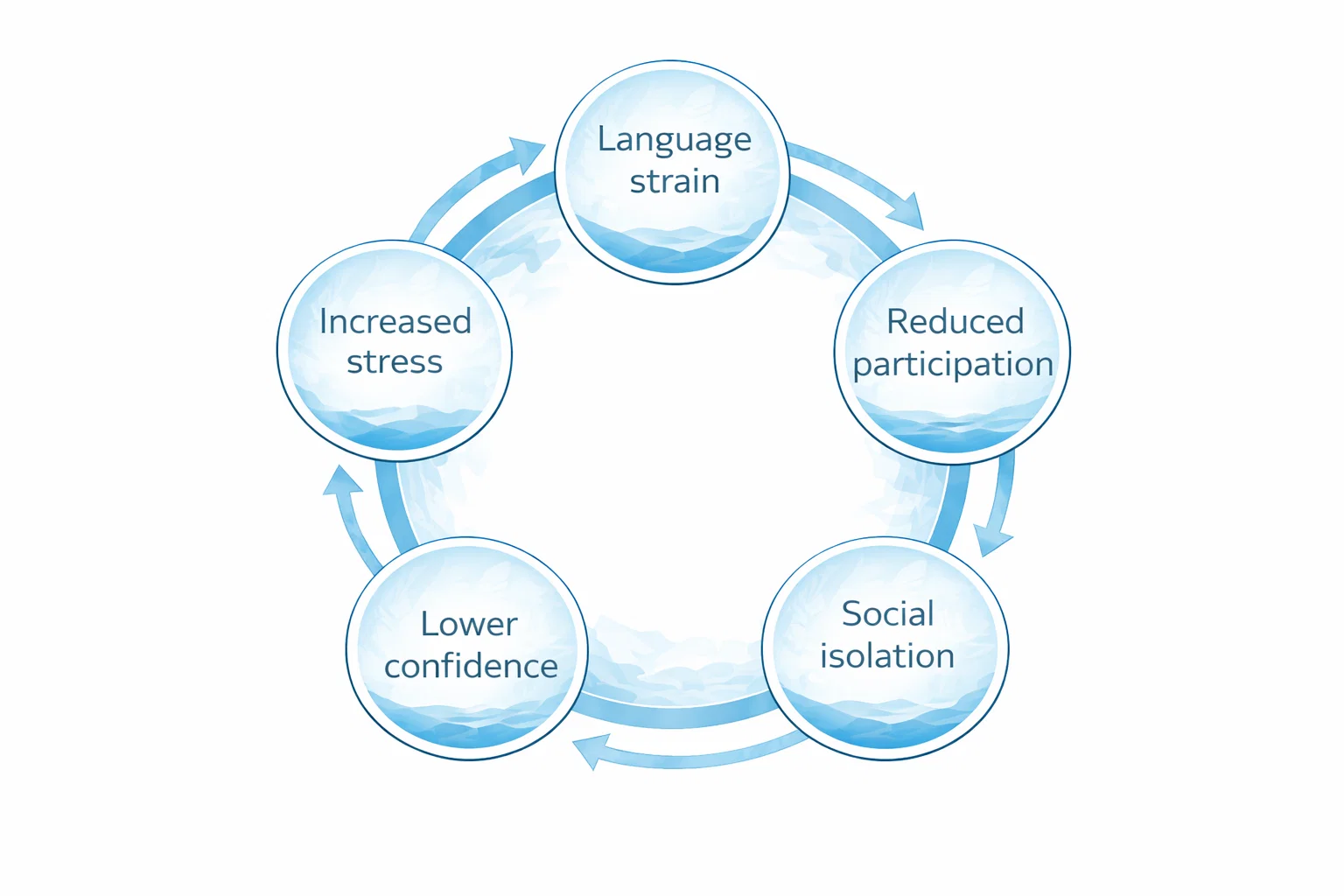
Without awareness, schools may interpret this pattern as introversion rather than strain.
Signs That Language Stress Is Affecting Student Mental Health
Short-term language adjustment is normal. However, schools should monitor when stress becomes persistent.
Warning indicators may include:
- Declining academic engagement
- Avoidance of specific subjects
- Frequent somatic complaints (headaches, stomach pain)
- Sleep disruption before presentations or exams
- Persistent self-critical statements
- Withdrawal from extracurricular activities
Language stress may coexist with:
- Generalised anxiety
- Depressive symptoms
- Identity confusion
- Perfectionism
Early identification reduces long-term risk.
For related identity patterns, see: Third Culture Kids (TCKs) and Emotional Wellbeing in International Schools
What International Schools Can Do to Support Multilingual Students
It is easy to frame language adjustment as an individual student responsibility.
However, international schools operate multilingual environments by design.
Institutional responsibility includes:
- Differentiating between language proficiency and cognitive ability
- Avoiding over-identification of learning disorders without cultural assessment
- Ensuring language support structures are robust and visible
- Aligning academic pacing with language transition realities
Language transition should not be treated as a temporary inconvenience—it is a developmental factor.
Why High-Achieving ESL Students Still Struggle With Anxiety
A particularly complex pattern occurs among high-performing international students.
These students may:
- Overcompensate through excessive studying
- Avoid seeking help
- Internalise mistakes as identity failure
- Maintain strong grades while experiencing chronic anxiety
From an institutional perspective, these students may not trigger concern because performance remains high.
From a clinical perspective, they may be at risk of burnout.
CALM International frequently observes that language-related stress in high-achieving students remains hidden until emotional exhaustion surfaces.
Monitoring wellbeing must extend beyond academic metrics.
How Teachers Can Identify Language-Related Stress in Students
Teachers are often first to observe subtle shifts.
Effective staff awareness includes:
- Recognising avoidance patterns
- Monitoring sudden participation changes
- Noting perfectionism spikes
- Identifying disproportionate stress reactions
Staff training should emphasise:
- Sensitivity to cultural differences
- Language-related emotional patterns (such as differences in how emotions are expressed across languages, or children feeling more able to communicate certain feelings in one language than another)
- Distinguishing between defiance and fear or anxiety
- Early supportive conversation skills
Psychological safety encourages disclosure.
Structured Support Strategies for International Schools
1) Academic Scaffolding
- Language-sensitive assessment feedback
- Flexible presentation formats
- Structured vocabulary reinforcement
- Writing support clinics
Scaffolding reduces anxiety without lowering standards.
2) Psychological Safety in Classrooms
Students are more likely to participate when:
- Mistakes are normalised as the path to learning
- Language diversity is respected
- Peer correction is moderated
- Teachers model patience
Psychological safety reduces performance anxiety.
3) Early Screening and Referral Pathways
When language-related stress begins affecting wellbeing, schools should:
- Document patterns
- Engage pastoral/counselling teams
- Communicate with parents
- Activate referral pathways where appropriate
4) Access to Context-Aware Clinical Support
When language stress escalates into persistent anxiety or emotional difficulty, professional mental health support may be appropriate.
Effective clinical support should:
- Understand multilingual identity development
- Differentiate cultural adjustment from pathology
- Align with school safeguarding frameworks
- Communicate appropriately with families
For schools seeking structured, context-aware support, explore our school-based mental health services for international schools, designed to integrate with existing safeguarding and pastoral systems.
Language Difficulty vs Learning Disorders: How Schools Can Tell the Difference
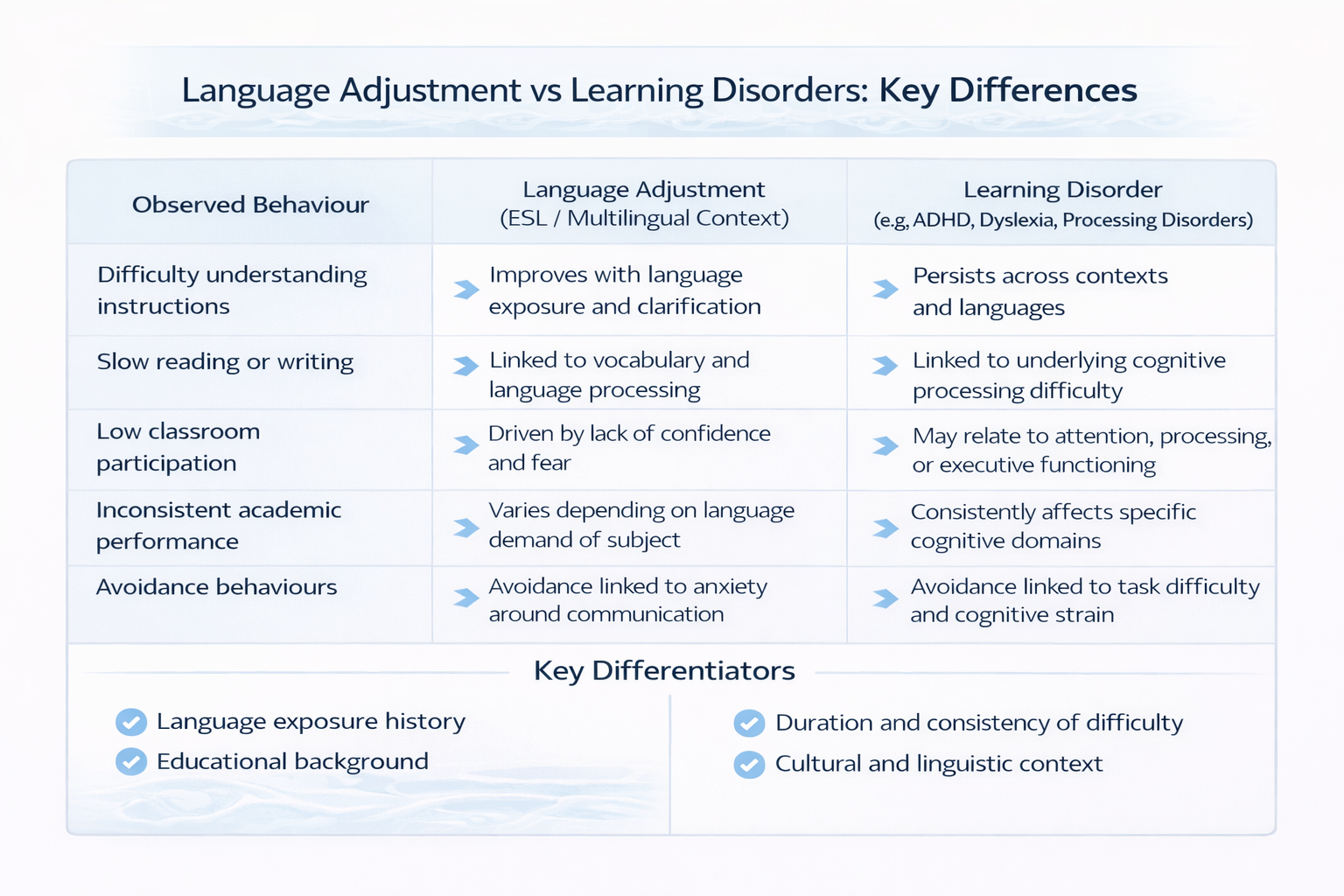
A critical institutional challenge is avoiding premature pathologising.
Language-related performance difficulty may resemble:
- ADHD
- Dyslexia
Processing disorders
Without culturally informed assessment, students risk misclassification.
Professional evaluation should consider:
- Length of language exposure
- Educational history
- Cultural learning differences
- Trauma or transition stress
Misdiagnosis can compound emotional harm.
Why “Try Harder” Doesn’t Work for Multilingual Students
Students navigating language transitions are often told to:
- Work harder
- Practice more
- Speak up confidently
While effort matters, structural design matters more.
International schools can reduce strain through:
- Predictable academic timelines
- Transition support programmes
- Integrated ESL and counselling collaboration
- Clear referral clarity
Language stress should be managed institutionally—not individualised as weakness.
Conclusion
Language barriers and academic stress in international schools are not isolated challenges. They intersect with identity, belonging, performance visibility, and academic expectations.
When unaddressed, language-related stress can contribute to anxiety, disengagement, or burnout, even among high-achieving students.
International schools that embed language-sensitive design, staff awareness, structured referral pathways, and clinically informed partnerships create environments where multilingual students can thrive confidently.
As part of a broader international school mental health framework, CALM International supports schools in identifying and responding to language-related academic stress through structured assessment, student support, and consultative guidance aligned with safeguarding systems.