
Choosing a child psychologist involves considering their professional qualifications, experience with your child’s needs, and approach to assessment or therapy. Clear communication with parents and a supportive relationship with the child are also important foundations for care.
Parents may seek guidance after noticing changes in their child’s emotions, behaviour, learning or relationships. Sometimes these concerns are clear; at other times, it can be difficult to understand what has changed or whether professional support is needed.
This guide explains the different professional roles, the credentials to consider in Singapore, and the questions that can help you make an informed decision for your child.
What is the difference between a child psychologist, a psychiatrist and a counsellor?
Psychologists, psychiatrists and counsellors may work with similar concerns, but their training and scope of practice differ. The most appropriate professional will depend on your child’s needs and whether the priority is psychological assessment, therapy, educational support or medical care.
A clinical psychologist assesses and treats emotional, behavioural and mental health difficulties through talking therapies, and cannot prescribe medication. A child psychiatrist is a medical doctor who can diagnose and prescribe. An educational psychologist focuses on learning and school functioning. A counsellor or psychotherapist provides talking therapy, with training that varies more widely than the other three.
| Professional | Training | Areas of support | Prescribes medication? | When their expertise may be relevant |
|---|---|---|---|---|
| Clinical psychologist | Postgraduate clinical psychology training, including supervised practice | Assessment and psychological therapy for emotional, behavioural and mental health concerns | No | Understanding psychological difficulties and developing a treatment plan |
| Educational or school psychologist | Specialist training in educational or school psychology; requirements vary by jurisdiction | Learning, development, school functioning and psychoeducational assessment | No | Understanding learning needs and identifying appropriate educational support |
| Child and adolescent psychiatrist | Medical degree and specialist training in psychiatry, with child and adolescent expertise | Medical and psychiatric assessment, diagnosis and treatment, including medication where appropriate | Yes | Medical assessment, medication or specialist psychiatric care may be needed |
| Counsellor or psychotherapist | Relevant counselling or psychotherapy training; qualifications and registration requirements vary | Therapy for emotional, behavioural, relationship and adjustment concerns within their competence | Not through this qualification alone | Therapeutic support suited to the practitioner’s training and the child’s concerns |
An initial consultation can help determine whether a child would benefit from assessment, therapy or a referral to another professional. A formal psychological assessment is not necessary for every child, and therapy itself usually begins with an assessment of the presenting concerns.
Some children benefit from the involvement of more than one professional. Collaboration can help address needs that span mental health, learning, development and family life, with appropriate consent and clear communication between those involved.
Is “psychologist” a protected title in Singapore?
Singapore’s regulatory framework for psychologists is developing. The Singapore Psychological Society currently describes the Singapore Register of Psychologists (SRP) as a voluntary professional register rather than a statutory licensing board. Its membership guidance states that mandatory professional licensing is not currently in place.
The Ministry of Health has announced plans for phased mandatory registration of five psychology subdisciplines: clinical, clinical neuropsychology, counselling, educational and forensic psychology. Its March 2026 announcement states that the detailed registration schedule and requirements will be announced by early 2027. Once implemented, the framework will protect the relevant registered job titles. See the MOH registration announcement and explanation of title protection.
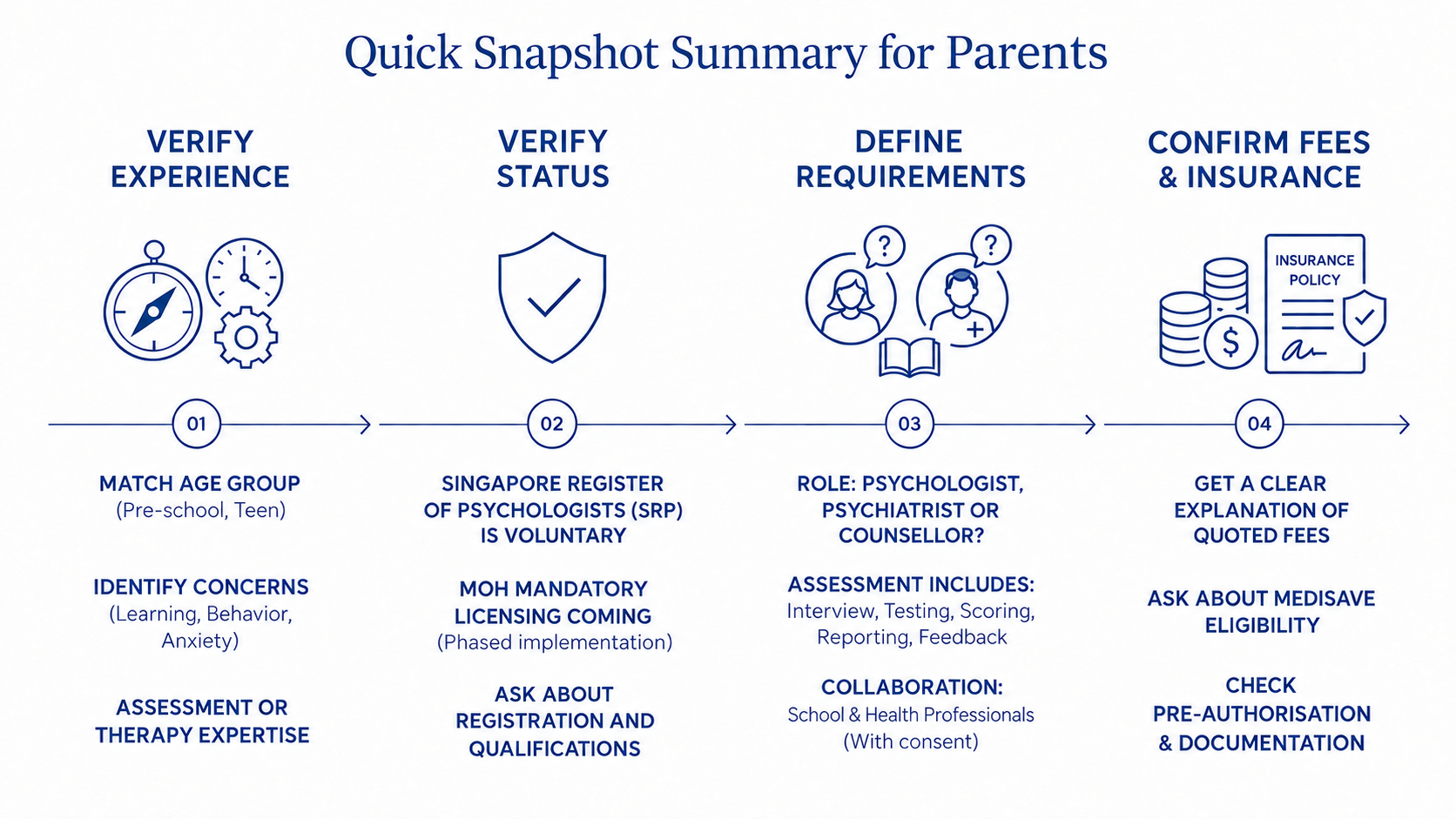
For parents, the practical priority is to verify a clinician’s qualifications, current registration status and relevant experience. Membership of a professional society should not be assumed to mean registration as a practising psychologist.
SRP registration indicates that a practitioner has met the Society’s requirements for professional psychology training and experience. Parents can check the SPS directory for the practitioner’s registered status and stated area of practice.
Some clinicians also hold registration with an overseas regulator, such as the Health and Care Professions Council in the United Kingdom, a relevant state licensing board in the United States, or the Psychology Board of Australia through Ahpra. These credentials should be checked for their current status, scope and any conditions. Overseas registration should not be treated as automatic authorisation to practise in every country.
Families are entitled to ask about a clinician’s training and professional standing. This information should be communicated clearly to support an informed choice.
How much does a child psychologist cost in Singapore?
Fees depend on the service, clinician, appointment duration and scope of work. An individual therapy appointment and a comprehensive psychoeducational assessment involve different processes, so their costs should be considered separately.
Before proceeding, ask for a clear explanation of what the quoted fee includes. For assessments, this may include parent interviews, testing, scoring, a written report and a feedback session. School observations, liaison with other professionals or additional reports may be charged separately.
Insurance and MediSave
Confirm coverage with both the practice and your insurer before booking. Ask about referral or pre-authorisation requirements, eligible services, claim limits and the documentation needed for reimbursement. MediSave eligibility should also be checked for the specific service and provider.
At CALM International, we work with a range of international insurance providers to make accessing care as simple as possible. Before your child’s appointment, our team can review your insurance details, verify mental health benefits, and check for any authorization requirements with your insurer. Once coverage is confirmed, we will explain any applicable out-of-pocket costs. Depending on your policy, claims can be submitted directly to your insurer, or we can provide the required documentation for you to seek reimbursement. Because MediSave eligibility and specific referral requirements vary by policy and provider, we recommend confirming these details with your insurer and our team during your initial inquiry.
Appointment availability
Ask when an initial appointment is available and whether subsequent sessions can be scheduled at suitable intervals. For assessments, clarify the expected timeline from the first consultation to the feedback session and completed report.
For instance, at CALM International, initial consultations are available based on the clinician’s next availability, typically starting within a couple of days. Assessments involve 5-6 sessions of testing followed by the feedback session and provision of the report.
Number of sessions
The number of sessions depends on the child’s needs, agreed goals and response to support. A clinician may provide an initial estimate, explain its basis and review it as the work progresses. Families should understand when progress will be discussed and how decisions about continuing or concluding therapy will be made.
How do I match the clinician to my child?
Relevant experience is an important consideration alongside qualifications. Working with a young child requires different communication and assessment approaches from working with an adolescent. Similarly, expertise in one area does not necessarily extend to every childhood concern.
Ask whether the clinician regularly works with:
- Your child’s age group. Communication, therapeutic methods and parental involvement should reflect the child’s developmental stage.
- The concerns you have identified. Anxiety, behavioural difficulties, trauma, learning differences, neurodevelopmental concerns and family transitions may require different expertise.
- The type of support being considered. Assessment and therapy involve related but distinct skills. Some clinicians provide both; others specialise in particular services.
The professional who conducts an assessment may refer your child to another clinician for ongoing therapy. Where this is recommended, the practice should explain the reason and how relevant information will be shared, with consent, to support continuity of care.
What should I ask a child psychologist before booking?
An initial enquiry is an opportunity to understand the clinician’s experience, proposed approach and practical arrangements. Questions may include:
- What are your professional qualifications and current registration details?
- What experience do you have with children of this age and with similar concerns?
- What would the initial consultation and subsequent sessions involve?
- How will parents be involved, and how will confidentiality be explained?
- When appropriate, how do you collaborate with schools or other professionals?
- How are goals established, progress assessed and the plan reviewed?
- What are the fees, and what documentation is available for insurance claims?
A clinician should be able to explain their recommendations in accessible language, discuss the limits of their expertise and identify when another professional may be better placed to help.
Recommendations should follow an adequate understanding of the child’s needs. Guaranteed outcomes, firm diagnoses without sufficient assessment, or pressure to commit to treatment without a clear rationale warrant further clarification.
Does the relationship between my child and the psychologist matter?
Yes. A supportive therapeutic relationship helps create the conditions in which a child can participate, express concerns and work towards agreed goals.
Trust may develop gradually. Some children are initially hesitant, particularly when they are uncertain about why they are attending or what will be expected of them. Early reluctance does not necessarily indicate that the clinician is unsuitable.
Consider whether the clinician listens respectfully, explains the process and adapts their communication to your child. Over time, your child should have opportunities to express preferences, raise concerns and contribute to the work in a developmentally appropriate way.
Practical considerations also matter. Appointment times, travel, language preferences and continuity with the same clinician can affect how manageable ongoing support is for the family.
If concerns about the relationship persist, discuss them with the clinician. Reviewing the approach or arranging a referral may be appropriate when the child’s needs would be better supported elsewhere.
What should internationally mobile families consider?
Families who move between countries may need to consider continuity of care, school requirements and the role of language and culture when choosing a psychologist.
Continuity of care. If relocation is likely, discuss this early. Online sessions after a move depend on clinical suitability and the professional requirements in the relevant countries. Where continued care is not possible, a planned referral and handover can help support the transition.
Assessment reports and school requirements. Schools and examination boards may have specific requirements for assessment methods, professional qualifications and the age of a report. Acceptance should be confirmed with the receiving institution. Explain any intended use of the report before the assessment begins.
Language and cultural understanding. A child’s preferred language, family background and experience of moving between cultures can influence how they communicate and experience support. Ask about the clinician’s experience with multilingual families, third-culture children and international school environments.
What happens in the first few sessions?
The initial process depends on the child’s age, concerns and the type of service being considered. It commonly includes:
- A consultation with parents or caregivers to understand developmental history, current concerns and the child’s home and school circumstances.
- Time with the child using an approach suited to their developmental stage, communication needs and comfort.
- Relevant information from the school or other professionals, where appropriate and with consent.
- A feedback discussion explaining the clinician’s initial understanding, any areas requiring further assessment and recommendations for support.
- An agreed plan outlining goals, parental involvement and when progress will be reviewed.
The sequence may vary, and some assessments require several appointments. The clinician should explain the purpose of each stage and provide opportunities for questions throughout the process.
Sources
- Singapore Psychological Society — Singapore Register of Psychologists
- Singapore Psychological Society — Membership guidance and FAQs
- Singapore Psychological Society — Member and registered psychologist directory
- Ministry of Health — Enhancing quality and coordination of care, 5 March 2026
- Ministry of Health — Regulatory framework and consumer safeguards, 7 May 2026
- Health and Care Professions Council — Professional register and information
- Australian Health Practitioner Regulation Agency — Registration information
This article provides general information for parents and caregivers and is not a substitute for an individual psychological or medical assessment. Fees, registration requirements and coverage arrangements may change. Confirm current details with the practice, relevant professional body or insurer.
Finding the right support for your child
Choosing a psychologist is a decision about the care your child needs and the professional best placed to provide it. Relevant qualifications, appropriate experience, clear communication and a respectful therapeutic relationship all deserve consideration.
Your knowledge of your child’s history, strengths and daily experiences is an important part of this process. Effective care brings that understanding together with clinical expertise and the child’s own perspective.
At CALM International, we welcome enquiries from parents who would like guidance on the next step. Contact our team to discuss whether an initial consultation, psychological assessment or therapy may be appropriate for your child.