
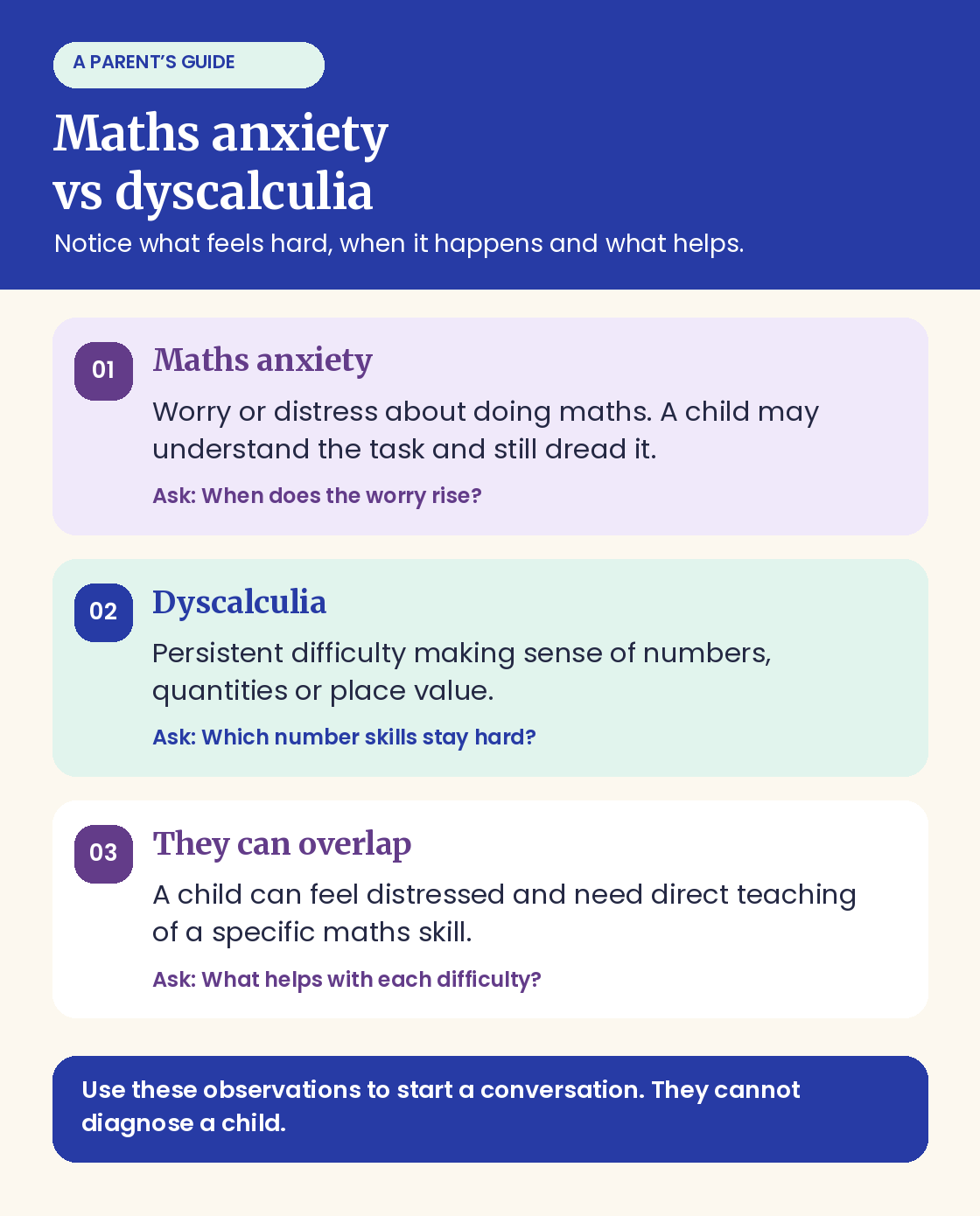
Maths anxiety is distress tied to doing or anticipating maths. Dyscalculia is a specific learning difficulty involving persistent problems understanding and working with numbers. A child can experience either or both. To decide what support to seek, look at the skills your child finds hard, the situations that increase distress, and what changes after targeted teaching and support. A single test score or difficult homework session cannot tell you the cause. SASC’s 2025 definition and research by Devine and colleagues explain why the two deserve separate attention.
Perhaps your child explains a calculation at the kitchen table but goes blank when the classroom timer starts. Or they are willing to try and still struggle to show why 42 is larger than 24. In either situation, “practise harder” is too vague. The next useful step is to understand what the task requires and which part is getting in the way.
What is the difference between maths anxiety and dyscalculia?
Maths anxiety refers to how a child feels in relation to maths. Worry can show up before the lesson begins, during a task or when a child expects others to see a mistake. It can matter even when grades look fine. A study of primary and secondary pupils found that strong maths anxiety and serious maths learning difficulties sometimes occurred together, while many highly anxious pupils performed in the typical or higher range.
Dyscalculia describes a persistent difficulty with numerical understanding. The 2025 Specific Learning Difficulties Assessment Standards Committee definition, hosted by the British Dyslexia Association, highlights difficulties understanding and comparing quantities, estimating and making sense of place value. The same guidance describes a wider category of specific learning difficulties in maths. A child may need substantial support with maths for reasons that do not fit the narrower term dyscalculia.
| Question | Maths anxiety | Dyscalculia or another maths learning difficulty |
|---|---|---|
| What is the main concern? | Worry, dread or distress linked to maths. | Ongoing difficulty acquiring and using particular maths skills. |
| What could a teacher compare? | Performance and distress during ordinary practice, timed work and public answering. | How the child handles the same concept using objects, drawings and written numbers, after it has been taught. |
| What can show up in both? | Hesitation, avoidance or uneven performance. | Hesitation, avoidance or uneven performance. |
| What support should we discuss? | Ways to reduce unnecessary pressure, plus emotional support if distress persists. | Targeted instruction and, when appropriate, assessment of learning needs. |
Use the table to start a conversation. Better performance when relaxed is useful information; it does not exclude a learning difficulty. Struggling in an untimed setting is also worth exploring, but may reflect a gap in teaching, language demands or other factors.
What might each look like in everyday schoolwork?
Consider two illustrative patterns. In the first, a child can show two ways to make 18 with counters and explain their reasoning, but stops answering when classmates are asked to compete for the quickest response. A teacher might check what happens when that child has time to think privately or can show their method in writing. A conversation about fear of getting an answer wrong may reveal something the grade does not.
In the second, a child happily joins a small group yet repeatedly reads 54 as five ones and four tens. Even after repeated, explicit teaching, the same confusion returns when the numbers change. The teacher could document how the child links quantities, place value and symbols, and whether understanding carries over to the next lesson.
Neither example assigns a diagnosis. A child could show both patterns: worry when being watched and also struggle to understand the concept with patient support. Ask what your child notices. “I know how to do it until the teacher calls on me” and “I never know what the first digit means” point to different questions for the school to explore.
Can a child have both maths anxiety and dyscalculia?
Yes. Devine and colleagues’ study found that the two can coexist and that one does not reliably identify the other. The finding describes a group of pupils; it cannot explain the direction of cause in an individual child.
A child who is worried about maths may spend considerable effort avoiding mistakes. Another may start dreading lessons after repeatedly losing track of the method. Whatever came first, support can address both concerns now. A child might receive focused teaching in place value while the teacher also gives them time to prepare an answer and avoids surprise public performance. If distress remains significant, a conversation with a qualified mental health professional can help determine what else needs attention.
Could a school move, language or a teaching gap explain the difficulty?
Yes, these are possibilities to explore. A child moving between curricula may meet topics in a different order or be expected to use an unfamiliar written method. The same pupil might solve a problem using a familiar representation and struggle when the new textbook uses unfamiliar instructions. Maths tasks also carry language demands: “How many more?” requires interpreting a relationship, even when the numbers themselves are easy. The What Works Clearinghouse maths intervention guide treats mathematical language and word problems as skills that benefit from deliberate instruction.
Ask the school to compare what was taught previously, what your child understands when language is clarified, and what happens after direct teaching of the missing idea. If your child learns in more than one language, share where and how they have studied maths, which terms they know and how they explain a solution. Avoid treating a home-language explanation as a formal test; it is one piece of the learning history.
A curriculum move can bring an existing difficulty into view or introduce a new gap. The timing alone cannot distinguish them. CALM International’s guide to English as an Additional Language and learning differences explains why the wider school and language history matters.
What should parents and teachers observe before seeking assessment?
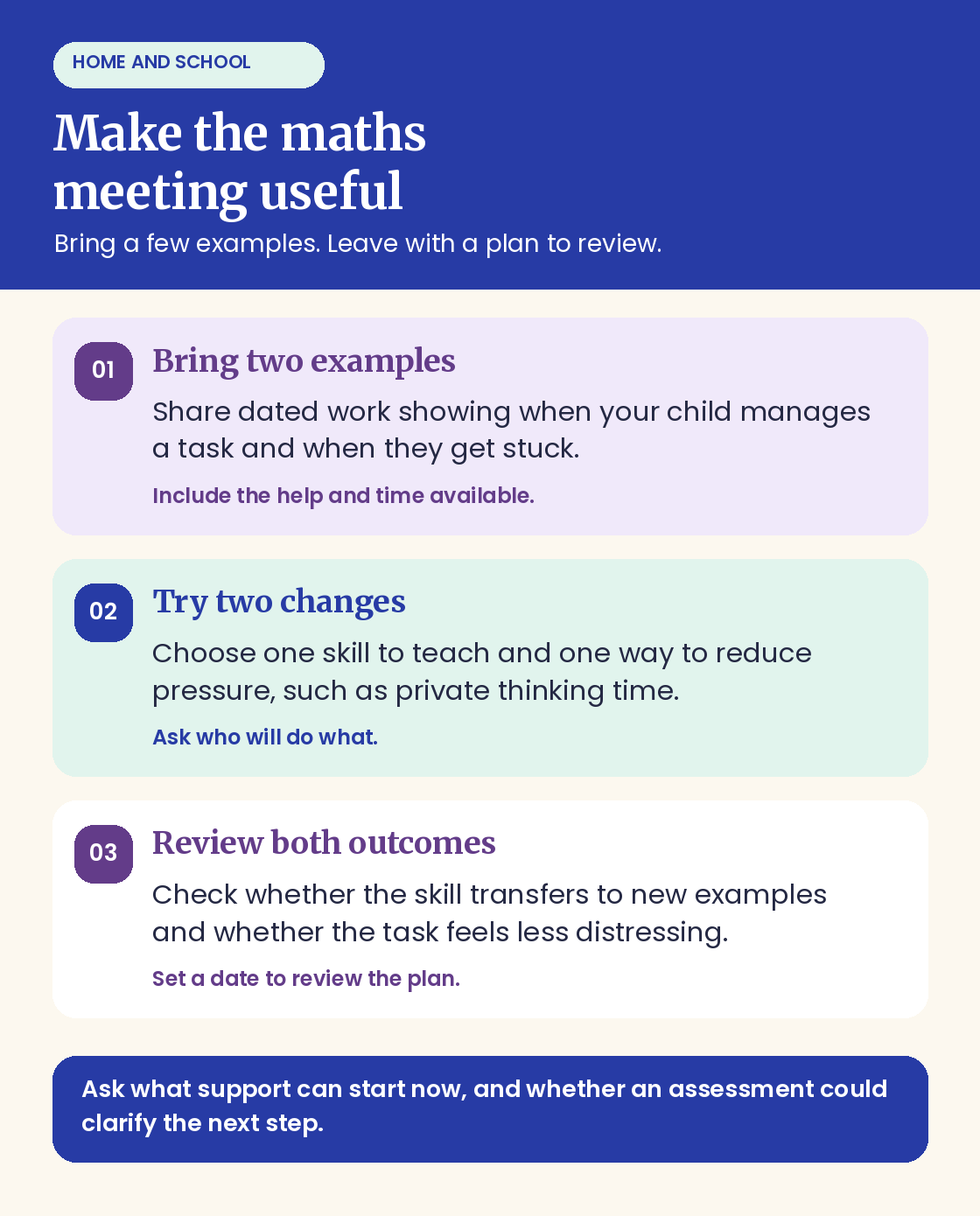
Bring two or three dated examples that show a contrast. A page where your child succeeds can be as useful as one where they get stuck. Ask the teacher to explain the underlying skill: for instance, choosing an operation, understanding regrouping, remembering a procedure or reading the question. Make a short note of the help that was available. Was there a worked example? Was the task timed? Was the problem read aloud or presented with a diagram?
You might write: “On Tuesday, she compared two numbers correctly using bundles of ten. On Thursday, she reversed the tens and ones again on the worksheet without the bundles. She said she wasn’t sure what the digits stood for.” This tells the teacher what to check next without asking your child to complete extra tests at home.
Take previous reports or support plans if you have them. Include how often the school targeted the skill, what was tried and what your child could do independently afterwards. Distinguish improvement on rehearsed examples from applying the idea to a new one. When describing distress, mention the situation and impact: for example, whether your child cannot get started, asks to leave class or spends much longer on homework than expected.
What can the school try while the concern is being explored?
Start by agreeing on one teachable skill and one change to the learning conditions. For example, the skill could be representing two-digit numbers as tens and ones; the condition could be a few private practice questions before any group response. Ask the teacher to choose examples appropriate for your child’s age and learning history.
For primary-aged pupils, the What Works Clearinghouse practice guide recommends structured instruction and representations that make mathematical ideas visible. A teacher might show a quantity using objects, draw the groups, connect the drawing to the written number, and then check whether the child can explain the connection on a new example. Ask the teacher to adapt the approach for an older pupil so the materials are age-appropriate and useful.
At home, keep the task small enough to talk about. “Show me the first part that makes sense” can reveal more than asking your child to redo a whole page. If a shared task is becoming a battle, pause and let the teacher know where it broke down. Agree on a review date so you can look at both understanding and distress. A quieter child is not necessarily learning more, and a higher mark does not always mean the worry has eased.
When should we ask about a psychoeducational assessment?
Ask about an assessment when difficulty with important maths skills remains persistent, is affecting school or daily life, and the current teaching and support have not clarified why or what to do next. You can ask sooner if the difficulty is substantial or a school transition makes planning urgent. You do not have to wait for a diagnosis to ask the school for practical support.
A useful referral states the question. For example: “Why does our child still struggle to compare quantities and use place value after targeted teaching, and what instruction should come next?” Or: “How much of the difficulty appears tied to skill development, and what additional information would help us understand the distress?” Ask what measures are appropriate for your child’s language, curriculum and age and what limitations the assessor expects.
The British Dyslexia Association’s assessment and support guidance distinguishes a fuller assessment from initial identification. Ask whether the proposed evaluation will examine the maths skills you are concerned about, school and developmental history, and the circumstances under which your child performs best. Discuss whether the provider can address dyscalculia specifically and whether additional input about language, attention or emotional wellbeing is needed. A broad assessment label on a service page does not tell you which questions every appointment can answer.
What should we ask for after the assessment?
Ask for findings you can use: which skill to teach first, what helps your child access classwork today, and how the school will know whether support is working. One recommendation might target understanding through explicit teaching; another might change how your child shows what they know while that skill develops. Ask who will do what, when the plan will be reviewed, and what to try if progress stalls.
For a child who dreads maths, ask how their experience will be tracked alongside skill gains. They may be able to say whether they can start a problem more readily, ask for help or explain a method in a small group. Agree with them how to discuss findings with teachers so the plan preserves their dignity and includes their perspective.
Frequently asked questions
Does being slow at maths mean my child has dyscalculia?
No. Speed alone cannot identify the cause. Ask about accuracy, strategies, conceptual understanding and learning history as well as what changes when time pressure is removed.
Can a child with good grades have maths anxiety?
Yes. Research in schoolchildren found that high maths anxiety could occur alongside typical or strong performance. Ask about the effort and distress involved, as well as the result.
Is a dyscalculia screener enough?
A screener can flag areas to investigate. Ask what it measures and what it misses. A qualified assessor can advise whether a fuller evaluation is needed, using a wider picture of the child’s skills, history and response to teaching.
Should we choose tutoring or therapy first?
Start with the most pressing need. Ask the school about targeted teaching for a specific skill gap. If distress persists, affects daily life or makes it hard for your child to engage with learning, discuss emotional support as well. Some children need both kinds of help.
Discuss a next step with CALM International
CALM International offers psychoeducational assessments and child and adolescent therapy. If you are unsure which route fits, share your child’s age, school curriculum, languages, examples of maths work and what the school has already tried. Ask whether the available assessment can address your specific concerns about maths learning, whether emotional support would be appropriate, and whether another specialist should be involved.
Contact CALM International to discuss assessment or support for your child.
Sources
- Specific Learning Difficulties Assessment Standards Committee. (2025). Definition of a Specific Learning Difficulty in Mathematics , hosted by the British Dyslexia Association.
- British Dyslexia Association. Dyscalculia: Assessment and Support .
- Devine, A., Hill, F., Carey, E., & Szűcs, D. (2018). Cognitive and Emotional Math Problems Largely Dissociate: Prevalence of Developmental Dyscalculia and Mathematics Anxiety . Journal of Educational Psychology.
- What Works Clearinghouse, Institute of Education Sciences. (2021). Assisting Students Struggling with Mathematics: Intervention in the Elementary Grades .
- CALM International. Psychoeducational Assessments .
- CALM International. Child & Adolescent Therapy .
- CALM International. How to Tell EAL Struggles Apart from a Learning Difference .