
OCD in children can involve unwanted, recurring thoughts and repetitive actions or mental rituals that feel difficult to resist. Seek professional advice when these experiences cause distress or interfere with school, sleep, relationships or everyday routines. Liking order, asking questions or having a bedtime ritual does not, by itself, mean a child has OCD.
Perhaps your child asks whether everything is safe, accepts your answer, then asks again. Homework is repeatedly erased. Leaving home depends on checking a bag until it feels right.
Parents can feel caught between wanting to comfort their child and noticing that the comfort never seems to last. Understanding the pattern is a useful starting point. As the American Academy of Child and Adolescent Psychiatry explains, distress and interference with a child’s life are central concerns in childhood OCD.
What is OCD, and how can it look in a child?
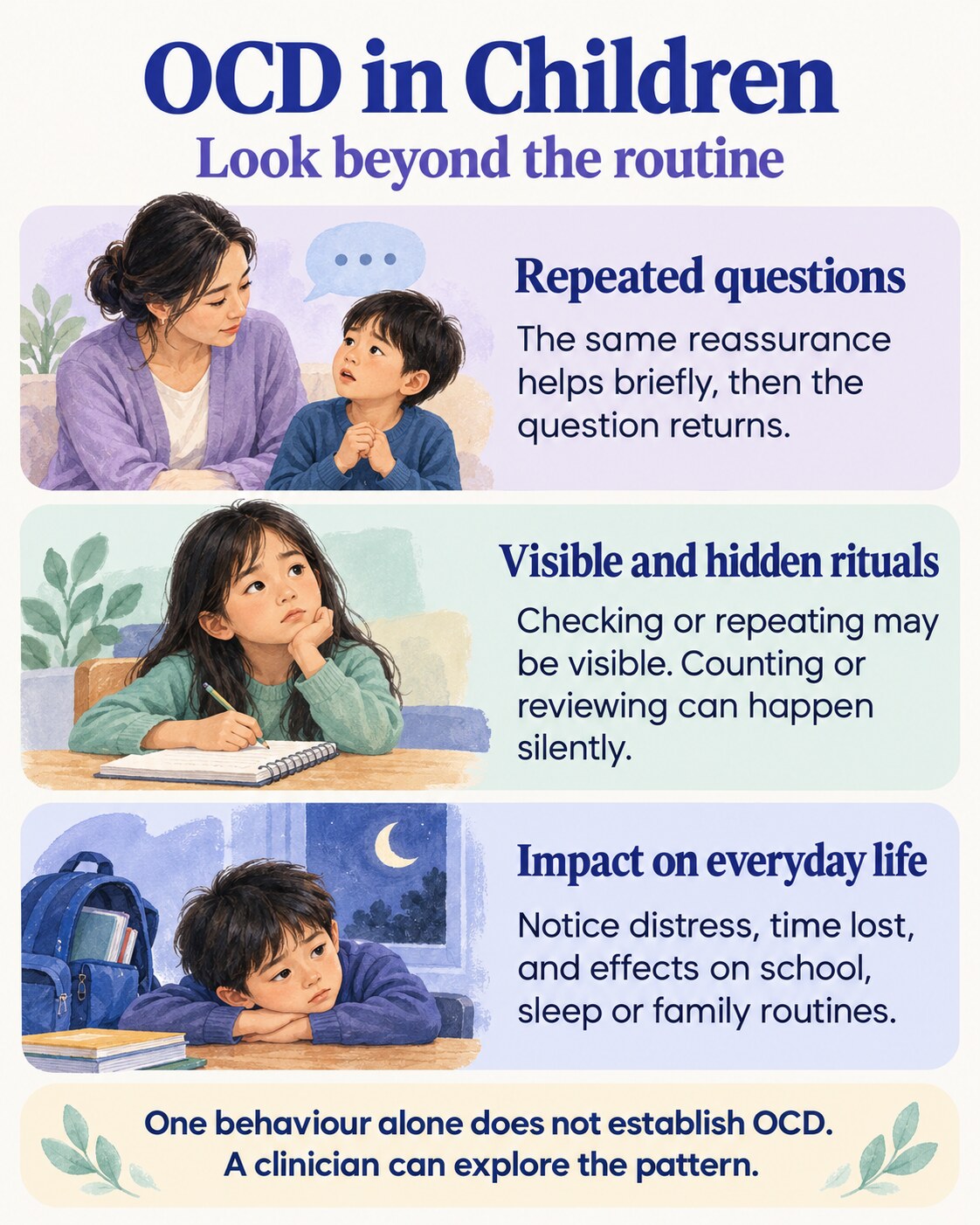
OCD stands for obsessive-compulsive disorder. Obsessions are intrusive thoughts, images or urges that repeatedly appear and are unwanted. Compulsions are behaviours or mental acts a person feels driven to perform, often to relieve distress or prevent a feared outcome.
A child may worry that something terrible will happen unless an action is repeated. Another may struggle with an uncomfortable sense that something is incomplete, without explaining a clear fear.
The National Institute of Mental Health’s OCD guide describes both visible behaviours, such as checking, and less visible acts, such as counting or repeating words silently. Compulsions may bring temporary relief while the difficulty continues.
OCD is therefore broader than cleanliness or neatness. A tidy bedroom cannot identify it; a messy bedroom cannot rule it out.
How are ordinary routines different from possible OCD rituals?
Many children enjoy predictable routines. The International OCD Foundation’s guidance on talking to children distinguishes comforting childhood habits from rituals that become excessive and disrupt daily life.
The table below offers conversation prompts, not diagnostic rules. Consider your child’s age, development and circumstances.
| Situation | A routine that may be manageable | A pattern worth discussing |
|---|---|---|
| Packing a school bag | Checking what tomorrow’s lessons require | Repeated checking delays departure and never feels finished |
| Doing homework | Correcting an error and continuing | Restarting work repeatedly despite understanding the task |
| Bedtime | Enjoying a familiar sequence | Feeling unable to sleep unless actions or words are repeated exactly |
| Asking a parent | Seeking information and using the answer | Asking for certainty repeatedly, with relief that quickly fades |
Ask what the action does for your child: is it enjoyable, useful, comforting, or something they feel compelled to complete? One difficult evening does not establish a diagnosis. A repeated pattern that limits ordinary life deserves attention.
What signs of OCD in children might parents notice?
The IOCDF’s childhood OCD overview describes patterns including checking belongings, excessive apologising, repeated reassurance-seeking and redoing work until it feels right.
Parents may notice:
- The same question returning despite repeated answers.
- Actions that must be restarted after interruption.
- Avoidance of particular objects, places or activities.
- Family members being asked to say or do things in a precise way.
- Distress when the child cannot finish a ritual.
These observations are clues to explore, not proof of OCD. Write down what actually happens rather than assuming a reason. “Asked me to check the zip six times before leaving” gives a professional more information than “was being obsessive.”
Can a child have compulsions that nobody sees?
Yes. Mental rituals can include silently repeating phrases, reviewing an event or trying to cancel an upsetting thought. A child may appear distracted while doing something internally that feels urgent.
The IOCDF’s clinical assessment guidance includes mental compulsions and highlights that some symptoms remain hidden from families. Assessment needs the child’s perspective as well as adults’ observations.
Instead of repeatedly asking “Why aren’t you concentrating?”, a parent might try:
“You seem caught up in something. Is there a thought or feeling that makes it hard to move on?”
This is an illustrative conversation starter. It does not establish what is happening, and a child may need time or a private conversation with a professional to explain.
Why does my child keep asking for reassurance?
Children ask questions for many reasons, including genuine uncertainty, a new situation or a need for connection. Reassurance-seeking alone is not specific to OCD.
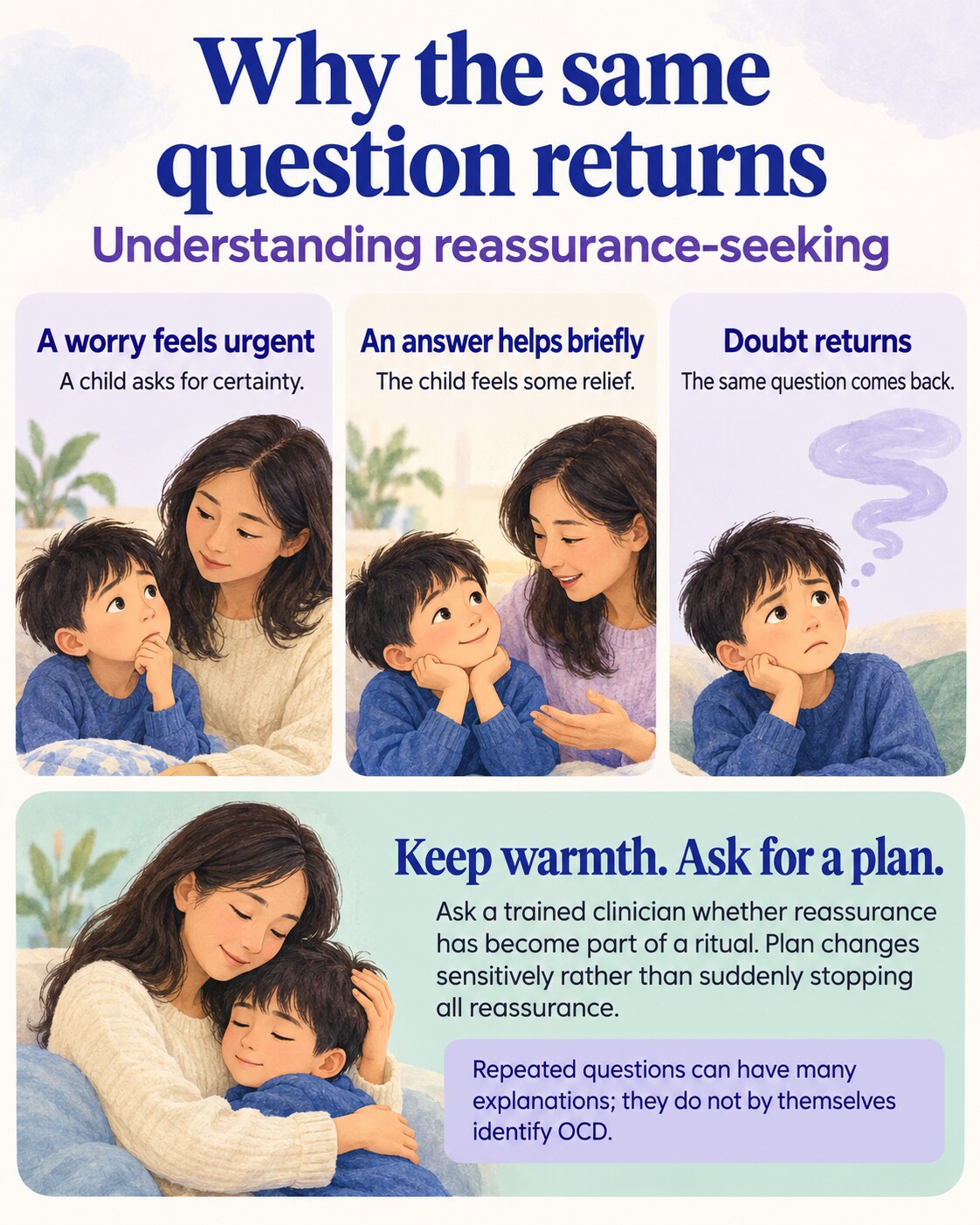
In an OCD pattern, a child may seek an answer to reduce distress, feel briefly relieved, then doubt the answer and ask again. The IOCDF’s household guidance explains why lengthy arguments about certainty may fail to resolve the loop.
Comforting your child is understandable. The aim is not to become emotionally unavailable or stop answering ordinary questions. It is to understand whether particular answers have become part of a repetitive ritual.
For example, a parent could bring this observation to an appointment: “My answer helps for two minutes, then the same question returns. How should we respond consistently?”
What is family accommodation, and should parents feel responsible?
Family accommodation means changing family behaviour to help a child avoid distress or complete rituals. Examples include checking on the child’s behalf, joining a repeated sequence or reorganising routines around a fear.
The AACAP family guide notes that caregivers may not recognise how much accommodation is happening. Families usually intend to help; this is not evidence of bad parenting.
An agreed treatment plan can help adults change their responses sensitively. Avoid abruptly withdrawing all reassurance or creating a confrontation to test whether your child can cope. Ask a suitably trained clinician which responses to change, how to explain the plan and what to do if distress escalates.
How can parents talk about the concern without increasing shame?
Choose a quieter moment. Describe the difficulty without criticising your child’s character: “Getting ready seems to be taking much longer, and you look upset.”
The IOCDF recommends keeping communication open and recognising that children may find their experiences embarrassing or hard to explain. Offer another route, such as writing down a concern or speaking to a professional.
You might say:
“I can see this is difficult. We can ask someone to help us understand what makes you feel stuck.”
Avoid promises that an appointment will remove every worry immediately. Explain its purpose: learning what is happening and deciding what support fits.
What if my child mentions upsetting or frightening thoughts?
Unwanted thoughts involving harm, religion or other distressing subjects can occur in OCD. The NIMH guide includes these among possible obsessional themes. The topic of a thought alone cannot establish a diagnosis or determine risk.
Listen calmly and seek a clinical assessment rather than treating disclosure as a confession or assuming all frightening thoughts are harmless. Clinicians need to distinguish unwanted intrusive experiences from intention, planning and other concerns.
If your child describes wanting or planning to harm themselves or another person, or you cannot keep them safe, seek urgent professional help. For immediate danger, contact local emergency services or attend the nearest emergency department. Do not wait for a routine enquiry response.
When should we seek an evaluation for childhood OCD?
Seek advice when repeated thoughts or rituals cause substantial distress, interfere with ordinary activities or increasingly shape family life. You do not need to wait for grades to fall or for a specific amount of time to pass.
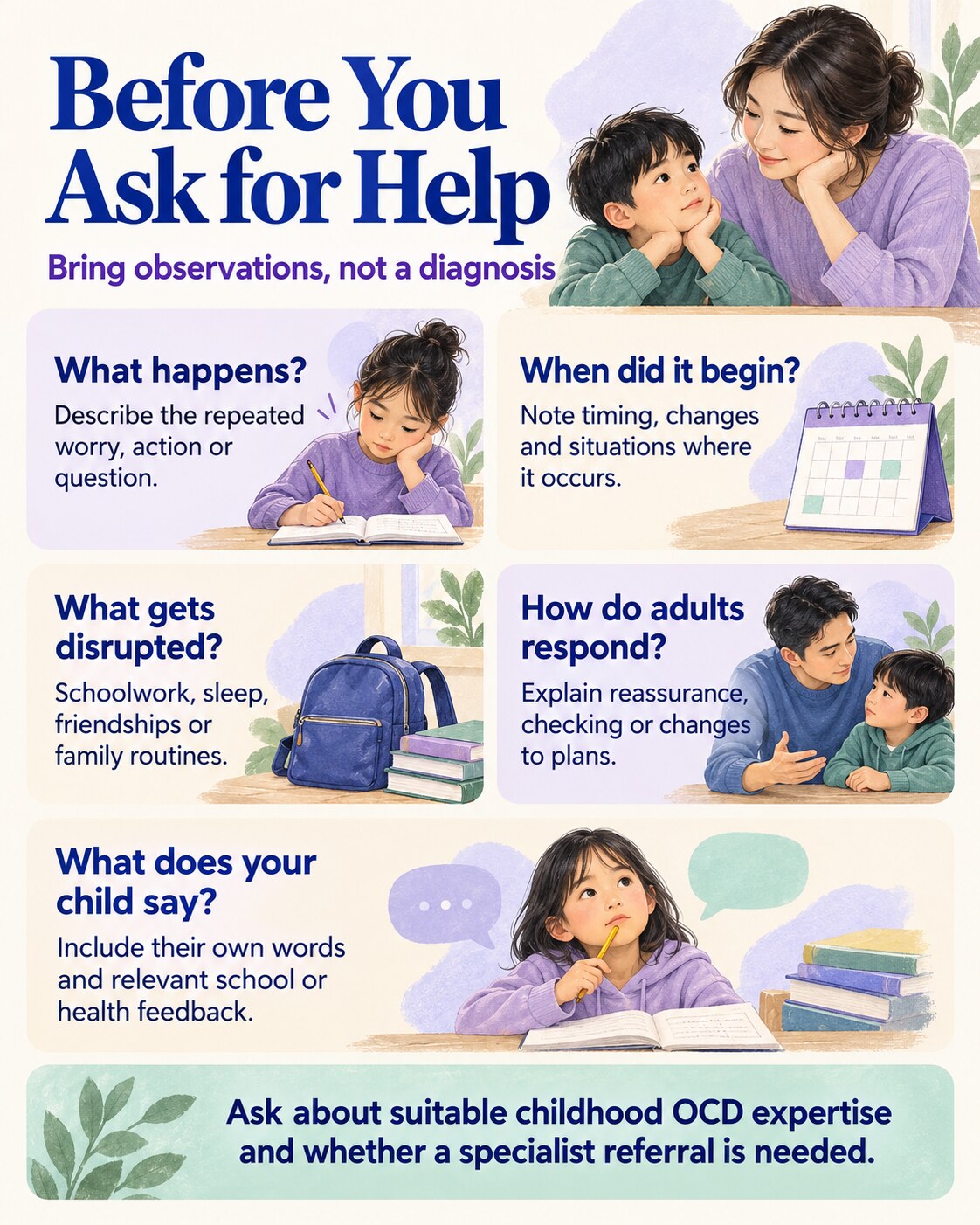
A paediatrician or family doctor can consider medical concerns and help with referral. The IOCDF’s advice on talking to your child’s doctor recommends taking notes about behaviours, timing and history. A sudden, marked change also warrants medical attention.
Useful appointment notes include:
- What happens before, during and after the repeated action.
- How long it takes and what becomes difficult afterwards.
- What your child says they fear or need to get right.
- How adults currently respond.
- Relevant school observations, health changes and previous support.
Bring a few clear examples. You do not need a complete diary before asking for help.
What happens during an OCD assessment for a child?
A clinical evaluation explores the child’s symptoms, history, everyday functioning and other possible explanations. It may include separate conversations with parents and the young person, and symptom questionnaires.
The IOCDF’s assessment guidance describes tools for recording symptom severity, alongside clinical interviews and risk assessment. A questionnaire supports professional judgement; it does not replace it.
Ask what question the evaluation will answer and what recommendations you will receive. An OCD-focused evaluation is not automatically the same as a broad psychoeducational assessment. If there are separate learning or attention questions, discuss whether additional testing would change support decisions.
CALM’s Psychoeducational Assessments page describes consultation, testing, recommendations and feedback. Ask about suitability rather than assuming a full testing package is the first step for repetitive worries.
What treatments help OCD in children?
One established approach is cognitive behavioural therapy (CBT) that includes exposure and response prevention (ERP). ERP helps a child practise responding to triggers without relying on their usual compulsions, with preparation and support from a trained clinician.
The IOCDF’s explanation of paediatric ERP emphasises a child-friendly, collaborative approach and family involvement. It is not a parent forcing a child into an overwhelming challenge.
NICE guidance recommends developmentally adapted CBT including ERP and family involvement for children with moderate to severe functional impairment, and in some circumstances after guided self-help has not helped. Medication may also be considered through an appropriate medical specialist; prescribing and monitoring require individual clinical decisions.
Before starting, ask:
- “What is your training in treating OCD in children?”
- “Does the plan include ERP, and how will you prepare my child?”
- “How will caregivers participate?”
- “How will we review progress and decide whether another referral is needed?”
The IOCDF’s therapist-selection guidance supports asking specifically about OCD and ERP experience. General counselling experience does not by itself confirm specialist competence.
How can the school help without reinforcing rituals?
With appropriate consent, explain the specific classroom difficulty and ask a relevant clinician to coordinate recommendations. The IOCDF’s school guidance describes how repeated erasing, rereading or questioning can affect schoolwork.
A useful meeting question is: “Our child understands the work but keeps restarting it. How can we support participation in a way that fits the treatment plan?”
Agree who the child can approach, what staff should do when a pattern appears and when to review the plan. Share only information needed for support, involving your child in an age-appropriate way. School policies and support pathways vary by country and institution.
For families changing international schools, a concise handover can record existing recommendations and responsibilities. Do not assume that a new school will recognise the pattern or interpret a previous plan in the same way.
CALM’s school counsellor and child psychologist guide explains the broader coordination question.
Frequently asked questions
Does liking things neat mean my child has OCD?
No. Preferences alone do not establish OCD. Consider whether repeated thoughts or actions feel difficult to resist, cause distress or disrupt life, and seek assessment if concerned.
Can OCD affect a child who does well academically?
Yes. Results do not describe every part of wellbeing. Consider time lost to rituals, distress and participation at home and school, rather than using grades as the only measure.
Should I stop all reassurance immediately?
No blanket rule fits every child. Ask a trained clinician to help distinguish ordinary support from accommodation and plan changes sensitively. Keep emotional warmth and attention available.
Does my child need an assessment before therapy?
A clinician needs to understand the concern to recommend appropriate care. Ask what initial evaluation is needed; do not assume that this means comprehensive learning testing.
Can OCD improve with treatment?
Effective treatments are available. Progress varies, and clinicians should review changes in symptoms and daily functioning with the child and family. Ask how the approach will be adjusted if it is not helping.
Discuss your child’s difficulties with CALM International
CALM International offers Child & Adolescent Therapy and School Wellness services. Describe your child’s age, location, repeated worries or rituals, and how everyday life is affected.
Ask whether a clinician with suitable childhood OCD assessment and treatment experience is available, and whether a specialist referral is appropriate. If ERP or medical treatment is recommended, confirm the provider’s specific expertise and service arrangements.
Make an enquiry with CALM International to discuss a suitable next step for your child.
Sources
- American Academy of Child and Adolescent Psychiatry. Obsessive-Compulsive Disorder in Children and Adolescents.
- National Institute of Mental Health. Obsessive-Compulsive Disorder: When Unwanted Thoughts or Repetitive Behaviors Take Over.
- International OCD Foundation. OCD & Kids.
- International OCD Foundation. How Do I Talk to My Child About OCD?
- International OCD Foundation. Managing OCD in Your Household.
- International OCD Foundation. Talking to Your Child’s Doctor.
- International OCD Foundation. Diagnosis & Clinical Assessment for Mental Health Professionals.
- International OCD Foundation. About ERP for Pediatric OCD.
- NICE. Obsessive-compulsive disorder and body dysmorphic disorder: treatment — recommendations (CG31).
- International OCD Foundation. How Do I Find the Right Therapist for My Child?
- International OCD Foundation. Talking to Your Child’s School.
- CALM International. Child & Adolescent Therapy; Psychoeducational Assessments; School Wellness.