
Your child’s teacher mentions that they have become quieter in class. Homework is ending in tears. Or your teenager has started asking to stay home from school, but cannot explain why.
You want to help, yet the next step feels unclear. Should you speak to the school counsellor, book an appointment with a child psychologist, or consider both?
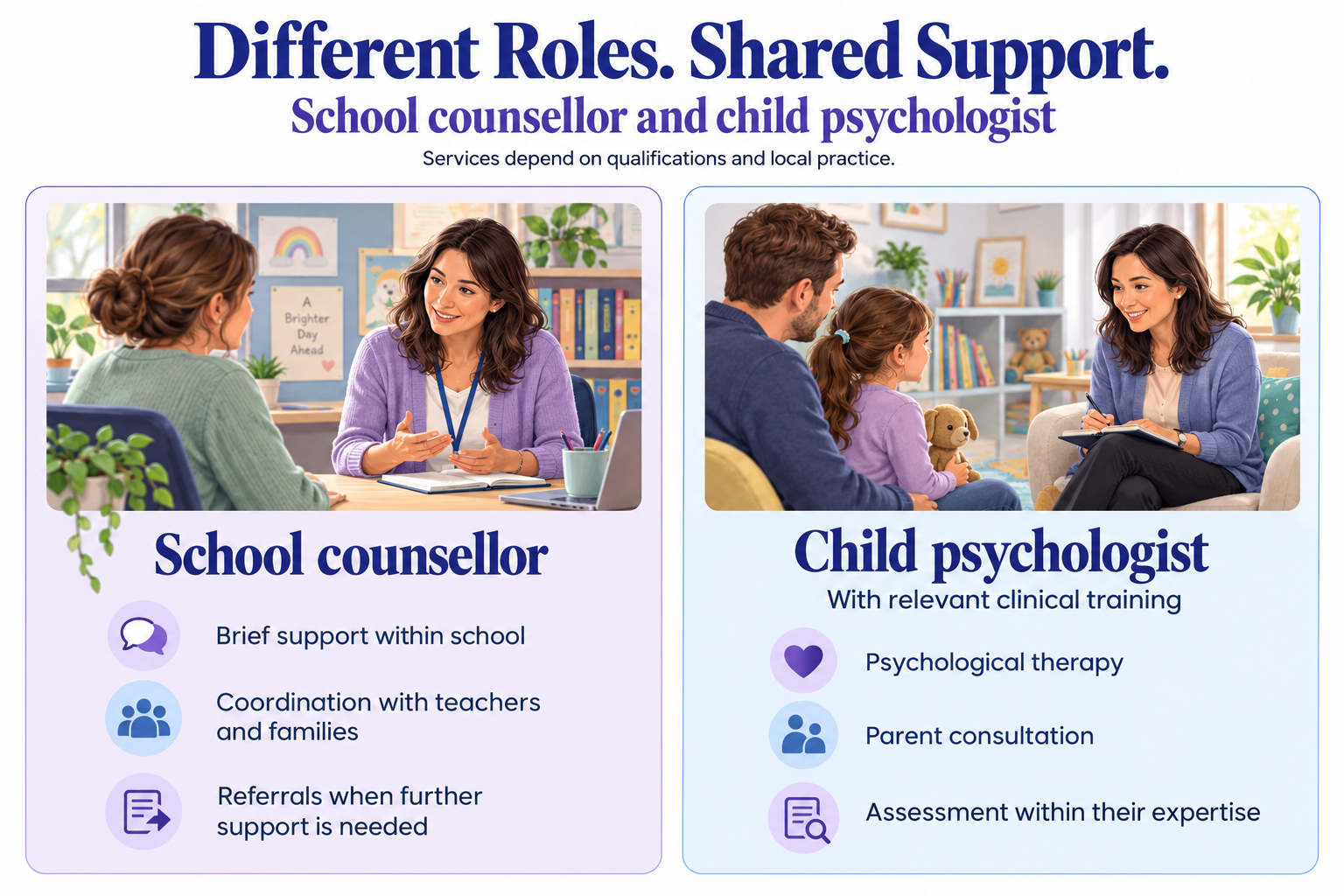
A school counsellor usually supports a student’s wellbeing and participation within school, often through brief counselling and coordination with staff. A child psychologist with appropriate clinical training can assess emotional or behavioural concerns and provide psychological treatment; some also offer specialist testing. The right starting point depends on your child’s needs, the professional’s qualifications and the services available.
These roles can complement each other. Your child may benefit from a familiar adult at school while also receiving support from an external clinician.
What is the difference between a school counsellor and a child psychologist?
The main distinction is their remit: what they are employed and qualified to do. A job title alone does not tell you the full scope of someone’s practice.
| Question | School counsellor | Child psychologist with relevant clinical training |
|---|---|---|
| What is their main focus? | Supporting students’ academic, social and emotional participation in school. | Understanding and addressing a child’s psychological needs through assessment and treatment. |
| What support might they provide? | Brief individual support, group or classroom activities, staff consultation and referrals. | Psychological therapy, parent consultation and, where appropriately trained, diagnostic or specialist assessment. |
| What perspective do they bring? | Knowledge of the school environment and access to information about classroom and peer experiences. | A clinical perspective on concerns that may affect school, home and other parts of life. |
| Do they provide formal diagnosis? | Not usually within the school counselling role; check the individual’s remit. | Some can, within their qualifications, competence and local professional requirements. |
| How long does support last? | Depends on the school’s programme and available resources; often brief. | Depends on the needs assessed and the agreed treatment plan; it may be brief or ongoing. |
The American School Counselor Association’s guidance on student mental health describes brief counselling and referral as core school counselling functions, rather than long-term clinical treatment. The American Psychological Association describes practising psychologists as providing services such as evaluation and psychotherapy.
These are US professional descriptions, not rules for every school in Asia. Ask your school and prospective clinician what they can provide in your location.
What does a school counsellor do?
A school counsellor can be a useful first contact when you notice a change in your child’s school experience. They may help students manage emotions, navigate relationships, set goals and access further support. ASCA’s overview of school counsellor roles also highlights collaboration with families and teachers.
When arranging a conversation, bring a specific question. For example:
- “My child says they have nobody to sit with at lunch. What have staff noticed?”
- “They are very worried about the move to secondary school. What support is available?”
- “Could we agree on a check-in and a date to review how things are going?”
Ask about practical access, too. Can your child request an appointment themselves? How often can they meet? What happens if the counsellor is unavailable?
You do not need to decide on a diagnosis before asking these questions. A first conversation can help you understand the school’s observations and options.
What does a child psychologist do?
In this guide, “child psychologist” means a psychologist with relevant training and experience in clinical work with children or adolescents. Some psychologists specialise in other areas, so confirm their expertise before booking.
A psychologist may use psychological therapies to help a child understand and manage difficult emotions, thoughts or behaviour. Their work may also include consultation with parents and assessment to clarify the concern. The APA’s description of clinical and counselling psychology explains these assessment and treatment functions.
For parents, useful questions include:
- “Do you regularly work with children of this age?”
- “What experience do you have with the difficulty we are describing?”
- “Would the first appointment involve my child, us as parents, or both?”
- “How would you decide whether therapy, testing or another referral is appropriate?”
External support is not limited to psychologists. Depending on the concern, an appropriately qualified counsellor, psychotherapist, paediatrician or psychiatrist may be suitable. The NHS overview of children’s mental health support describes a range of professionals and interventions. Its service pathways are UK-specific, but the distinction between different types of support is useful when asking a provider about their role.
When might school counselling be a suitable starting point?
Speaking to the school counsellor may be a practical first step when you want to understand a school-related concern and there is no immediate safety issue.
Perhaps your child has recently changed classes, is unsettled after a friendship disagreement, or wants help talking to a teacher. Start by asking what the school has noticed and what support it can offer.
Before the conversation ends, try to agree on three things:
- The concern: What exactly are you trying to understand or improve?
- The next step: Who will do what, and when?
- The review: How will you decide whether the support is helping?
For example, instead of leaving with “We will keep an eye on things”, ask whether someone will check in with your child and when you will hear an update.
Starting at school does not commit you to using school support alone. You can seek clinical advice alongside it whenever you are concerned.
When should you consider a child psychologist or external clinician?
Consider a professional consultation when the difficulty is persistent, distressing, worsening or interfering with everyday life. The National Institute of Mental Health’s guide for parents recommends seeking help when emotions or behaviour last for weeks or longer, cause distress, or disrupt functioning at school, at home or with friends.
Examples include sustained withdrawal, loss of interest in usual activities, substantial sleep changes, frequent intense worry or a marked decline in school functioning. These signs do not establish a diagnosis, but they are reasons to seek advice. You do not need to wait several weeks if the concern is severe or worsening.
Other reasons to discuss external support include uncertainty about the underlying difficulty, a recommendation from the school or doctor, or a need for services the school cannot offer.
School-only difficulties can also warrant clinical attention. A child who feels comfortable at home but is repeatedly unable to enter the classroom still needs their experience taken seriously.
If your child talks about suicide or harming themselves or others, seek urgent professional help. If there is immediate danger, contact local emergency services or go to the nearest emergency department. A routine enquiry form is not an emergency service.
Is school counselling enough? Three examples to discuss
The following examples are illustrative, not diagnostic rules or descriptions of CALM patients.
1. A child feels unsettled after changing schools
A parent notices that their child is reluctant to join lunchtime activities after a school move. They ask the counsellor what opportunities exist to help the child feel included and agree on a follow-up conversation.
If distress increases or the child continues to struggle, the parent can also seek external advice. The review should consider the child’s experience, rather than attendance alone.
2. A teenager is increasingly avoiding school
A parent reports repeated missed school days and growing distress the evening before school. Rather than relying on occasional check-ins alone, they request a clinical consultation while asking the school to share its observations and discuss immediate support.
A useful question for both professionals is: “What do we need to understand before deciding on the plan?”
3. Homework distress comes with persistent reading difficulties
A child becomes upset whenever reading homework begins. The parent asks the school for examples of the reading difficulty, what teaching support has been tried and how the child has responded.
They then discuss whether a learning assessment would help answer a specific question. Counselling and an assessment would serve different purposes: one may address emotional distress, while the other investigates learning needs.
In each example, the next step follows the concern being investigated. There is no requirement to “finish” school counselling before asking for other support.
Does my child need therapy or a psychological assessment?
Therapy aims to help a child make changes or develop skills. Assessment aims to answer questions about their needs and guide decisions. They can be used separately or together.
The APA’s guide to psychological testing and assessment explains that assessment may combine interviews, observations, records and standardised measures. The tools should follow the question being asked; every child does not need the same testing package.
Before agreeing to an assessment, ask:
- “What question will this assessment answer?”
- “How could the findings change the support we provide?”
- “What will the report include, and who will explain it?”
If persistent learning or attention concerns are part of the picture, explore CALM International’s psychoeducational assessment service. The service includes consultation, testing, a report and feedback, with recommendations for school and home.
An initial discussion can help establish whether assessment is appropriate. Booking therapy does not automatically mean a child needs formal testing.
How can a school counsellor and child psychologist work together?
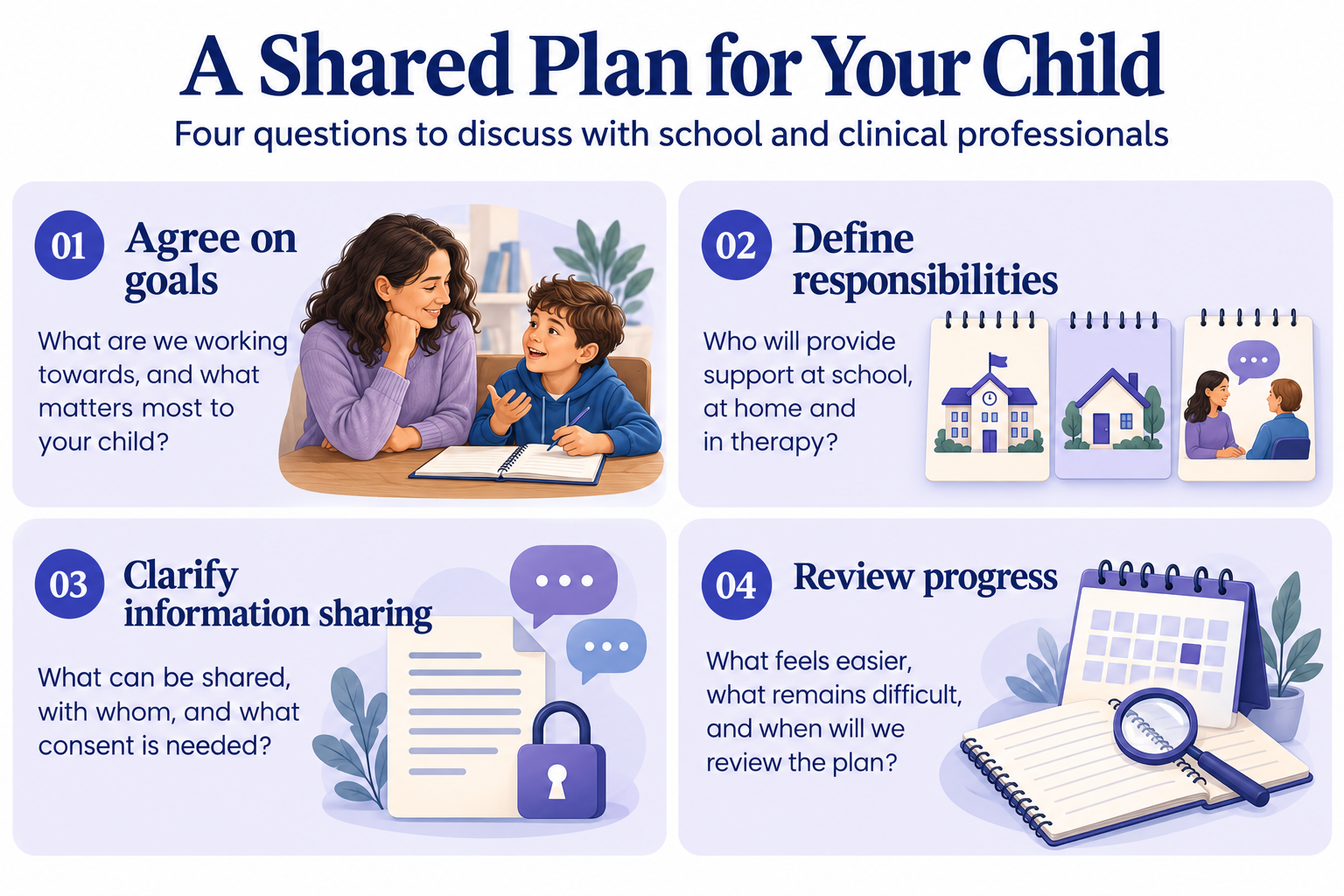
Parents can ask the professionals to agree on a coordinated plan, within the relevant consent and privacy requirements. The CDC’s guidance on children’s therapy highlights the importance of treatment that fits the child and family, including caregiver involvement.
Here is a practical framework to bring to a meeting:
| Planning question | Example to discuss |
|---|---|
| What are we working towards? | Helping the child feel able to ask for help when overwhelmed. |
| What will happen at school? | Agreeing on a named staff contact and a clear way to request support. |
| What will happen at home? | Asking the clinician which responses parents should practise. |
| What information will be shared? | Agreeing on relevant recommendations and who needs to receive them. |
| How will progress be reviewed? | Setting a review date and asking the child what feels easier or remains difficult. |
These are discussion prompts, not a treatment plan. The professionals should tailor recommendations to your child.
At CALM International, School Wellness services include support for school counsellors and collaboration with existing school systems. Ask how coordination with your child’s school could work in your circumstances.
Will counselling be confidential?
Confidentiality helps children feel safe enough to speak honestly, but it has limits. The ASCA guidance on confidentiality discusses protecting student privacy alongside legal duties and the need to prevent serious harm. Exact requirements vary by jurisdiction and school policy.
Ask both the school and external clinician:
- What information will parents receive?
- What can remain private between the child and professional?
- When would information need to be shared for safety or safeguarding?
- What consent is needed for communication between the clinic and school?
Avoid promising your child that everything will stay secret. Instead, ask the professional to explain confidentiality in language your child can understand.
What should international-school families consider?
Start by finding out who is actually on the school’s support team. Some schools have a counsellor, school psychologist, learning-support specialist or visiting clinician, with different responsibilities.
A school psychologist is a distinct role. The National Association of School Psychologists describes expertise in learning, behaviour and mental health, including assessment and consultation. Ask which services your school provides rather than assuming every assessment must happen externally.
If your family is multilingual or has moved between countries, bring that context into the conversation. Useful questions include:
- “Can my child comfortably express themselves in the language used for sessions?”
- “How will you consider our school moves and educational history?”
- “If testing is recommended, how will language and cultural context affect interpretation?”
- “If we relocate, what information could help the next professional continue support?”
Confirm where a clinician is authorised to practise and whether they can offer the proposed service where your child is located, including online work.
What can parents prepare before asking for help?
You do not need a complete explanation. A short record of what you have noticed is a useful starting point.
Write down when the concern began, where it happens, what your child says about it and what has already been tried. Bring relevant school feedback or previous reports if available.
Use concrete observations: “They have missed four mornings this month” gives a professional more to explore than “They are becoming difficult”. Also note strengths, interests and situations in which your child feels comfortable.
You might introduce the appointment by saying: “We want to understand what has been hard for you and find someone who can help.” Invite questions, and tell them what you know about the first meeting without promising a particular outcome.
Discuss suitable support with CALM International
If you are unsure whether your child needs school counselling, external therapy or an assessment, start by describing what you are noticing. You do not need to choose a diagnosis or testing package before making an enquiry.
CALM International offers Child & Adolescent Therapy, Psychoeducational Assessments and School Wellness support.
Share your child’s age, location, main concerns and any support already in place. Ask which clinician or service may be suitable and whether school coordination is available.
Make an enquiry with CALM International to discuss suitable support for your child.
Sources
Sources checked on 5 October 2026. International sources inform the general guidance; professional scope, confidentiality rules and referral pathways vary by country and school.
- American School Counselor Association. The School Counselor and Student Mental Health.
- American School Counselor Association. Who Are School Counselors?.
- American Psychological Association. What do practicing psychologists do?.
- American Psychological Association. A Career in Clinical or Counseling Psychology.
- National Institute of Mental Health. Children and Mental Health: Is This Just a Stage?.
- American Psychological Association. Understanding psychological testing and assessment.
- Centers for Disease Control and Prevention. Treating Children’s Mental Health with Therapy.
- American School Counselor Association. The School Counselor and Confidentiality.
- National Association of School Psychologists. What Is a School Psychologist?.
- NHS. Receiving mental health support — children and young people.