If your child is learning in English while speaking another language at home, it can be difficult to know whether their EAL learning difficulties are part of normal language development or a sign of an underlying learning difference.
A multilingual child who reads slowly, mixes up words, struggles to follow instructions, or freezes when asked to write may simply still be developing their English. However, similar difficulties can also be caused by dyslexia or another specific learning disorder.
The main difference is that EAL difficulties generally affect performance in English, while a learning difference usually affects the underlying skills needed to learn across languages.
Looking at the child’s home-language abilities, progress over time, learning profile, and response to support can help distinguish between the two. When the answer remains unclear, a psychoeducational assessment can separate language proficiency from underlying cognitive and learning abilities.
What Is EAL?
EAL stands for English as an Additional Language. It describes children who use another language at home and are learning through English at school.
EAL is not a disorder or learning disability. It is a normal part of multilingual language development.
A child learning English may:
- Speak confidently in everyday conversations but struggle with academic language
- Understand more English than they can express
- Make grammar or pronunciation errors influenced by their home language
- Need more time to read, write, or follow complex instructions
- Code-switch between English and another language
These patterns can be expected while a child is developing proficiency in a second language.
Can EAL Look Like a Learning Difference?
Yes. EAL difficulties can look very similar to dyslexia and other learning differences.
Both may involve:
- Slow or hesitant reading
- Spelling mistakes
- Weak written work
- Difficulty following multi-step instructions
- Avoidance of reading or writing tasks
- Trouble remembering unfamiliar words
- Lower classroom performance than expected
The visible signs may be similar, but the underlying cause is different.
An EAL learner may struggle because they are still learning English vocabulary, grammar, and academic language. A child with a learning difference may struggle because of difficulties with skills such as phonological processing, working memory, processing speed, decoding, or written expression.
Some children may also be both multilingual and dyslexic.
Why EAL and Learning Differences Are Often Confused
Children can become fluent in conversational English much faster than they develop academic English.
A child may sound confident when talking to friends but still struggle to:
- Understand textbooks
- Follow subject-specific vocabulary
- Explain complex ideas
- Write structured answers
- Interpret abstract instructions
- Read for deeper meaning
This difference between conversational fluency and academic language can make a capable child appear to have a learning problem.
The opposite can also happen. When a multilingual child has dyslexia or another specific learning disorder, their difficulties may be dismissed as part of learning English.
This can delay assessment and appropriate support.
Signs the Difficulty Is More Likely Related to EAL
No single sign can confirm that a child’s difficulties are caused only by language development. However, the following patterns are more consistent with EAL learning difficulties.
The Child Performs Well in Their Home Language
A child may read, write, understand instructions, and express ideas confidently in their first language but struggle to do the same in English.
This suggests that the underlying learning skills are developing normally and that English proficiency may be the main barrier.
Understanding Is Stronger Than Speaking or Writing
Many EAL learners have stronger receptive language than expressive language.
In other words, they understand more than they can currently say or write.
This receptive-versus-expressive language gap is common during second-language development.
Progress Is Slow but Consistent
A child with EAL difficulties will usually continue making progress with suitable teaching, exposure, and language support.
Their development may be uneven, but their English skills should gradually improve over time.
Mistakes Reflect the Home Language
Some errors occur because a child applies the grammar, sentence structure, or sounds of their home language to English.
These are called transfer errors.
Transfer errors are a normal feature of multilingual development and do not necessarily indicate a learning disorder.
Difficulties Affect English Broadly
A child who is still acquiring English may struggle across several areas, including vocabulary, reading comprehension, speaking, writing, and classroom instructions.
This broad pattern differs from some learning disorders, which may create a more specific and persistent difficulty in one area.
Signs It May Be More Than an EAL Challenge
The following signs may indicate dyslexia or another learning difference rather than language development alone.
The Same Difficulty Appears in the Home Language
A learning difference usually affects the underlying processes involved in learning, not just English.
For example, a child with dyslexia may struggle to read, spell, recognise sounds, or remember written words in both English and their first language.
Home-language difficulties are therefore an important warning sign.
However, this comparison is most useful when the child has received adequate instruction in their home language.
Progress Has Stalled Despite Appropriate Support
EAL learners generally improve with consistent language teaching and exposure.
A learning difference may be more likely when a child has received suitable support but continues to make very limited progress.
The key question is not simply whether the child is behind. It is whether their progress is significantly slower than expected despite good-quality instruction.
There Is a Significant Gap Between Ability and Output
A child may reason well, understand complex ideas, and speak confidently but have serious difficulty reading, spelling, organising written work, or getting ideas onto the page.
This unexpected gap between ability and academic output may indicate a specific learning disorder.
The Difficulty Is Narrow and Persistent
Language-learning difficulties usually affect English relatively broadly.
A learning difference may create a more selective pattern, such as persistent problems with:
- Decoding unfamiliar words
- Connecting letters with sounds
- Spelling
- Reading fluency
- Number sense
- Written expression
- Working memory
A child may perform well in most areas but remain significantly behind in one particular skill.
There Is a Family History of Learning Differences
Learning differences such as dyslexia often run in families.
A parent or sibling with a history of reading, spelling, writing, or numeracy difficulties may increase the likelihood that the child has a similar learning profile.
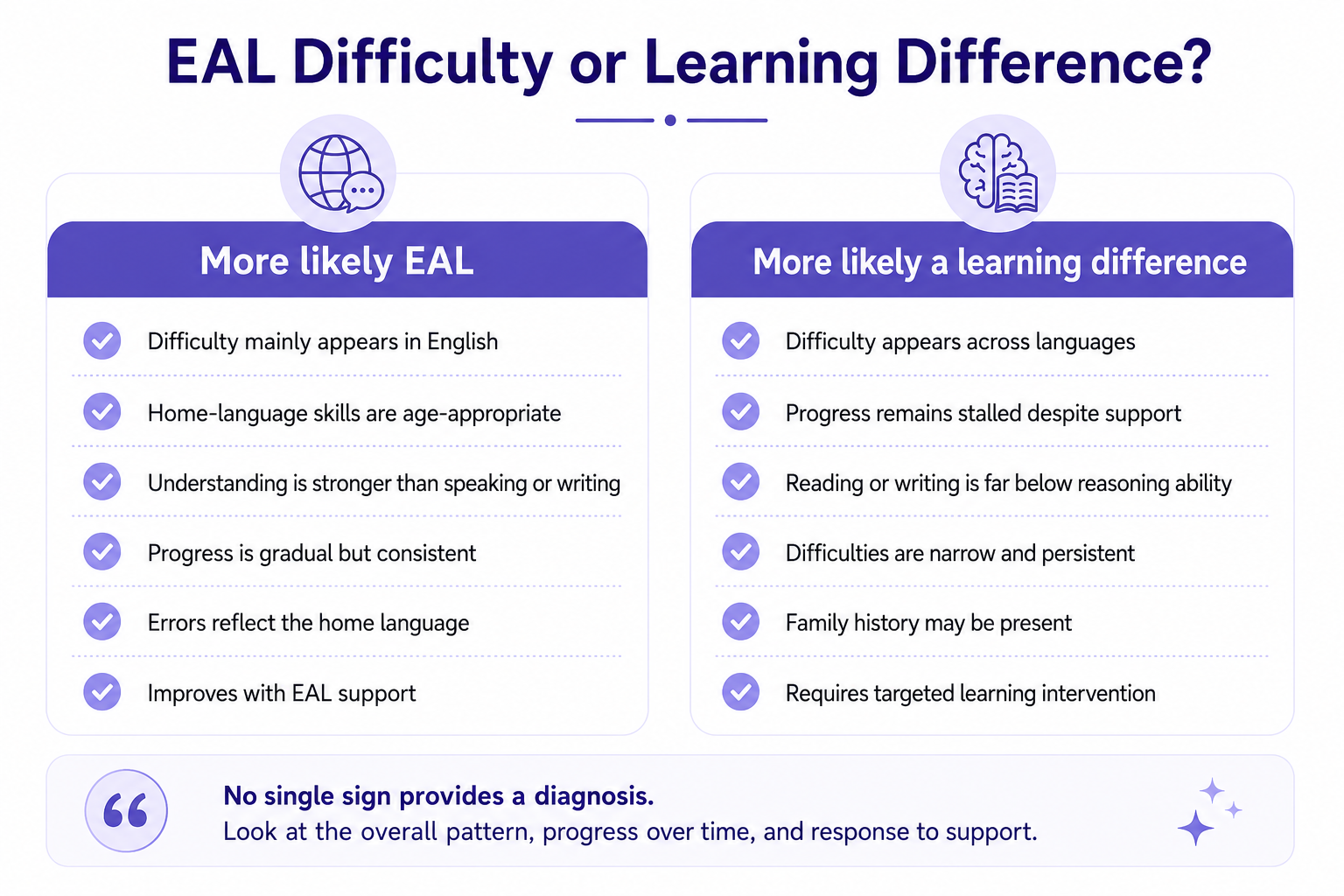
EAL Difficulties vs a Learning Difference
| What you observe | More consistent with EAL | More consistent with a learning difference |
|---|---|---|
| Reading in the home language | Age-appropriate | May also be difficult |
| Understanding compared with speaking | Understanding is often stronger | Not necessarily the main pattern |
| Progress over time | Gradual, steady improvement | Progress may remain stalled |
| Areas affected | Broadly affects English | May affect one specific skill |
| Type of errors | Influenced by the home language | Persistent despite correction and support |
| Response to instruction | Improves with language teaching | Difficulty remains despite suitable support |
| Family history | Usually unrelated | May be present |
| Underlying reasoning | Often age-appropriate | May also be age-appropriate despite low output |
This comparison can help identify patterns, but no single sign provides a diagnosis.
A psychologist must consider the child’s full language history, educational background, development, teaching exposure, and assessment results.
Can a Child Have Both EAL Difficulties and Dyslexia?
Yes. A child can be learning English as an Additional Language and also have dyslexia or another learning difference.
The two are not mutually exclusive.
In fact, being multilingual can make dyslexia more difficult to identify because reading, spelling, and vocabulary difficulties may initially be attributed to limited English proficiency.
A child may therefore continue receiving additional English lessons even though language support alone does not address the underlying difficulty.
Possible signs of both EAL and dyslexia include:
- Persistent reading difficulties in more than one language
- Poor phonological awareness
- Difficulty connecting sounds and letters
- Weak spelling despite repeated practice
- A family history of dyslexia
- Progress that remains slow despite appropriate English support
- Strong reasoning abilities alongside unexpectedly weak literacy skills
Identifying both factors allows the school to provide language support and targeted learning intervention at the same time.
What Is a Psychoeducational Assessment?
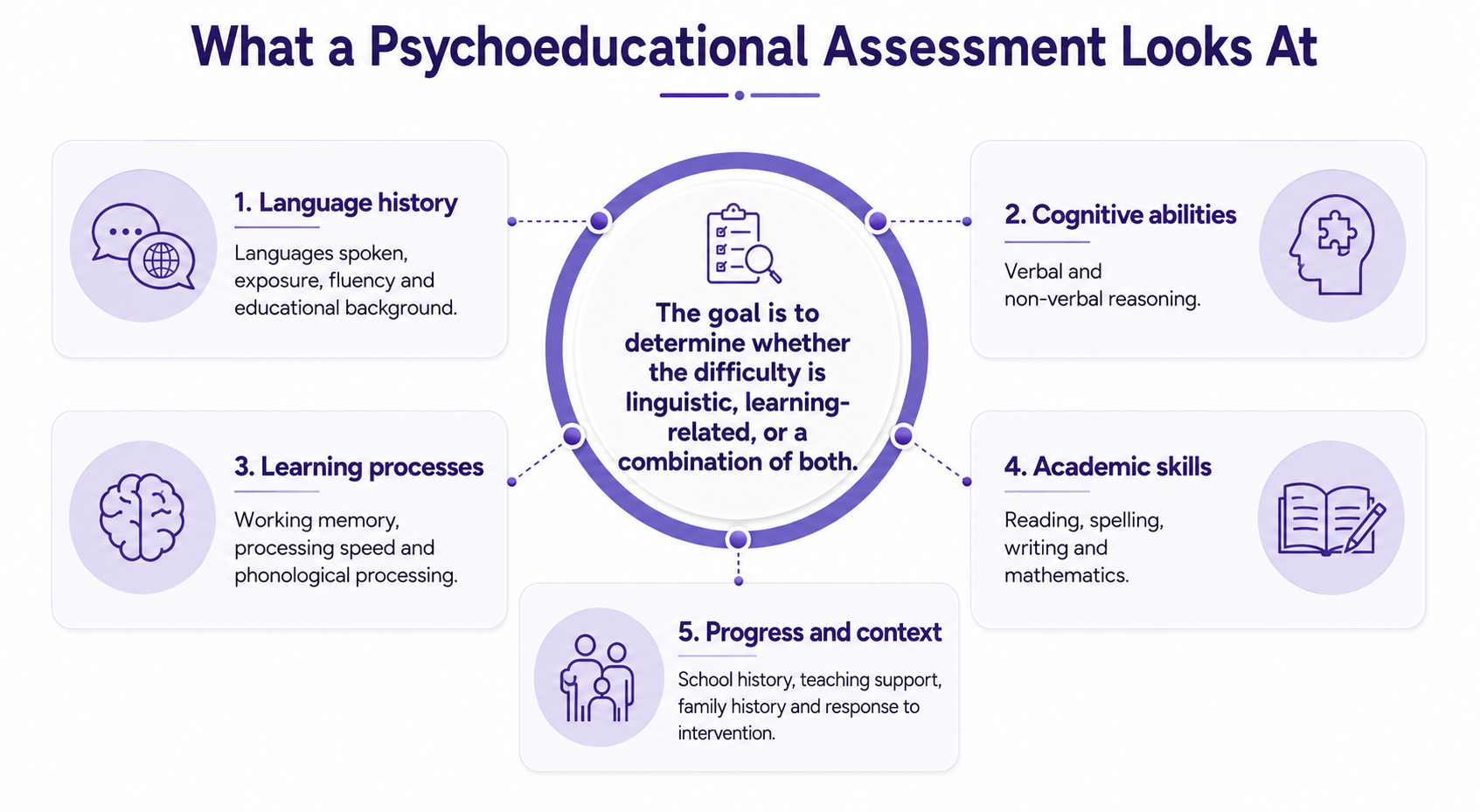
A psychoeducational assessment is a comprehensive evaluation of a child’s cognitive abilities, academic skills, learning processes, and educational needs.
For a multilingual child, the purpose is not simply to test how well they understand English. It is to determine whether their difficulties are primarily related to language acquisition, an underlying learning difference, or a combination of both.
An assessment may examine:
- Verbal and non-verbal reasoning
- Working memory
- Processing speed
- Phonological processing
- Reading accuracy and fluency
- Reading comprehension
- Spelling
- Written expression
- Mathematics
- Attention and executive functioning
- The child’s language and educational history
- Performance in the home language, where possible
A well-designed assessment reduces reliance on English-heavy tasks where appropriate and interprets the results within the child’s cultural, linguistic, and educational context.
Can a Psychoeducational Assessment Be Accurate for an EAL Child?
Yes, but the psychologist must account for the child’s language background when selecting tests and interpreting the results.
An EAL-informed psychoeducational assessment should consider:
- Which languages the child speaks
- When the child began learning each language
- The child’s strongest language
- How much formal instruction they have received in each language
- Whether the child has moved between countries, schools, or curricula
- Whether the same difficulties appear across languages
- Whether test performance may have been affected by unfamiliar vocabulary or cultural knowledge
Scores should not be interpreted in isolation.
A child’s learning history, classroom performance, response to intervention, family history, and language development are all needed to form an accurate conclusion.
When Should Parents Wait and Monitor?
Waiting may be reasonable when:
- The difficulty appears only in English
- The child is learning normally in their home language
- Their English is steadily improving
- Their mistakes are consistent with second-language acquisition
- They have had limited exposure to academic English
- Teachers can identify clear progress over time
Waiting should not mean doing nothing.
The child should still receive appropriate EAL support, and their progress should be monitored using specific learning goals.
When Should Parents Consider an Assessment?
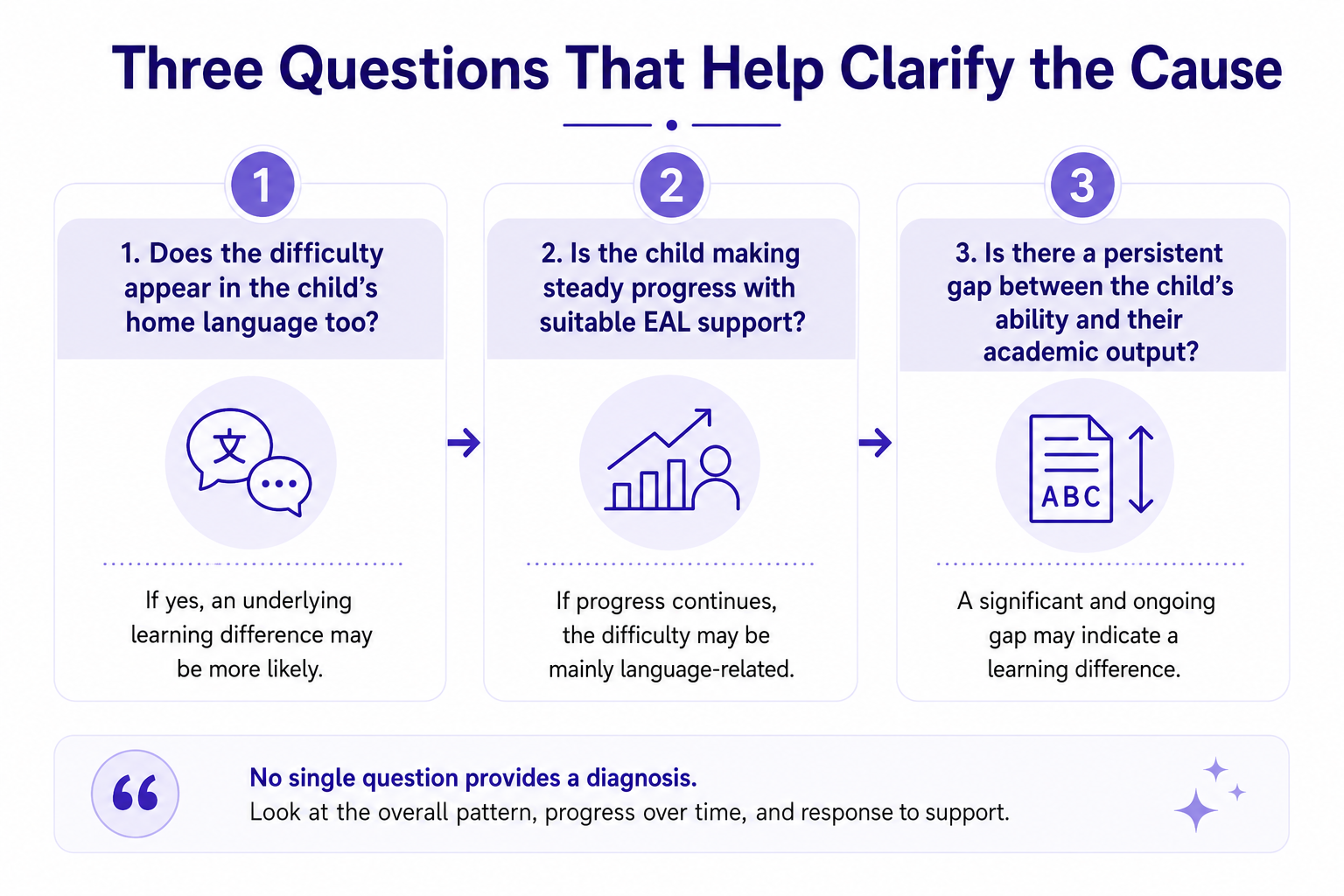
Parents may wish to consider a psychoeducational assessment when:
- Difficulties appear in both English and the home language
- Progress has stalled despite sustained support
- Reading or writing is far below the child’s apparent ability
- The child has persistent difficulty with sounds, decoding, spelling, or number sense
- There is a family history of dyslexia or another learning disorder
- Teachers and EAL specialists disagree about the cause
- The child is becoming anxious, frustrated, or reluctant to attend school
- Uncertainty is preventing the school from providing suitable support
- The child may need formal classroom or examination accommodations
Early assessment does not automatically place a label on a child. Its purpose is to understand how the child learns and identify the support that will help them make progress.
Why Accurate Identification Matters
EAL difficulties and learning differences require different forms of support.
A child with an English-language gap may benefit from:
- Explicit vocabulary teaching
- Visual supports
- Additional processing time
- Repeated exposure to academic language
- Opportunities to use their home language
- Structured speaking and writing support
A child with dyslexia or another learning difference may require:
- Structured literacy instruction
- Explicit phonics teaching
- Targeted decoding and spelling intervention
- Assistive technology
- Extra time
- Reduced copying demands
- Formal school or examination accommodations
A multilingual child with a learning difference may need both types of support.
Providing only English lessons to a child with dyslexia will not address the full problem. Similarly, diagnosing a normal language-development pattern as a disorder may lead to unnecessary intervention.
Accurate identification helps ensure that the child receives the right support at the right time.
Getting the Right Support for Your Child
The question is not whether a child needs to try harder or simply spend more time learning English.
The goal is to understand why they are struggling.
When difficulties are limited to English and the child is progressing, patient and structured EAL support may be appropriate. When the difficulties are persistent, appear across languages, or remain despite intervention, a psychoeducational assessment can provide greater clarity.
The right conclusion may be that the child needs more time, targeted learning support, or both.
Understanding the difference allows families and schools to respond to the child’s actual needs rather than relying on assumptions.